London Interbank Offered Rate (LIBOR)
The London Interbank Offered Rate (LIBOR) was the historical global benchmark interest rate at which major international banks estimated they could borrow unsecured short-term funds from one another in the wholesale London interbank market.
What Was LIBOR?
The London Interbank Offered Rate (LIBOR) was historically recognized as the world’s most critical interest rate benchmark. Established in 1969 by Greek banker Minos Zombanakis to price an $80 million syndicated loan for the Shah of Iran, LIBOR evolved over four decades to become the financial foundation for hundreds of trillions of dollars in global contracts.
Published daily by the British Bankers’ Association (BBA) and later administered by the Intercontinental Exchange (ICE), LIBOR measured the average interest rate at which leading global commercial banks estimated they could borrow unsecured wholesale funds from their peers in the London interbank market. At its zenith, LIBOR underpinned more than $350 trillion USD in financial instruments—ranging from residential adjustable-rate mortgages and corporate credit lines to complex interest rate swaps and cross-currency derivatives.
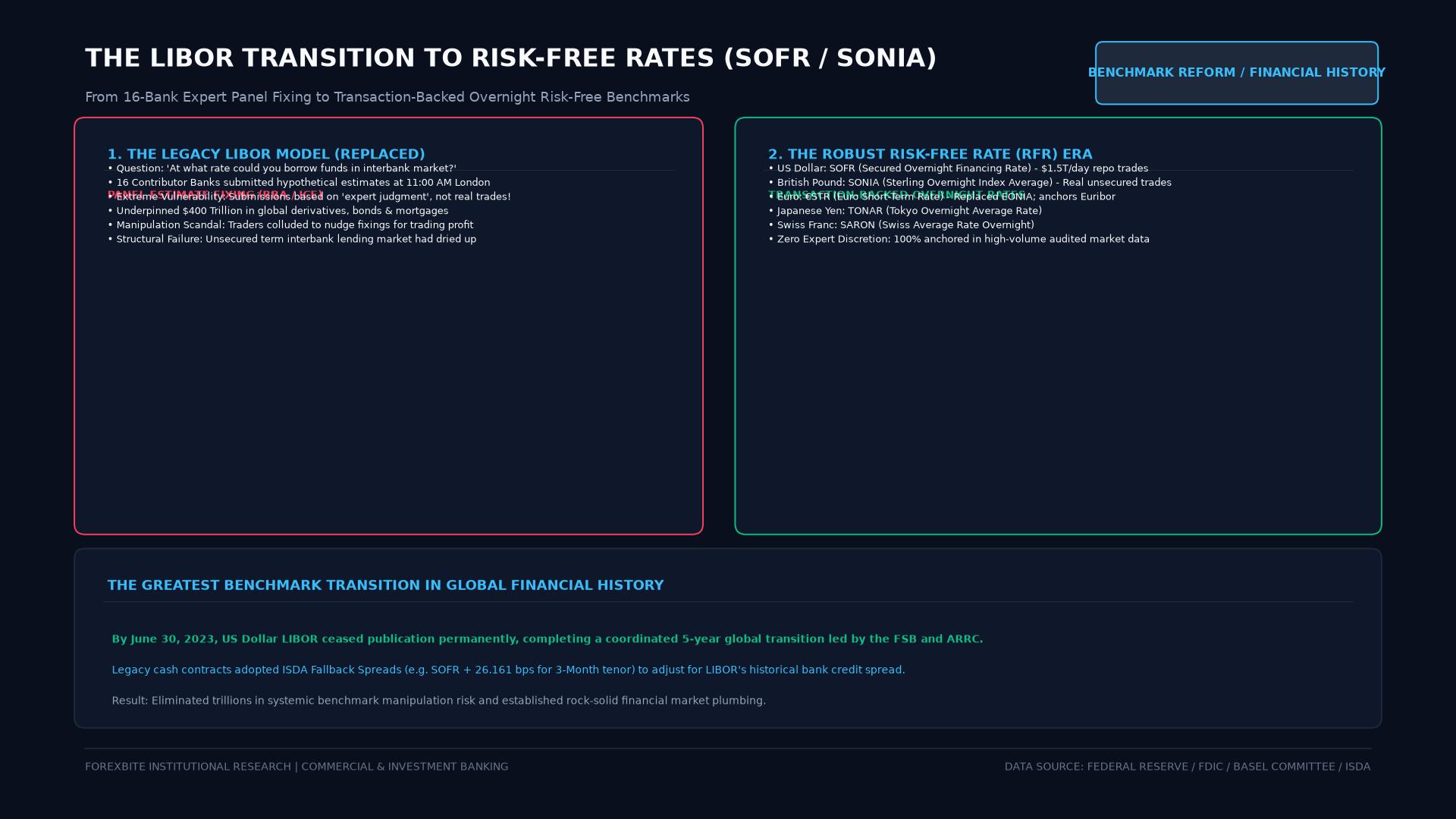 Figure: Historical British Bankers’ Association (BBA) panel survey mechanism and its global post-2021 replacement by robust transaction-based Risk-Free Rates.
How LIBOR Was Calculated: The Panel Bank System
Unlike modern transaction-based reference rates, LIBOR was calculated from survey submissions rather than actual market transactions.
Every London business morning, a panel of 11 to 18 major international banks answered a standardized hypothetical question:
“At what rate could you borrow funds, were you to do so by asking for and then accepting inter-bank offers in reasonable market size just prior to 11 am?”
The administrator calculated the benchmark using a trimmed average:
- The highest 25% and lowest 25% of submitted rates were discarded to eliminate outliers.
- The remaining middle 50% of submissions were averaged arithmetically.
- Rates were published across five major currencies (USD, GBP, EUR, JPY, CHF) and seven maturities (ranging from overnight to 12 months).
The Rigging Scandal and the Structural Flaws of LIBOR
In 2012, international regulatory investigations uncovered widespread, systemic corruption in the compilation of LIBOR, igniting one of the largest scandals in financial history.
1. Proprietary Trading Manipulation
Regulatory authorities (including the CFTC, the UK Financial Conduct Authority, and the US Department of Justice) revealed that derivatives traders at major panel banks routinely colluded with rate-setting colleagues to artificially inflate or deflate daily rate submissions to benefit their trading books in interest rate swaps.
2. “Lowballing” Distress During the 2008 Financial Crisis
During the 2008 Global Financial Crisis, banks deliberately submitted artificially low borrowing estimates (“lowballing”). Banks feared that submitting realistic, elevated borrowing costs would signal to the global market that they were on the brink of insolvency, creating a self-fulfilling bank run.
3. The Fatal Structural Flaw: Subjective Fiction
Beyond corruption, LIBOR suffered from an existential economic flaw: following the 2008 financial crisis, unsecured interbank borrowing virtually ceased. Banks preferred secured repo funding or holding central bank reserves. Consequently, LIBOR had transitioned into an ungrounded fiction where trillions in global debt were pegged to subjective, hypothetical estimates rather than actual executed transactions.
The Scandal Fallout:
- Over $9 Billion USD in global regulatory fines levied across major banks
  (including Barclays, UBS, Deutsche Bank, Citigroup, RBS, and Rabobank).
- Multiple criminal convictions of derivatives traders.
- Regulatory mandates by global central banks to permanently retire the benchmark.
The Global Transition to Risk-Free Reference Rates (RFRs)
To restore institutional integrity to global finance, the Financial Stability Board (FSB) and major central banks orchestrated a multi-year global transition from subjective, unsecured LIBOR to objective, transaction-backed Risk-Free Rates (RFRs):
| Currency | Historical Benchmark | Modern Replacement Rate (RFR) | Underlying Collateral / Market |
|---|---|---|---|
| US Dollar (USD) | USD LIBOR | SOFR (Secured Overnight Financing Rate) | Backed by >$1 Trillion in daily overnight US Treasury repo trades. |
| British Pound (GBP) | GBP LIBOR | SONIA (Sterling Overnight Index Average) | Unsecured overnight sterling wholesale deposit transactions. |
| Euro (EUR) | EUR LIBOR / Euribor | €STR (Euro Short-Term Rate) | Unsecured overnight euro borrowing transactions across banks. |
| Japanese Yen (JPY) | JPY LIBOR | TONA (Tokyo Overnight Average Rate) | Unsecured overnight call money market transactions in Tokyo. |
| Swiss Franc (CHF) | CHF LIBOR | SARON (Swiss Average Rate Overnight) | Swiss franc overnight repo market. |
Official Cessation Timeline
The retirement of LIBOR was executed in a phased regulatory schedule:
- December 31, 2021: All non-USD LIBOR settings (GBP, EUR, JPY, CHF) and 1-week and 2-month USD LIBOR permanently ceased.
- June 30, 2023: The remaining legacy USD LIBOR tenors (Overnight, 1-Month, 3-Month, 6-Month, and 12-Month) were permanently phased out, concluding the largest financial contract transition in human history.
Key Takeaways
- LIBOR was the primary global interest rate benchmark from 1969 until its complete phase-out in 2023.
- It was calculated from subjective daily rate submissions by major panel banks in London.
- The 2012 rigging scandal revealed widespread manipulation to profit proprietary trading desks and conceal crisis distress.
- Regulators permanently replaced LIBOR with transparent, transaction-backed risk-free rates (SOFR, SONIA, €STR).
- The transition successfully shifted hundreds of trillions in global derivatives onto secured, observable repo benchmarks.
Frequently Asked Questions
What makes SOFR superior to USD LIBOR?
USD LIBOR was based on subjective estimates of unsecured borrowing in an illiquid market. SOFR (Secured Overnight Financing Rate) is derived from more than $1 trillion in actual, observable overnight repurchase agreements fully secured by US Treasury bonds, making it virtually immune to manipulation.
What is the difference between an in-advance rate (LIBOR) and an in-arrears rate (SOFR)?
LIBOR was an “in-advance” forward-looking term rate; borrowers knew their exact interest payment at the start of a 3-month loan period. SOFR is an overnight rate that is compounded daily “in-arrears,” meaning the final interest payment is calculated at the end of the loan period based on actual daily rates.
What happened to contracts that still referenced LIBOR after June 2023?
Regulatory legislation (such as the US Adjustable Interest Rate (LIBOR) Act) established statutory fallback rules that automatically converted legacy “tough legacy” contracts referencing USD LIBOR to corresponding SOFR benchmarks plus a fixed credit spread adjustment (CAS).
Ready to trade forex?
Open a free demo account with a regulated broker. Practice with virtual funds before risking real money.