Macro-based
A macro-based strategy—commonly known as global macro—is an investment methodology that guides portfolio positioning and asset allocation based on large-scale macroeconomic trends, including central bank interest rate policies, inflation cycles, sovereign debt flows, and geopolitical dynamics.
What Is a Macro-Based Strategy?
A macro-based strategy (frequently referred to as global macro) is one of the most influential investment styles in the global hedge fund and foreign exchange industries. Rather than focusing on microeconomic metrics—such as individual corporate balance sheets, earnings per share, or short-term chart patterns—macro-based investors analyze the broad, systemic economic forces that govern global capital flows across entire asset classes.
Macro-based traders deploy capital across four primary liquid asset classes: foreign exchange (currencies), sovereign interest rates (government bonds), equity indices, and physical commodities. In the foreign exchange market, macro-based strategies are preeminent: currency values are fundamentally driven by relative macroeconomic divergence between sovereign nations, specifically real interest rate differentials, inflation trajectories, current account balances, and central bank monetary policy cycles.
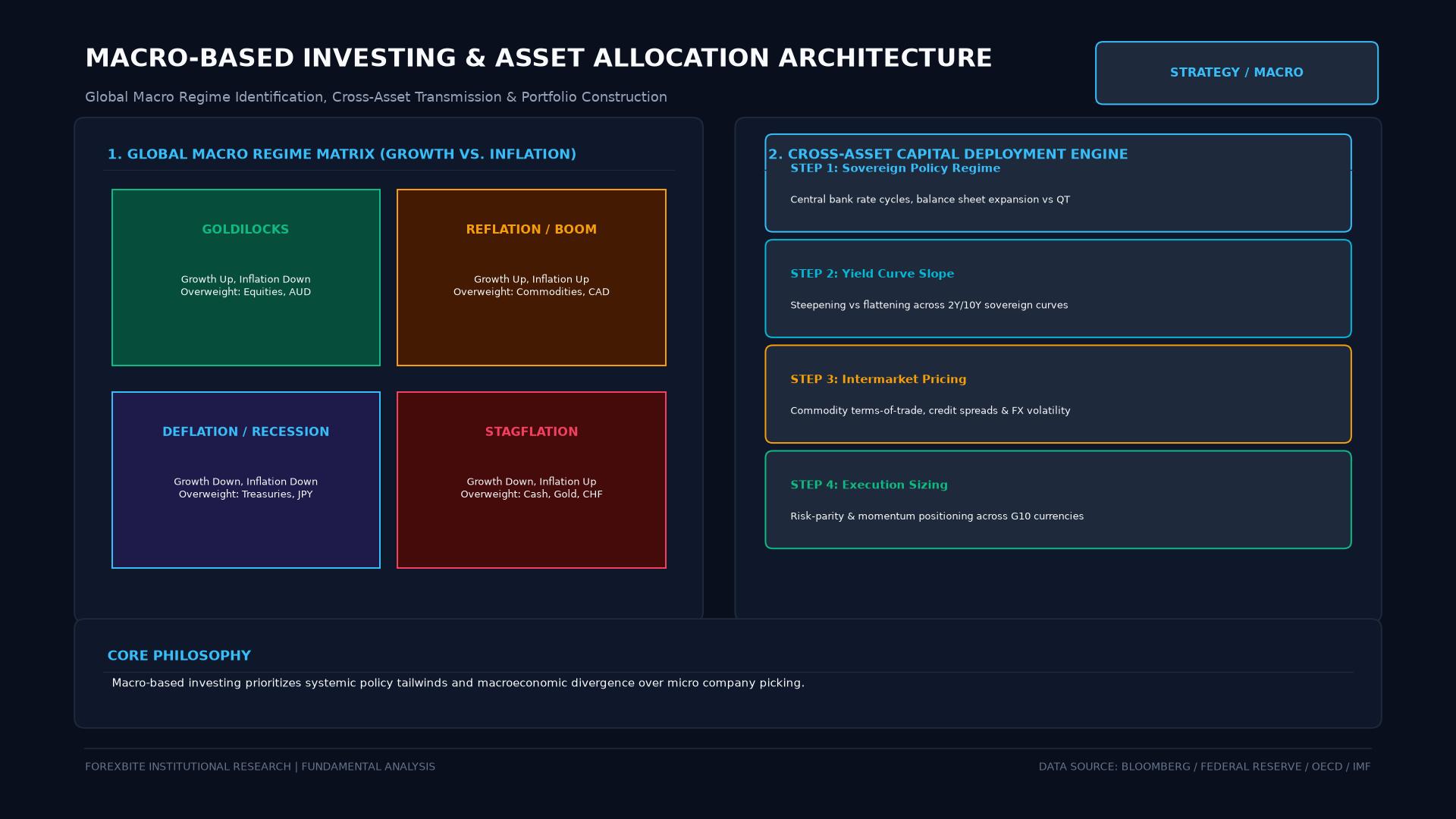 Figure: Global macro regime matrix (Growth vs Inflation) mapping Goldilocks, Reflation, Deflation, and Stagflation quadrants to cross-asset portfolio allocation across sovereign debt, equities, commodities, and currencies.
Key Takeaways
- Divergence as the Core Catalyst: Macro trading thrives on economic and monetary divergence: going long the currency of a nation with accelerating growth and rising real yields, while shorting the currency of a nation facing recession and rate cuts.
- Top-Down Asset Allocation: Global macro employs a strict top-down perspective, beginning with macroeconomic regimes (inflationary boom, stagflation, deflationary bust) before selecting individual instruments.
- Dominance in the FX Market: Foreign exchange is the purest expression of macro-based trading because every currency pair represents an explicit economic comparison between two sovereign central banks.
- Two Dominant Disciplines: Executed either through Discretionary Global Macro (relying on fund manager experience and qualitative macro insight) or Systematic Global Macro (using algorithmic models and automated econometric inputs).
- Asymmetric Risk-Reward: Legendary macro traders prioritize asymmetric trade expressions (such as using out-of-the-money options) where potential upside is exponential while maximum downside is strictly capped.
Comparative Taxonomy: Trading Methodologies
| Trading Philosophy | Primary Analytical Inputs | Holding Horizon | Typical Instruments | Key Market Focus |
|---|---|---|---|---|
| Global Macro | Central bank policy, GDP, inflation, fiscal deficits | Weeks, months, to years | FX, Sovereign Bonds, Index Futures, Commodities | Broad systemic trends and economic regimes |
| Technical Analysis | Price action, chart patterns, volume, oscillators | Minutes, hours, to days | Spot FX, CFDs, Single Stocks | Market psychology, support/resistance, momentum |
| Fundamental Equity | Corporate earnings, EBITDA, balance sheets, P/E | Months to years | Individual common stocks | Company-specific cash flows and competitive moats |
| High-Frequency (HFT) | Order book microstructure, latency, tick queues | Microseconds to seconds | Futures, Equities, ECN Spot | Bid-ask spread capture, statistical arbitrage |
The Macro Framework: Real Yields and the Taylor Rule
Macro-based foreign exchange positioning is heavily anchored in Real Interest Rates rather than nominal rates. Global capital moves across borders seeking the highest real risk-adjusted return:
$$\text{Real Interest Rate} = \text{Nominal Policy Rate} - \text{Expected Inflation Rate}$$
$$\text{Relative Real Rate Advantage} = (\text{Nominal}_A - \text{Inflation}_A) - (\text{Nominal}_B - \text{Inflation}_B)$$
If the United States offers a 5.0% nominal rate with 2.5% inflation (Real Rate = +2.5%), while the Eurozone offers a 3.5% nominal rate with 2.5% inflation (Real Rate = +1.0%), global fixed-income allocators direct sovereign capital into U.S. dollar-denominated assets. This relative real yield surplus creates continuous structural buying pressure on EUR/USD to the downside.
Real-World Case Study: Stanley Druckenmiller and the German Reunification Trade
In 1989, following the fall of the Berlin Wall, legendary macro trader Stanley Druckenmiller (managing George Soros’s Quantum Fund) formulated a landmark macro-based thesis:
- Macro Thesis: Integrating East Germany would require massive German fiscal stimulus and public borrowing.
- Central Bank Reaction: Druckenmiller recognized that the inflation-averse German Bundesbank would aggressively hike interest rates to counteract the inflationary impact of reunification deficit spending.
- The Expression: While consensus feared the economic burden would weaken Germany, Druckenmiller took a massive Long Deutsche Mark (DEM) position against the U.S. Dollar and European currencies, while simultaneously shorting German government bonds.
- Outcome: As predicted, the Bundesbank aggressively hiked interest rates to historical highs. Global capital flooded into the Deutsche Mark, generating hundreds of millions of dollars in net profit for the fund and laying the groundwork for the 1992 European Exchange Rate Mechanism (ERM) collapse.
Risk Considerations and Pitfalls in Macro-Based Trading
- The Timing Trap (“Being Too Early is Indistinguishable from Being Wrong”): A macro thesis may be fundamentally correct, but markets can remain irrational longer than a trader can remain solvent. Entering a macro trade before the market begins pricing the shift can result in painful drawdown.
- Geopolitical Tail Risk: Unexpected political events—such as sudden tariff announcements, surprise election outcomes, or military conflicts—can instantly invalidate economic growth models.
- Negative Carry Costs: Holding a long-term macro position against a prevailing interest rate differential (fighting the carry) steadily erodes portfolio capital via daily financing swap charges.
Frequently Asked Questions (FAQ)
What is the difference between discretionary macro and systematic macro?
Discretionary macro relies on human portfolio managers who synthesize news, data, and policy speeches to make qualitative investment decisions. Systematic macro encodes economic rules, momentum indicators, and econometric models into computer algorithms that execute trades automatically based on statistical data.
Can retail forex traders utilize macro-based strategies?
Yes. Retail traders can track major economic indicators (such as the U.S. Non-Farm Payrolls, CPI inflation, and central bank rate decisions) via economic calendars, taking multi-week swing positions that align with central bank monetary policy divergence rather than relying purely on technical charts.
Why do macro hedge funds trade currencies more than individual stocks?
Currencies offer virtually limitless liquidity, zero short-selling restrictions, 24-hour trading, and direct exposure to sovereign interest rate policies. For multi-billion-dollar hedge funds, currency markets provide the capacity to deploy enormous capital without causing disruptive market impact.
Ready to trade forex?
Open a free demo account with a regulated broker. Practice with virtual funds before risking real money.