Dealing Desk
A dealing desk (DD) refers to an operational brokerage model where the broker acts as a market maker, creating an internal liquidity pool and taking the opposing side of client trades (B-Book execution) rather than routing orders directly to external interbank liquidity providers.
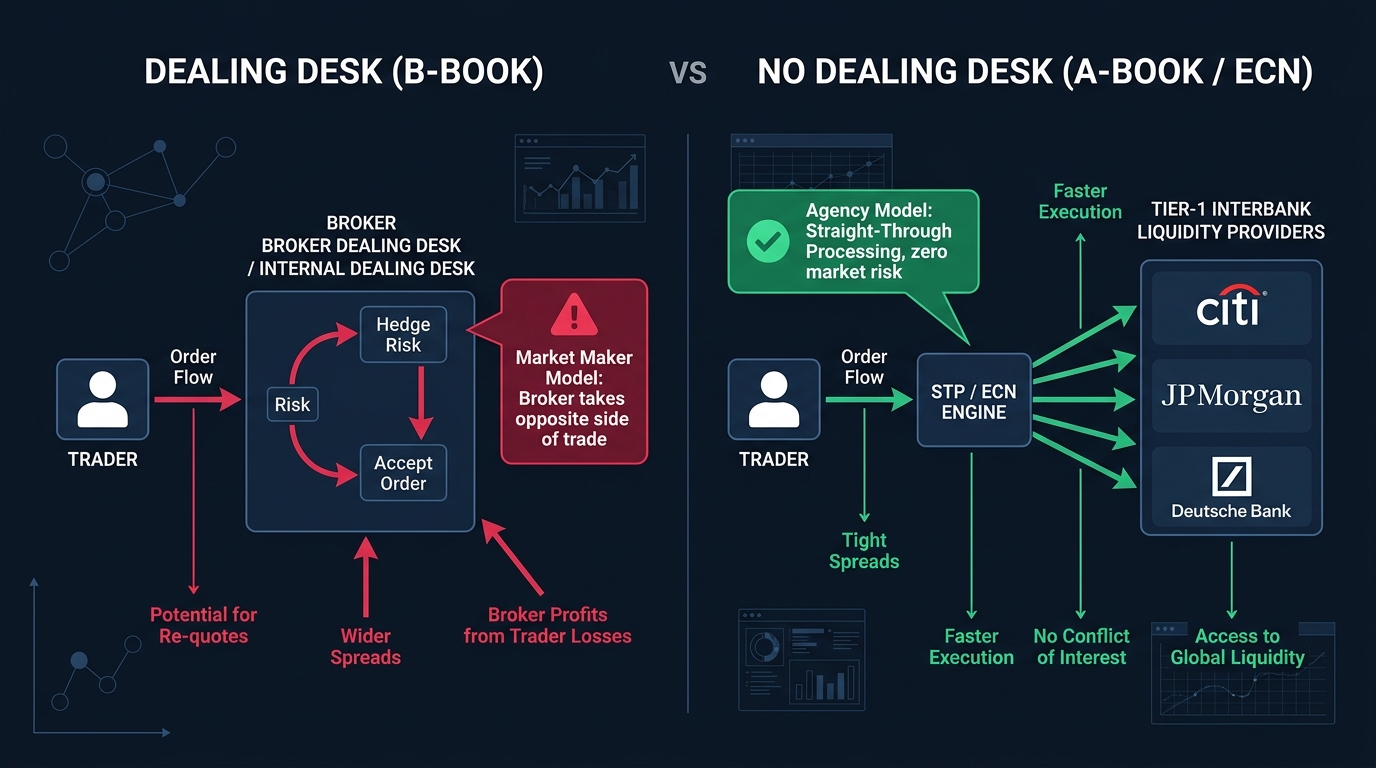
What Is a Dealing Desk Broker?
In the retail foreign exchange industry, brokers are broadly separated into two operational architectures: Dealing Desk (DD) brokers and No Dealing Desk (NDD) brokers.
A Dealing Desk broker—frequently termed a Market Maker—operates an internal dealing desk that sits directly between the retail client and the broader interbank market. When a trader clicks “Buy” on their trading terminal, the order does not travel to an external tier-1 bank (such as JPMorgan Chase, Deutsche Bank, or Citi). Instead, the dealing desk broker accepts the order internally, fills the trade from its own inventory, and acts as the direct counterparty to the trade.
This operational structure means that in a pure dealing desk model:
- When the client buys, the broker sells.
- When the client sells, the broker buys.
- If the client profits on the trade, the payout comes directly from the broker’s capital.
- If the client loses money on the trade, the lost funds become direct revenue for the brokerage.
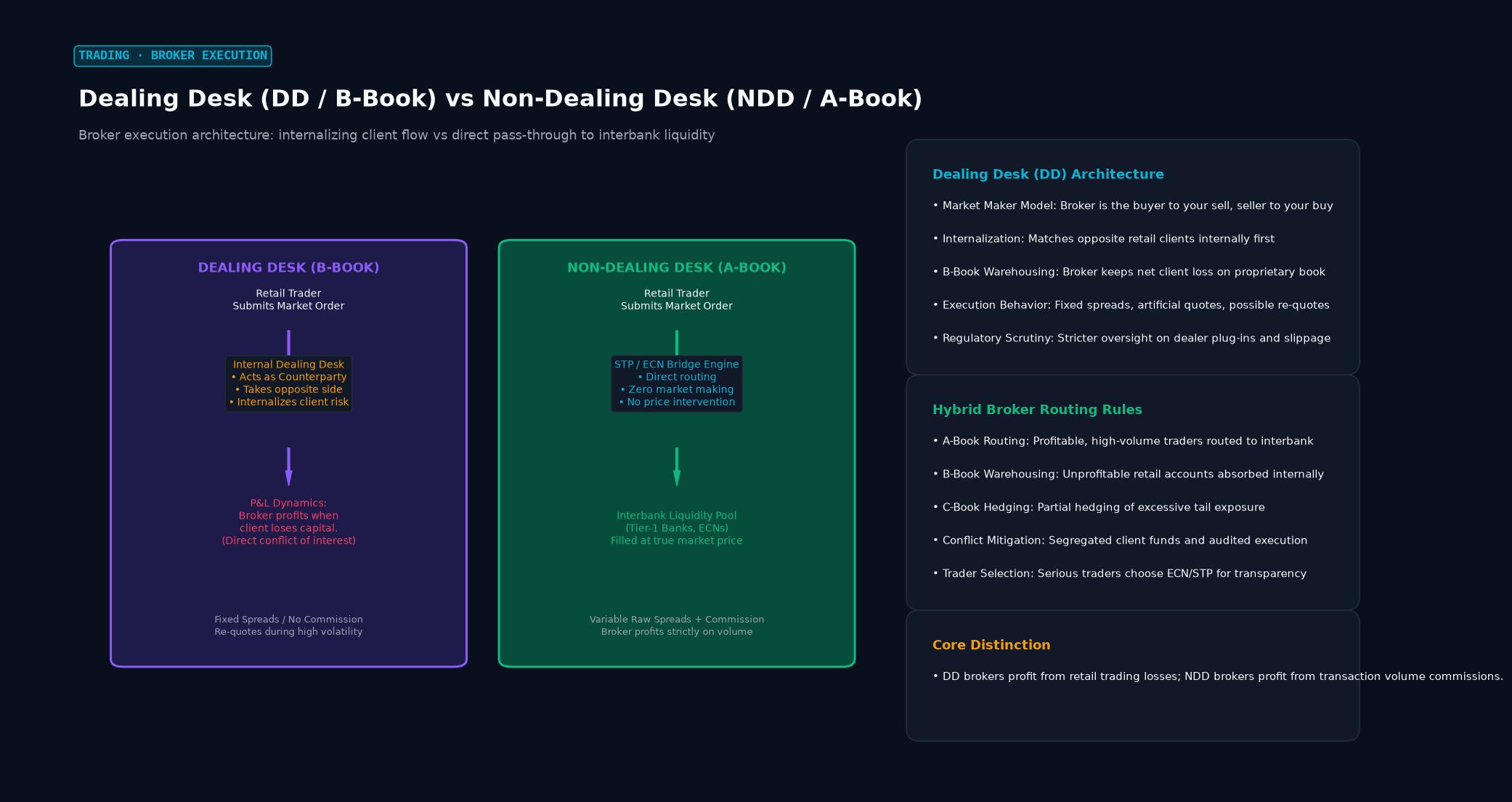 Figure: Broker execution architecture: internalizing client flow vs direct pass-through to interbank liquidity
Dealing Desk (B-Book) vs. No Dealing Desk (A-Book)
To manage commercial risk, modern brokerages categorize client orders into internal risk management streams, known universally on institutional trading desks as the A-Book and the B-Book:
The Dealing Desk Model (B-Book Execution)
Under the B-Book model, the brokerage assumes 100% of the counterparty risk:
- Internal Liquidity Matching: The broker attempts to match internal buyers with internal sellers. If Client A buys 5 lots of EUR/USD and Client B sells 5 lots of EUR/USD at the same moment, the broker nets the two positions against each other, collecting the bid-ask spread risk-free.
- Warehousing Risk: In practice, retail order flow is heavily unbalanced. Because statistical studies demonstrate that between 70% and 80% of retail forex traders lose money over time, dealing desk brokers warehouse net unhedged client positions internally, knowing that client losses directly swell the brokerage’s bottom-line profits.
The No Dealing Desk Model (A-Book / STP / ECN)
In contrast, a No Dealing Desk (NDD) broker operates purely as an agency intermediary via Straight-Through Processing (STP) or an Electronic Communication Network (ECN):
- Direct Market Routing: Every client order is instantly routed electronically to external interbank liquidity providers.
- Zero Counterparty Conflict: The NDD broker makes money exclusively by charging a transparent per-lot commission or a fractional spread markup. The broker is completely indifferent to whether the trader wins or loses.
Key Characteristics of Dealing Desk Brokers
Traders can recognize a dealing desk environment through distinct pricing and execution features:
1. Fixed Spreads
Because dealing desk brokers create their own internal market prices, they frequently offer fixed spreads (e.g., a guaranteed 2.0-pip spread on EUR/USD regardless of time of day). While fixed spreads provide cost predictability, the broker compensates by widening the spread significantly compared to raw interbank quotes (which routinely trade below 0.3 pips).
2. Requotes and Execution Delays
During high-impact macroeconomic news releases (such as US Nonfarm Payrolls or CPI), interbank prices move faster than dealing desk risk managers can adjust internal quotes. If a trader attempts to enter at the displayed price, the broker’s system may reject the order and issue a requote—demanding that the trader accept a worse price before filling the trade.
3. Hedging and Scalping Restrictions
Because dealing desk brokers carry inventory risk, rapid scalping (opening and closing trades within 10 to 30 seconds) can disrupt internal matching engines. Consequently, some dealing desk brokers enforce strict minimum trade duration rules (e.g., requiring trades to remain open for at least two minutes) or ban automated scalping Expert Advisors (EAs).
The Inherent Conflict of Interest
The fundamental criticism leveled against dealing desk brokers is the structural conflict of interest:
Because the broker profits directly when a client loses, unscrupulous or under-regulated dealing desk operators historically deployed manipulative software plugins (such as virtual dealer plugins) designed to induce artificial slippage, hunt stop-losses, or introduce execution latency against consistently profitable traders.
However, reputable, tier-1 regulated market makers (regulated by agencies like the UK FCA, Australian ASIC, or US CFTC) are subject to stringent oversight, capital adequacy rules, and regular execution audits, ensuring that price quotes remain fair and tightly tethered to real interbank rates.
Practical Comparison: Dealing Desk vs. ECN/STP
| Feature | Dealing Desk (Market Maker) | No Dealing Desk (ECN / STP) |
|---|---|---|
| Counterparty | The Broker | External Bank / Liquidity Provider |
| Broker Revenue | Spreads + Client Losses (B-Book) | Transparent Commission or Spread Markup |
| Conflict of Interest | Inherent (Broker wins when client loses) | None (Broker wants client to trade long-term) |
| Spread Type | Typically Fixed or Artificially Smoothed | Raw Variable Interbank Spreads (from 0.0 pips) |
| Execution Speed | Moderate; potential for requotes | Ultra-fast sub-millisecond execution |
| Scalping / EA Friendly | Often restricted or monitored | Fully permitted and welcomed |
Key Takeaways
- A dealing desk broker acts as a market maker, taking the opposing side of client trades internally rather than routing them to interbank providers.
- In B-Book execution, client losses become direct revenue for the brokerage, creating an inherent conflict of interest.
- No Dealing Desk (NDD / ECN / STP) brokers route orders externally, earning revenue strictly through volume commissions.
- Dealing desk brokers frequently offer fixed spreads, but may utilize requotes or restrict high-speed scalping strategies.
- Sophisticated hybrid brokers run both models: routing profitable traders to the A-Book while keeping inexperienced traders on the B-Book.
FAQ
Are all dealing desk brokers bad? No. Large, highly regulated market makers provide stable liquidity, guaranteed stop-losses (often for a small fee), and negative balance protection, which can be advantageous for beginners trading micro-lots who value predictable execution over raw interbank spreads.
What is a hybrid broker? A hybrid broker operates both an A-Book and a B-Book. The broker’s automated risk management algorithm analyzes client trading behavior: consistent, disciplined, profitable traders are routed straight to external liquidity providers (A-Book), while erratic, high-risk, unprofitable traders are kept on the internal dealing desk (B-Book).
How can I verify if my broker is No Dealing Desk (NDD)? Check the broker’s regulatory disclosure documents (such as the Order Execution Policy or Product Disclosure Statement). An authentic NDD broker will explicitly state that it acts as an agent, routes orders through STP/ECN technology, and connects to named tier-1 liquidity providers.
Ready to trade forex?
Open a free demo account with a regulated broker. Practice with virtual funds before risking real money.