Monetarist
A monetarist is an economist or policymaker who adheres to Monetarism, an economic school of thought asserting that the supply of money is the primary driver of economic activity and that uncontrolled money supply expansion is the sole long-term cause of inflation.
What Is a Monetarist?
A monetarist is an economist, central banker, or market strategist who subscribes to the principles of Monetarism—the macroeconomic school of thought pioneered by Nobel laureate Milton Friedman and Anna Schwartz at the University of Chicago during the mid-20th century. Monetarists challenge traditional Keynesian economics, asserting that changes in the national money supply (monetary aggregates such as M1, M2, and M3) exert the single most powerful influence on national output and employment in the short run, and determine the general price level (inflation) in the long run.
The foundational thesis of monetarism was crystallized in Milton Friedman’s famous maxim: “Inflation is always and everywhere a monetary phenomenon in the sense that it is and can be produced only by a more rapid increase in the quantity of money than in output.”
In foreign exchange and macroeconomic analysis, monetarist models provide the analytical foundation for long-term currency valuation. A sovereign nation that prints money at a rate drastically exceeding its real economic productivity growth will inevitably experience domestic currency debasement, leading to secular foreign exchange depreciation against more disciplined currencies.
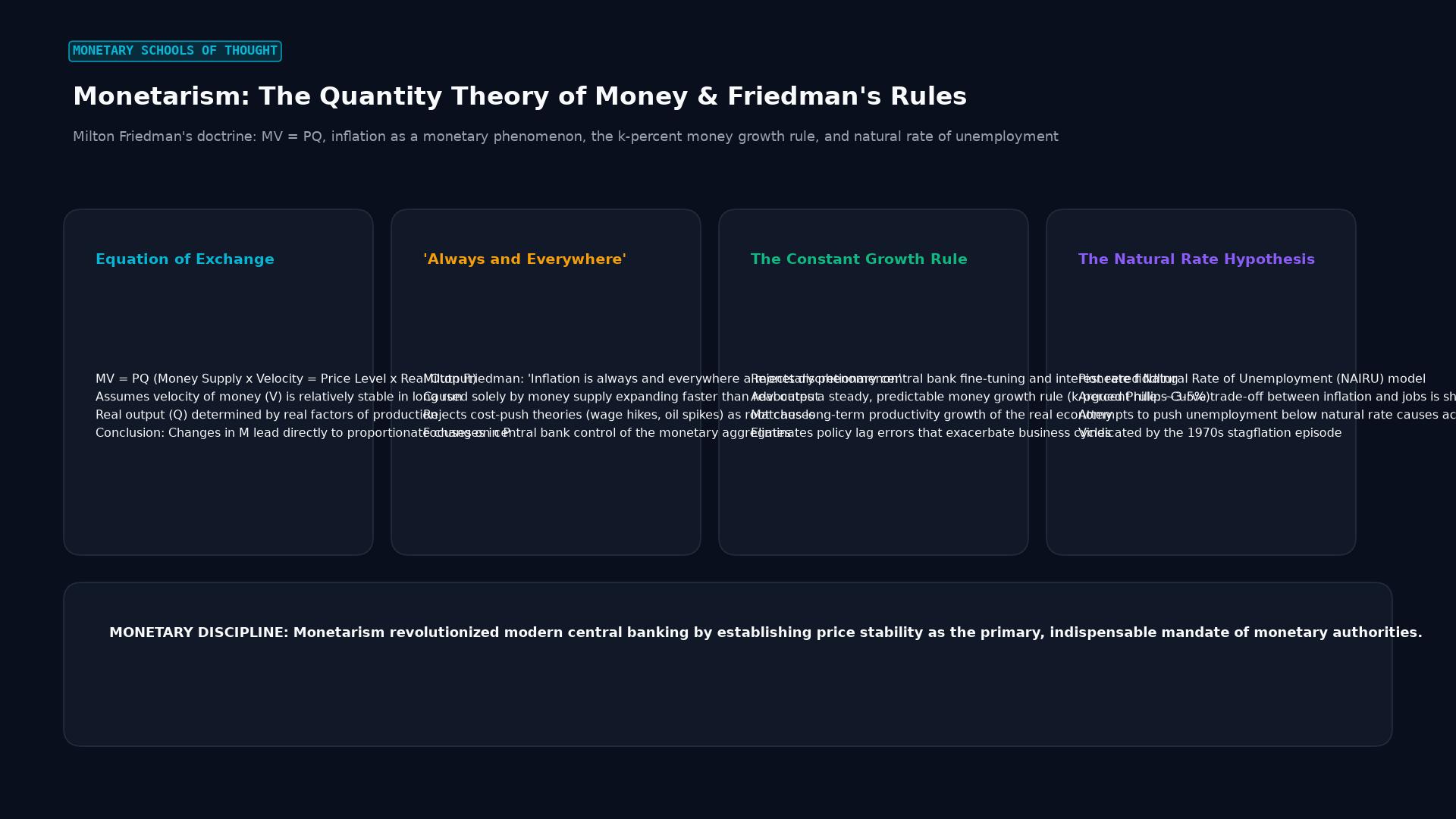 Figure: Milton Friedman’s doctrine: MV = PQ, inflation as a monetary phenomenon, the k-percent money growth rule, and natural rate of unemployment
Key Takeaways
- The Equation of Exchange: Monetarist theory is rooted in Irving Fisher’s identity: $M \cdot V = P \cdot Y$, demonstrating that unrestrained growth in money supply ($M$) directly inflates price levels ($P$).
- Rejection of Discretionary “Fine-Tuning”: Monetarists argue that long, variable policy lags (the time between recognizing an economic slowdown and policy taking effect) mean that discretionary central bank interest rate interventions often destabilize the economy.
- The “k-Percent” Growth Rule: Friedman advocated replacing human central bank committee discretion with a transparent, binding rule: expanding the money supply at a fixed, constant rate (e.g., 3% to 5% per year) matching the long-term trend rate of real GDP growth.
- Skepticism of Fiscal Stimulus: Monetarists argue that government deficit spending merely “crowds out” private investment unless funded by new money creation, making pure fiscal policy ineffective at generating real long-term growth.
- Foundation of Volcker’s Disinflation: Monetarist policies reached their zenith from 1979 to 1982 when Federal Reserve Chairman Paul Volcker curbed stagflation by targeting money supply growth rather than interest rates.
Comparative Taxonomy: Monetarism vs. Competing Macroeconomic Schools
| Theoretical Dimension | Monetarist (Friedman) | Keynesian (Keynes) | Austrian School (Hayek) | Modern Monetary Theory (MMT) |
|---|---|---|---|---|
| Primary Economic Driver | Money supply growth ($M$) | Aggregate demand ($C+I+G$) | Capital structure & interest rates | State fiscal spending & taxation |
| Cause of Inflation | Excessive money creation | Demand-pull & wage-push shocks | Credit expansion by central banks | Real resource capacity constraints |
| Primary Policy Tool | Fixed money supply rule | Discretionary government spending | Abolition of central bank intervention | Unconstrained fiscal deficits |
| View on Central Banks | Necessary, but must be rule-bound | Crucial discretionary stabilizer | Inherently destructive; distort price signals | Financing arm of government treasury |
| Forex Currency Driver | Relative money supply growth | Current account & interest rates | Purchasing power parity & sound money | Sovereign currency monopoly |
The Mathematics of the Quantity Theory of Money
Taking natural logarithms and differentiating the Equation of Exchange ($M \cdot V = P \cdot Y$) with respect to time yields the dynamic percentage growth equation:
$$% \Delta M + % \Delta V = % \Delta P + % \Delta Y$$
Where:
- $% \Delta M$ is the growth rate of the money supply.
- $% \Delta V$ is the rate of change in monetary velocity.
- $% \Delta P = \pi$ is the annual rate of inflation.
- $% \Delta Y = g$ is the real rate of economic growth.
Assuming that the velocity of money is constant in the long run ($% \Delta V = 0$):
$$\text{Long-Term Inflation Rate } (\pi) = % \Delta M - g$$
Foreign Exchange Valuation Implication:
If the Federal Reserve expands the U.S. money supply by 10% per year while the U.S. economy grows at 2% ($\pi_{\text{US}} = 8%$), while the Swiss National Bank expands its money supply by 3% while Switzerland grows at 1.5% ($\pi_{\text{CH}} = 1.5%$): Under Purchasing Power Parity (PPP), the U.S. Dollar must depreciate against the Swiss Franc by approximately 6.5% annually to balance international price parity.
Real-World Case Study: Paul Volcker and the Great Inflation (1979–1982)
During the 1970s, U.S. inflation spiraled out of control, reaching 14.8% by 1980 due to persistent monetary accommodation and energy price shocks.
- The Policy Shift: In October 1979, newly appointed Fed Chairman Paul Volcker embraced monetarist doctrine. He announced that the Federal Reserve would cease targeting the federal funds interest rate and instead strictly target the growth rate of monetary aggregates (M1 and M2).
- The Interest Rate Spike: By allowing interest rates to float freely while restricting money supply growth, the Fed funds rate skyrocketed to an unprecedented 20.0%.
- The Recession and Victory: The monetary squeeze triggered a severe recession with unemployment exceeding 10%. However, by 1983, inflation collapsed below 4.0%.
- Forex Impact: The massive contraction in dollar liquidity and soaring real yields unleashed a historic bull market for the U.S. Dollar, causing the U.S. Dollar Index (DXY) to appreciate by over 50% between 1980 and 1985, cementing Volcker’s monetarist revolution.
Modern Criticisms and Limitations of Monetarism
- The Breakdown of Velocity Stability: Starting in the 1980s, financial deregulation, electronic banking, and complex credit derivatives caused the velocity of money ($V$) to become wildly unstable and unpredictable, breaking the tight historical correlation between M2 growth and inflation.
- The Post-2008 QE Paradox: Following the 2008 financial crisis, the Federal Reserve and ECB expanded the monetary base (M0) by trillions of dollars through Quantitative Easing (QE). Traditional monetarists warned of imminent hyperinflation; however, because commercial banks hoarded these funds as excess reserves at the central bank, broad money (M2) grew moderately, and inflation remained stubbornly below 2% for over a decade.
Frequently Asked Questions (FAQ)
What is the difference between a monetarist and a Keynesian?
Keynesians believe that private markets are inherently unstable and require active government fiscal spending and tax adjustments to smooth business cycles. Monetarists believe that private competitive markets are naturally self-stabilizing and that government and central bank discretionary interventions are the primary cause of economic booms and busts.
Why do monetarists oppose discretionary central bank interest rate cuts?
Monetarists argue that central bankers lack the foresight to time rate adjustments accurately. Due to administrative and transmission lags (often 12 to 18 months before a rate cut impacts the real economy), the stimulus often hits the economy when it is already recovering naturally, overheating the market and sparking high inflation.
What is Friedman’s “k-percent rule”?
The k-percent rule is a proposed monetary policy framework where the central bank is legally required to increase the money supply by a fixed mathematical percentage (such as 3% per year) every single year, regardless of economic conditions, eliminating human political interference in monetary policy.
Ready to trade forex?
Open a free demo account with a regulated broker. Practice with virtual funds before risking real money.