Monetary Base (M0)
The monetary base (M0)—also known as high-powered money—is the narrowest measure of money supply, comprising physical currency in circulation plus commercial bank reserve deposits held at the central bank.
What Is the Monetary Base (M0)?
The monetary base (commonly categorized as M0, base money, or high-powered money) is the most liquid, fundamental component of a sovereign nation’s financial architecture. Representing the direct liability of the national central bank (such as the Federal Reserve, the European Central Bank, or the Bank of England), the monetary base comprises two primary components:
- Physical Currency: All paper banknotes and metal coins circulating in the hands of the public, private businesses, and stored inside commercial bank vaults (vault cash).
- Central Bank Reserves: The cash balances maintained by eligible commercial depository institutions in digital accounts directly at the central bank, encompassing both legally mandated required reserves and discretionary excess reserves.
The monetary base is termed “high-powered money” ($H$) because it serves as the ultimate bedrock upon which the private commercial banking sector creates broader credit, checking deposits, and loans through the fractional reserve banking system.
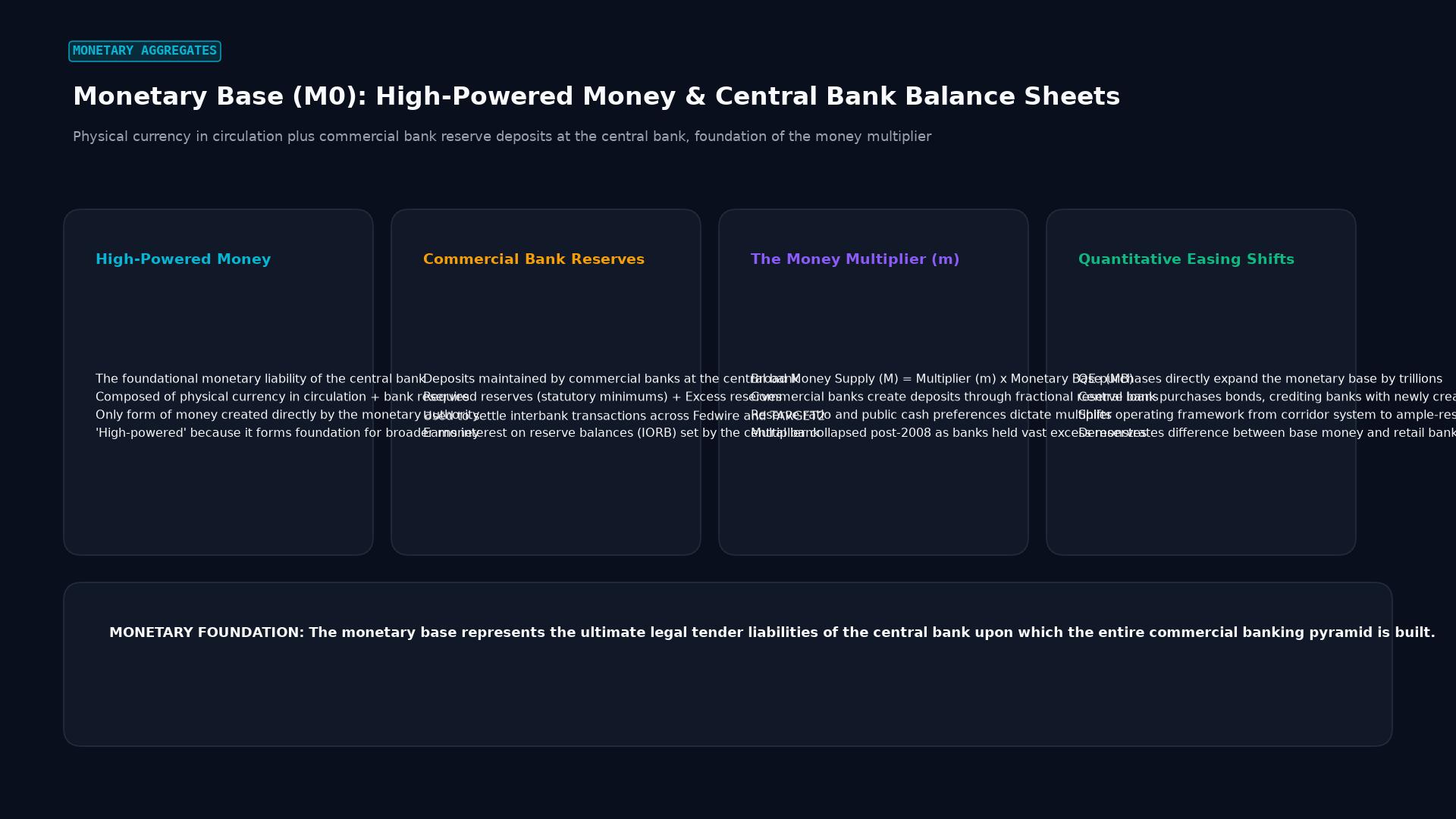 Figure: Physical currency in circulation plus commercial bank reserve deposits at the central bank, foundation of the money multiplier
Key Takeaways
- Direct Central Bank Creation: Unlike broad money (M2), which is largely created by private commercial banks through lending, the monetary base ($M_0$) is created solely by central bank operations.
- The Engine of Quantitative Easing (QE): When a central bank conducts Large-Scale Asset Purchases (QE), it purchases bonds and pays for them by crediting banks with newly minted reserves, directly expanding the monetary base.
- The Money Multiplier Equation: The total broad money supply ($M$) is a multiple ($m$) of the monetary base ($M_0$): $M = m \times M_0$.
- High-Powered Money: Central bank reserves and physical cash can settle any sovereign debt with legal finality, making them the ultimate risk-free settlement medium of the economy.
- Currency Valuation Impact: An abrupt, massive expansion of the monetary base relative to global trading partners can ignite depreciation pressures on the domestic currency in spot foreign exchange markets.
Comparative Taxonomy: The Hierarchy of Monetary Aggregates
Central banks track liquidity across escalating tiers of liquidity, from high-powered base money to broad commercial liquidity.
| Aggregate | Classification | Key Components Included | Degree of Liquidity | Direct Central Bank Control? |
|---|---|---|---|---|
| Monetary Base (M0) | Base Money | Physical cash in circulation + Commercial bank reserves | Maximum (Legal finality) | 100% Control |
| M1 | Narrow Money | Physical cash + Demand checking deposits + Traveler’s checks | High (Immediate spendability) | Influenced via interest rates |
| M2 | Broad Money | M1 + Savings deposits + Small time deposits + Retail money funds | Moderate | Indirectly determined by bank lending |
| M3 / M4 | Broadest Money | M2 + Large institutional time deposits + Repos + Institutional funds | Low to Moderate | Minimal (Determined by wholesale credit) |
The Mathematics of the Money Multiplier
The transmission of the monetary base ($M_0$) into broad money ($M_1$) is modeled through the Money Multiplier:
$$M_0 = C + R$$
$$M_1 = C + D$$
Where:
- $C$ is currency in circulation.
- $R$ is bank reserves.
- $D$ is commercial bank demand deposits.
Dividing through by deposits ($D$) defines the currency ratio $c = \frac{C}{D}$ and the reserve ratio $r = \frac{R}{D}$:
$$\text{Money Multiplier } (m) = \frac{M_1}{M_0} = \frac{C + D}{C + R} = \frac{\frac{C}{D} + 1}{\frac{C}{D} + \frac{R}{D}} = \frac{c + 1}{c + r}$$
$$M_1 = \left( \frac{c + 1}{c + r} \right) \times M_0$$
Macro Implications:
If the public prefers cash over bank deposits (high currency ratio $c$, as seen during bank runs) or commercial banks hoard reserves rather than lending (high reserve ratio $r$), the money multiplier collapses. Even if the central bank expands the monetary base ($M_0$) by 300%, broad economic money supply ($M_1$ and $M_2$) may stagnate—a classic monetary phenomenon known as pushing on a string.
Real-World Case Study: The Post-2008 QE Explosion and the Reserve Hoard
Prior to September 2008, the U.S. monetary base was remarkably stable, standing at roughly $850 billion, reflecting physical greenbacks and minimal required commercial bank reserves.
- The Policy Shock: Following the collapse of Lehman Brothers and during the 2020 pandemic crisis, the Federal Reserve initiated massive Quantitative Easing (QE) programs.
- The Base Surge: By late 2021, the Fed’s asset purchases expanded the U.S. monetary base past $6.4 trillion—an unprecedented seven-fold increase.
- The Inflation Mystery: Traditional monetarists warned that multiplying base money would instantly cause hyperinflation. However, broad money (M2) did not multiply by 7x.
- The Mechanism: To prevent uncontrolled credit creation, the Fed introduced Interest on Reserve Balances (IORB). Commercial banks found it more profitable to park trillions in excess reserves risk-free at the Fed rather than lending them out. Consequently, the money multiplier collapsed, neutralizing immediate hyperinflationary impulses until massive fiscal stimulus arrived in 2021.
Forex Market Implications of Monetary Base Shifts
- Foreign Exchange Debasement: If Central Bank A expands its monetary base through unsterilized bond purchases while Central Bank B pursues quantitative tightening (QT), Central Bank A’s currency typically experiences persistent selling pressure in spot forex markets.
- Carry Trade Influx: A massive monetary base expansion suppresses domestic interbank money market yields, transforming the domestic currency into a premier global funding currency for international carry trades (e.g., the Japanese Yen and Swiss Franc).
Frequently Asked Questions (FAQ)
Is M0 the same as the Monetary Base?
In modern macroeconomic practice, yes. While historically some central banks (like the Bank of England) distinguished between M0 (physical currency plus operational bank deposits) and the monetary base, the terms are now used interchangeably across international economic reporting.
Can a commercial bank create base money?
No. Commercial banks can create broad money (M1 and M2 demand deposits) when they issue loans, but they cannot legally create base money ($M_0$). Only sovereign central banks have the legal authority to expand the monetary base.
What happens to the monetary base during Quantitative Tightening (QT)?
During Quantitative Tightening, the central bank allows maturing bonds to roll off its balance sheet without reinvesting the proceeds, or sells bonds back to private primary dealers. This drains reserves from commercial banks, shrinking the monetary base and tightening liquidity across financial markets.
Ready to trade forex?
Open a free demo account with a regulated broker. Practice with virtual funds before risking real money.