News Trading
News trading is an execution strategy that capitalizes on explosive market volatility and price dislocations triggered by the immediate release of high-impact macroeconomic data, central bank interest rate decisions, and breaking geopolitical events.
What Is News Trading?
News trading is an aggressive, event-driven trading methodology in which market participants position themselves to profit from the rapid price expansions and liquidity shifts that occur immediately following high-impact financial announcements. In the foreign exchange (Forex) market, where prices respond continuously to shifting macroeconomic expectations, economic news releases serve as the primary catalyst for intraday trend formation.
News events fall into two primary classifications:
- Scheduled Economic Releases: Predictable calendar events with widely published consensus forecasts—such as the U.S. Non-Farm Payrolls (NFP), Consumer Price Index (CPI) Inflation, Gross Domestic Product (GDP), and Central Bank Interest Rate Decisions (FOMC, ECB, BOE, BOJ).
- Unscheduled Breaking News: Unpredictable geopolitical developments, sudden military conflicts, emergency bank interventions, or natural disasters that instantly shock market risk sentiment.
While news trading offers substantial profit potential—often producing moves of 50 to 150+ pips within minutes—it also presents the highest execution hazards in financial trading, characterized by extreme bid-ask spread widening, order execution delays, and massive negative slippage.
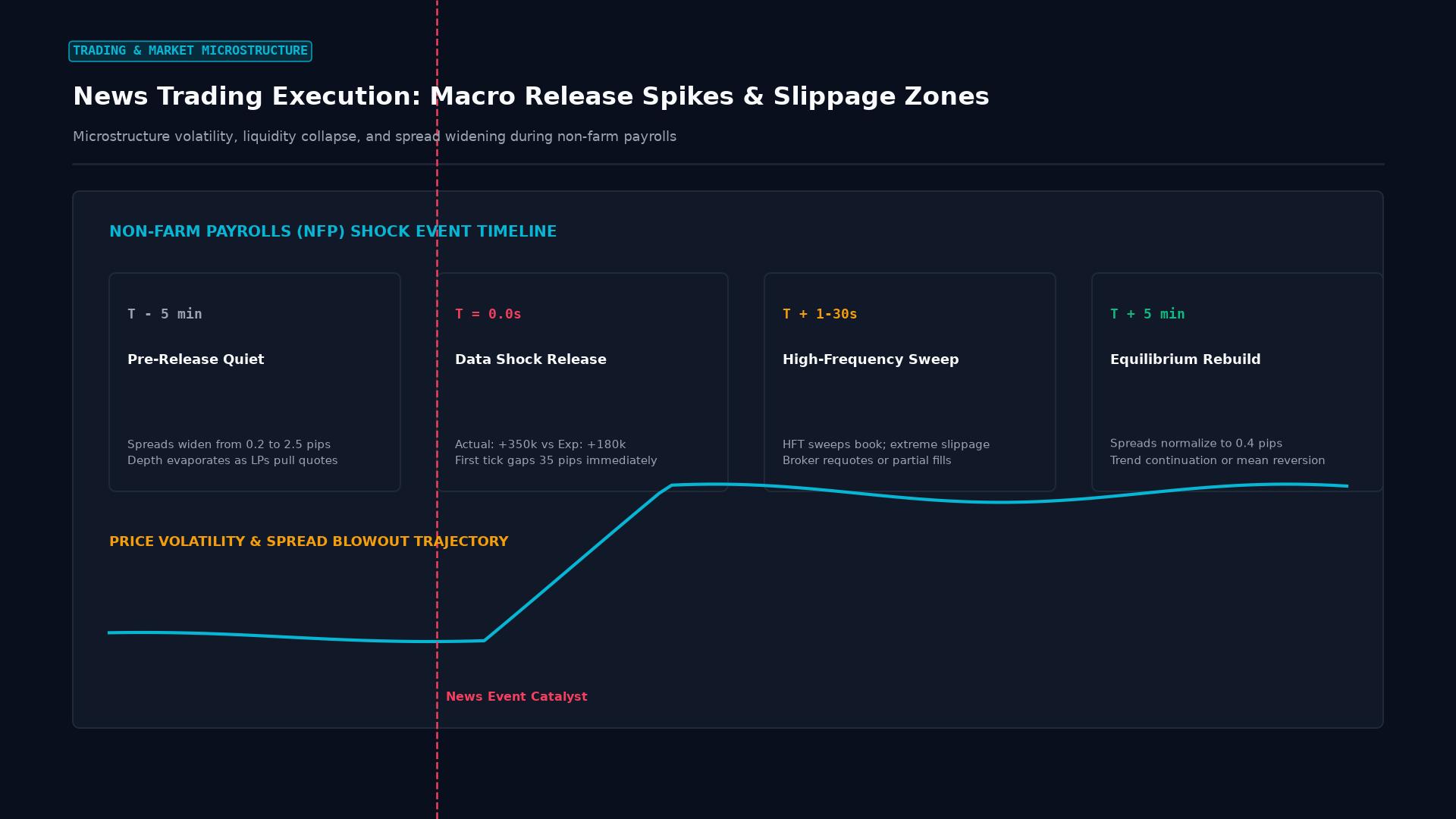 Figure: Macroeconomic release timeline: pre-release liquidity withdrawal, spread widening, high-frequency order sweeps, and equilibrium recovery.
Key Takeaways
- Driven by the “Surprise Factor”: Market reaction is not governed by the absolute data number, but by the divergence between the actual result and the market consensus forecast (the “surprise delta”).
- Extreme Microstructure Friction: Seconds prior to high-impact releases, institutional market makers pull resting limit orders to shield against adverse selection, causing bid-ask spreads to widen from 0.1 pips to 10–25+ pips.
- Severe Negative Slippage: Market orders and resting stop-loss orders frequently experience catastrophic execution slippage, executing dozens of pips away from the displayed price during liquidity voids.
- Three Dominant Strategic Models: Traders deploy Pre-News Straddles, Post-Release Momentum Chasing, or News Fading (Mean Reversion).
- Institutional Algorithmic Dominance: Professional hedge funds employ Natural Language Processing (NLP) algorithms connected directly to machine-readable news feeds (such as Bloomberg Event-Driven feeds), executing institutional trades within milliseconds of data decryption.
Comparative Taxonomy: News Trading Strategies
| Strategy Model | Order Timing | Order Types Deployed | Primary Advantage | Critical Vulnerability |
|---|---|---|---|---|
| Pre-News Straddle | 1 to 2 minutes before release | Buy Stop + Sell Stop bracket | Captures breakout in either direction | Dual execution whipsaw across widened spreads |
| Post-News Momentum | 1 to 5 seconds after release | Market Order in surprise direction | Aligned with actual fundamental data | High negative slippage at peak volatility |
| News Fade (Contrarian) | 5 to 30 minutes after release | Limit Orders at major technical levels | Fades emotional overreaction; tight spreads | Trampled if news sparks a secular trend change |
| Algorithmic NLP | Sub-millisecond at release | Low-latency API FIX commands | Fills before human traders read text | Requires multi-million-dollar infrastructure |
The Mathematics of the “Surprise Delta”
Algorithmic trading desks evaluate scheduled macroeconomic data through normalized statistical deviation scores (often called the Standardized Surprise Score):
$$\text{Surprise Score } (Z) = \frac{\text{Actual Reported Value} - \text{Bloomberg Consensus Forecast}}{\sigma_{\text{Historical Forecast Error}}}$$
Application in Forex Trading:
- If $|Z| < 0.5$: The release is virtually in line with consensus. Prices typically experience a momentary two-way whipsaw and return immediately to pre-news levels.
- If $|Z| > 2.0$: A massive statistical surprise has occurred. Automated trading engines fire aggressive market orders, driving powerful one-way trend continuation that can dominate price action for multiple sessions.
Real-World Case Study: The U.S. CPI Inflation Shock and EUR/USD
On November 10, 2022, at 08:30 AM EST, the U.S. Bureau of Labor Statistics released October Consumer Price Index (CPI) inflation data.
- The Expectation: Wall Street consensus projected headline year-over-year inflation at 8.0%.
- The Surprise: Actual CPI printed at 7.7% (Core CPI dropped to 6.3%), signaling that post-pandemic inflation had definitively peaked and the Federal Reserve would slow its aggressive interest rate hikes.
- The Instant Market Reaction:
- Within 200 milliseconds, high-frequency algorithms dumped the U.S. Dollar.
- EUR/USD spiked from 1.0020 to 1.0180 (+160 pips) in under two minutes.
- The Retail Trap vs. Professional Execution:
- Retail traders who placed pre-news Buy Stop orders at 1.0040 were filled with 40 pips of slippage at 1.0080.
- Disciplined “News Fade” and pullback traders waited 15 minutes for the initial panic to stabilize, entering long on the first technical retracement to 1.0110, capturing a sustained multi-day 400-pip rally toward 1.0400.
Tactical Rules for News Traders
- Never Use Pre-News Straddles on Unregulated Brokers: Placing simultaneous Buy Stop and Sell Stop orders right before NFP is a classic amateur trap. When the news hits and the spread expands to 20 pips, both orders are triggered simultaneously, locking the trader into a double-sized losing position across massive negative slippage.
- Wait for the Initial 5-Minute Candle Close: The safest news trading methodology is waiting for the initial emotional volatility spike to conclude. Let the 5-minute candle close, confirm the fundamental surprise direction, and enter on the first technical pullback toward the candle’s midpoint.
- Reduce Position Sizing by 50%: Because volatility during news releases is 3x to 5x higher than normal trading hours, cut your standard lot size in half to maintain identical dollar risk parameters.
Frequently Asked Questions (FAQ)
Which economic news events move forex pairs the most?
The three most market-moving scheduled releases globally are the U.S. Non-Farm Payrolls (NFP) (first Friday of the month), the U.S. Consumer Price Index (CPI), and Central Bank Interest Rate Decisions and Press Conferences (especially the Federal Reserve FOMC, ECB, and BOJ).
Why do brokers widen spreads during news announcements?
Retail brokers receive their liquidity from Tier-1 interbank banks and non-bank market makers. During high-impact news, market makers face extreme risk of being “picked off” by informed flow. To protect themselves from catastrophic inventory losses, they withdraw resting limit orders and dramatically widen quoted bid-ask spreads.
Can guaranteed stop-losses protect me during news trading?
Yes, but only if your broker explicitly offers a Guaranteed Stop-Loss Order (GSLO). While a standard stop-loss is filled at the next available market price (subject to severe slippage), a GSLO guarantees execution at your exact specified price, though brokers charge an additional premium fee when the order is triggered.
Ready to trade forex?
Open a free demo account with a regulated broker. Practice with virtual funds before risking real money.