Non-Dealing Desk (NDD)
A Non-Dealing Desk (NDD) broker provides direct market access by routing client foreign exchange orders automatically to interbank liquidity providers without dealer intervention, manual requotes, or internal price filtering.
What Is a Non-Dealing Desk (NDD) Broker?
In retail and institutional foreign exchange trading, a Non-Dealing Desk (NDD) broker operates without an internal trading desk or market-making dealing team. Rather than taking the opposing side of client positions or executing trades on an internal B-book, an NDD broker functions strictly as an intermediary technology bridge, passing client orders directly into the interbank market or multilateral trading venues.
Historically, retail currency trading was dominated by traditional Dealing Desk (DD) brokers (market makers) who set their own synthetic bid/ask quotes and profited directly when their clients suffered losses. The development of NDD brokerage architecture democratized institutional-grade execution for retail traders, introducing transparent pricing, eliminating manual dealer requotes, and removing the structural conflict of interest between broker and trader.
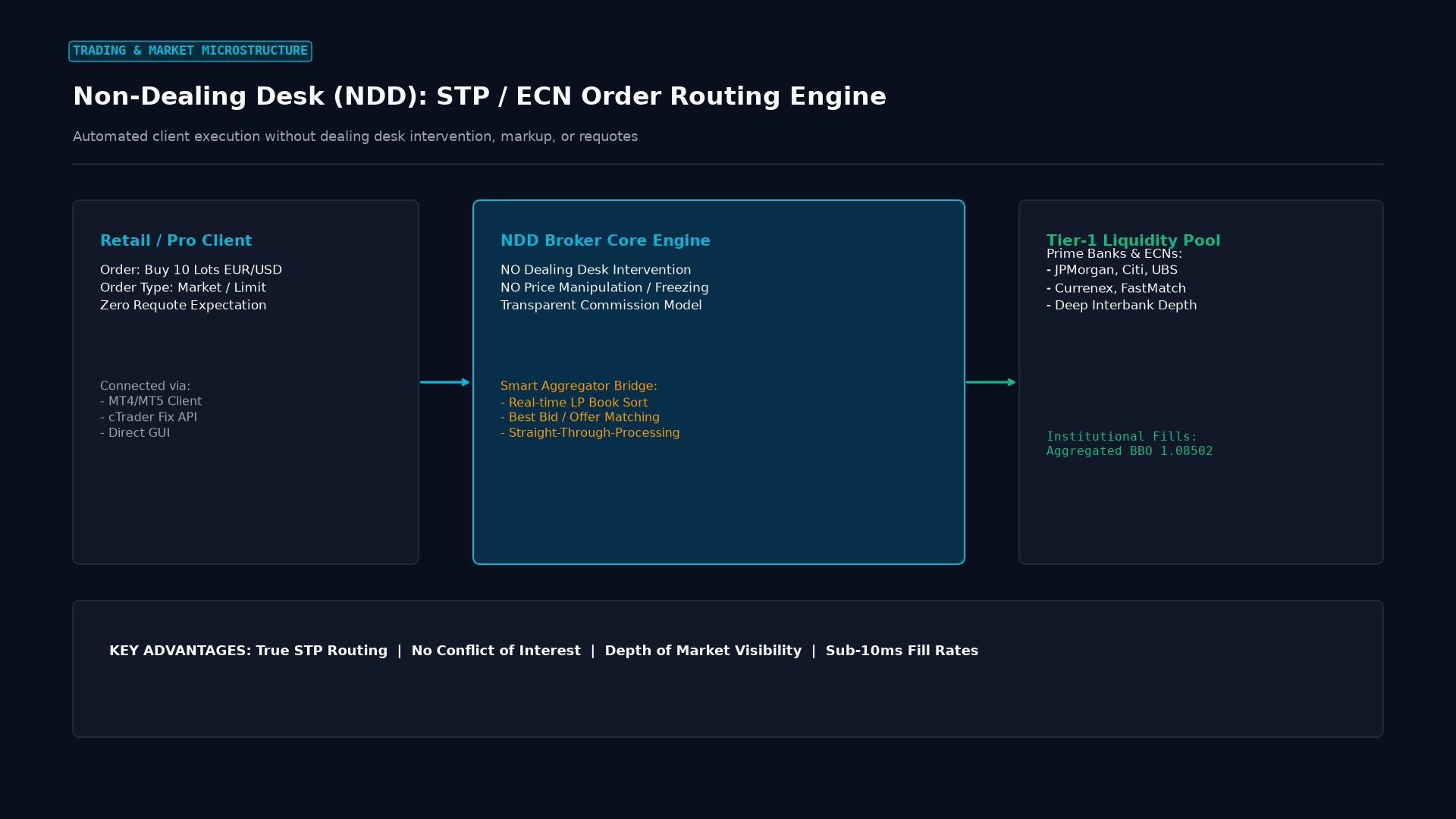 Figure: Automated NDD broker routing: client orders bridged directly via FIX protocol to multi-bank liquidity providers without dealing desk intervention.
Technical Architecture: Subtypes of NDD Execution
The Non-Dealing Desk framework encompasses two distinct operational technologies:
1. Straight-Through Processing (STP)
Under an STP model, client orders are routed automatically to external liquidity providers (tier-1 banks like JPMorgan, UBS, and Deutsche Bank). The broker’s aggregation engine continuously compares streaming bid/ask quotes from each provider and routes client buy orders to the lowest ask and sell orders to the highest bid.
2. Electronic Communication Network (ECN)
Under an ECN model, client orders enter an open, consolidated Central Limit Order Book (CLOB). Inside this network, the trader’s order can match not only against commercial banks but also against institutional hedge funds, proprietary desks, and other retail traders, allowing market participants to act as both liquidity makers (limit orders) and liquidity takers (market orders).
Execution Cost Mechanics
The effective spread paid by an NDD trader reflects true interbank market depth:
$$\text{Effective Spread}{\text{NDD}} = \min{j \in L} \left( \text{Ask}j \right) - \max{j \in L} \left( \text{Bid}_j \right) + M$$
Where:
- $L$: Set of active streaming liquidity providers.
- $M$: Fixed transparent spread markup or explicit commission charge per standard lot.
Comparative Matrix: Brokerage Execution Models
| Execution Parameter | Dealing Desk (DD / Market Maker) | Non-Dealing Desk: STP | Non-Dealing Desk: ECN |
|---|---|---|---|
| Price Determination | Fixed or artificially marked-up by dealer | Raw interbank aggregation + markup | Pure open-market CLOB pricing |
| Dealing Desk Interference | Yes (Manual reviews, requotes possible) | None (100% automated) | None (100% automated) |
| Market Depth (Level II) | Hidden / Synthetic | Limited | Full Level II Depth of Market |
| Scalping / News Trading | Often restricted or penalized | Unrestricted | Unrestricted |
| Revenue Stream | Client trading losses + widened spreads | Spread markup or volume commission | Volume commission per lot traded |
| Counterparty Risk | Direct broker credit risk | Liquidity provider / Prime broker | Clearing house / Network participants |
Real-World Case Study: The CFTC / NFA Sanctions on Undisclosed B-Booking (2017)
The vital distinction between genuine Non-Dealing Desk execution and deceptive market-making was highlighted in February 2017, when the US Commodity Futures Trading Commission (CFTC) and the National Futures Association (NFA) levied landmark enforcement penalties against major retail broker FXCM.
The Anatomy of an NDD Enforcement Action:
1. The Representation: FXCM advertised to retail traders that it operated an independent "No Dealing Desk" (NDD) execution model, promising zero conflicts of interest and straight-through routing to independent liquidity providers.
2. The Investigation: Regulatory authorities discovered that FXCM had a secret financial interest in a high-frequency trading firm, Effex Capital.
3. The Mechanism: Rather than routing orders impartially, FXCM routed massive portions of its retail order flow to Effex Capital, which acted as an abusive internal market maker, using asymmetric price slippage algorithms to capture profits at retail clients' expense while rebating tens of millions of dollars back to FXCM.
4. The Penalty: The CFTC fined FXCM $7 million, the NFA permanently banned its senior executives from the US derivatives industry, and FXCM was forced to withdraw from the US retail forex market.
The regulatory ruling underscored that true NDD execution requires complete operational and financial independence from liquidity providers.
Frequently Asked Questions (FAQ)
Why do professional and algorithmic traders avoid Dealing Desk brokers in favor of NDD?
Professional and algorithmic traders prefer Non-Dealing Desk brokers because automated strategies (such as high-frequency trading, automated scalping, and news breakout systems) require millisecond execution without manual requotes or dealer latency. Furthermore, Dealing Desk brokers frequently restrict or ban strategies that consistently capture profits from their internal B-books, whereas NDD brokers welcome profitable, high-volume flow because they earn revenue from transaction volume regardless of trade outcome.
Can an NDD broker offer fixed spreads?
In virtually all cases, no. True interbank market spreads fluctuate continuously based on underlying liquidity, volatility, and trading session depth. During major economic releases or illiquid market rollovers, interbank spreads naturally widen. A broker offering permanently fixed spreads is almost certainly operating a Dealing Desk (B-book), as it must artificially manipulate and absorb market risk to maintain non-moving price spreads.
What is “positive slippage” and does it occur on NDD accounts?
Positive slippage occurs when an order executes at a price more favorable than the requested price (for example, buying EUR/USD at 1.0848 when the requested limit price was 1.0850). On genuine NDD accounts, price improvement algorithms pass positive slippage directly to the trader. In contrast, unethical Dealing Desk brokers historically engaged in “asymmetric slippage”—passing negative slippage onto the client while pocketing positive price improvements for the broker’s own account.
Ready to trade forex?
Open a free demo account with a regulated broker. Practice with virtual funds before risking real money.