Old Lady
"The Old Lady of Threadneedle Street" (commonly shortened to "The Old Lady") is the traditional financial and market slang nickname for the Bank of England (BoE), the central bank of the United Kingdom, established in 1694 and headquartered on Threadneedle Street in London.
What Is the “Old Lady”?
In international banking and foreign exchange markets, “The Old Lady”—more formally known as “The Old Lady of Threadneedle Street”—is the universally recognized nickname for the Bank of England (BoE). Established by Royal Charter in 1694, the Bank of England is the world’s eighth-oldest bank and the second-oldest central bank continuously operating today (after Sweden’s Sveriges Riksbank).
The nickname originated in 1797 from a political cartoon by British caricaturist James Gillray, titled The Old Lady of Threadneedle Street in Danger. The satirical print depicted the Bank of England as an elderly woman dressed in a gown constructed from ten-pound banknotes, sitting atop a strongbox of gold coin reserves while resisting the advances of Prime Minister William Pitt the Younger, who was demanding gold funds to finance the Napoleonic Wars. The moniker stuck permanently and is widely used across institutional trading floors, financial press releases, and macroeconomic dispatches.
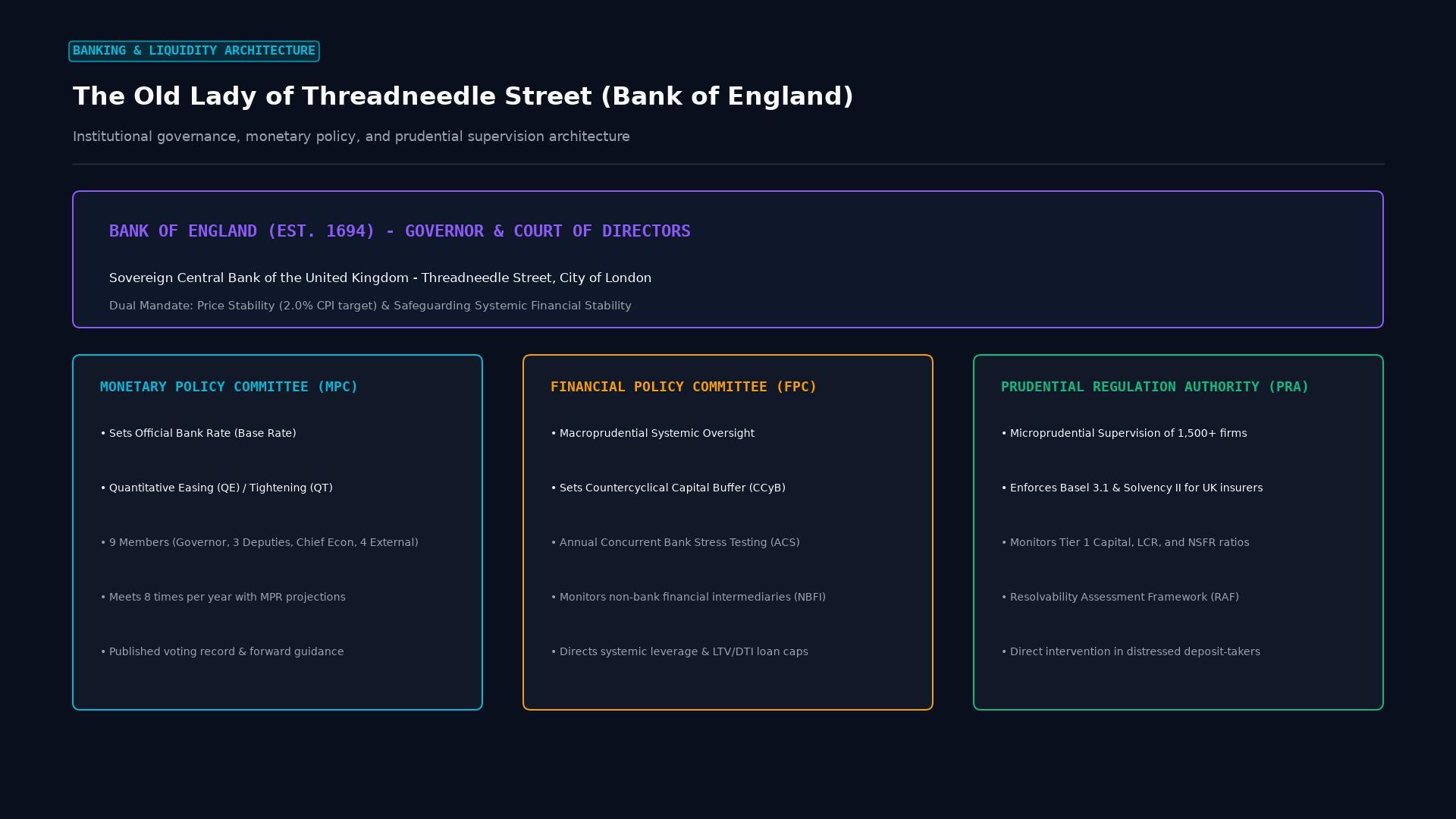 Figure: Governance and statutory framework of the Bank of England: Monetary Policy Committee (MPC), Financial Policy Committee (FPC), and Prudential Regulation Authority (PRA).
Historical Origins and Market Evolution
The institution has evolved through three centuries of monetary history, laying the foundational framework for modern central banking:
1. The 1797 Restriction Period and the Cartoon
During the French Revolutionary Wars in February 1797, a run on regional English banks forced the government to pass the Bank Restriction Act, prohibiting the Bank of England from converting its paper banknotes into gold coin (specie). Gillray’s famous cartoon captured the public tension between private commercial banking obligations and government wartime demands.
2. The 1844 Bank Charter Act (Peel’s Act)
Sir Robert Peel’s Bank Charter Act formally divided the Bank into two distinct entities:
- The Issue Department: Sole authority in England and Wales to issue banknotes backed by gold reserves and government debt.
- The Banking Department: Handled commercial banking, debt management, and liquidity operations.
This separation established the blueprint for statutory central bank reserves and gold-backing disciplines during the Pax Britannica era.
3. Nationalization (1946) and Operational Independence (1997)
Following World War II, Clement Attlee’s Labour government nationalized the Bank in 1946, placing it under public ownership. In May 1997, Chancellor Gordon Brown granted the Bank of England operational independence to set monetary policy without political interference, establishing the statutory Monetary Policy Committee (MPC) with a primary mandate to target a 2.0% annual inflation rate based on the Consumer Price Index (CPI).
Institutional Mandates and Policy Tools
In global currency trading (particularly on GBP pairs like GBP/USD, EUR/GBP, and GBP/JPY), market participants monitor the Old Lady’s policy decisions, press conferences, and the quarterly Monetary Policy Report (MPR).
| Mechanism | Operational Scope | Impact on British Pound (GBP) |
|---|---|---|
| Official Bank Rate | The benchmark interest rate paid on commercial bank reserve balances held at the BoE. | Direct driver of short-term gilt yields and GBP exchange rate differentials. |
| Asset Purchase Facility (APF) | Large-scale bond-buying program (QE) or balance-sheet runoff (QT). | Liquidity injections depress long-term yields; active gilt sales (QT) tighten domestic conditions. |
| Prudential Regulation (PRA) | Microprudential supervision of 1,500+ commercial banks, building societies, and insurers. | Ensures systemic resilience; capital buffer rules prevent credit crunches during recessions. |
| Forward Guidance | Communication via MPC voting splits (e.g., 6-3 vs. 5-4) and economic projections. | Guides market expectations regarding terminal rates and rate-cut trajectories. |
| Emergency Liquidity Assistance (ELA) | Lender-of-last-resort repo facilities for domestic financial institutions facing solvency shocks. | Restores market confidence during liquidity crises (e.g., LDI pension crisis of 2022). |
Real-World Case Study: The 2022 Gilt Market Intervention
In late September 2022, the UK government under Prime Minister Liz Truss announced the “Mini-Budget”—an unfunded £45 billion package of tax cuts. Financial markets reacted with unprecedented volatility:
- 30-year UK sovereign gilt yields surged over 130 basis points in three trading days.
- Liability-Driven Investment (LDI) pension funds faced catastrophic margin calls on interest rate derivative hedges, threatening a disorderly fire-sale of UK sovereign debt.
- The British Pound (Cable) plummeted to an all-time record low of 1.0350 against the US Dollar.
       2022 LDI CRISIS & THE OLD LADY'S TEMPORARY GILT INTERVENTION

 Unfunded Tax Cuts ---> Gilt Yields Surge ---> LDI Pension Margin Calls
                                                        |
 BoE Backstop Offer <--- Emergency £65B APF Buying <--- Imminent Gilt Collapse
 (Yields Drop 100 bps)   (Stabilizes Collateral)         (GBP/USD Rebounds)
On September 28, 2022, the Bank of England stepped in as lender of last resort, announcing a temporary, targeted bond-purchase operation of up to £5 billion per day for long-dated gilts to restore orderly market conditions. Gilt yields immediately dropped over 100 bps within hours, halting the systemic margin spiral and allowing the British Pound to recover toward 1.1200 within weeks.
Frequently Asked Questions
Why is the Bank of England specifically located on Threadneedle Street?
The Bank moved to its current site on Threadneedle Street in the City of London in 1734. The site was expanded throughout the 18th and 19th centuries, eventually occupying a fortress-like 3.5-acre triangular plot designed by architect Sir John Soane and later modified by Sir Herbert Baker.
How does the Old Lady’s Monetary Policy Committee vote?
The MPC consists of nine members: the Governor of the Bank of England, three Deputy Governors, the Bank’s Chief Economist, and four external members appointed directly by the Chancellor of the Exchequer. Each member holds one equal vote, and decisions are reached by simple majority. The individual voting breakdown (e.g., 7-2 or 5-4) is released immediately alongside the rate decision, providing critical insight into policy consensus.
What is the difference between “Cable” and “The Old Lady”?
While both are historic forex slang terms associated with the United Kingdom, they denote different concepts:
- “The Old Lady” refers specifically to the institution—the Bank of England.
- “Cable” refers to the GBP/USD currency pair itself, named after the transatlantic telegraph cable laid beneath the Atlantic Ocean in 1858 that first synchronized exchange rates between London and New York.
Ready to trade forex?
Open a free demo account with a regulated broker. Practice with virtual funds before risking real money.