Overheating
Overheating is an economic state in which aggregate demand expands beyond an economy's maximum sustainable productive capacity (potential GDP), creating a positive output gap characterized by acute labor shortages, supply-chain bottlenecks, and accelerating demand-pull inflation that necessitates aggressive central bank monetary tightening.
What Is Economic Overheating?
In macroeconomic theory and central banking, an economy is said to be overheating when aggregate demand ($AD$) grows at a rate that exceeds the economy’s long-term non-inflationary productive capacity (potential Gross Domestic Product, or $Y^*$). When an economy overheats, its economic growth rate is unsustainably rapid, pushing resource utilization to physical and structural limits.
Because factories operate near 100% capacity and labor markets become excessively tight (with unemployment falling far below the Non-Accelerating Inflation Rate of Unemployment, or NAIRU), employers must bid aggressively against one another for scarce labor by raising wages. Simultaneously, businesses raise consumer prices to ration scarce goods and services. This dynamic triggers a self-reinforcing wage-price spiral, fueling broad-based demand-pull inflation.
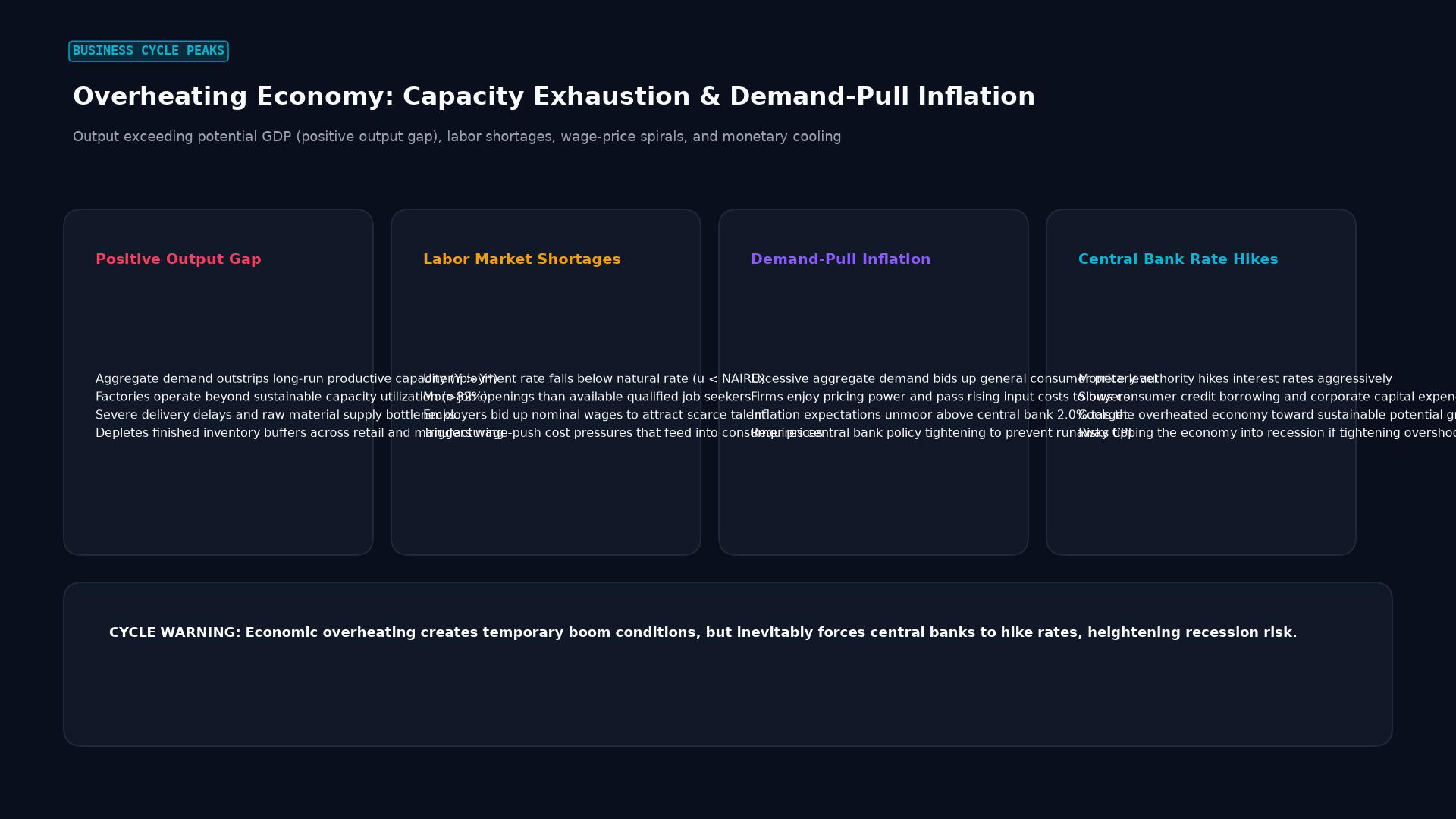 Figure: Output exceeding potential GDP (positive output gap), labor shortages, wage-price spirals, and monetary cooling
The Output Gap: Measuring Overheating Mathematically
Macroeconomists and central banks (such as the Federal Reserve, European Central Bank, and Bank of England) quantify overheating through the Output Gap:
$$\text{Output Gap} = \left(\frac{Y - Y^}{Y^}\right) \times 100%$$
Where:
- $Y$ = Actual Real Gross Domestic Product (Real GDP).
- $Y^*$ = Potential GDP (the maximum output an economy can sustain over time without triggering accelerating inflation).
Output Gap States
- Negative Output Gap ($Y < Y^*$): The economy is operating below capacity (economic slack). Unemployment is elevated, and deflationary or disinflationary pressures prevail.
- Balanced Equilibrium ($Y = Y^*$): The economy operates at full employment with stable prices matching the central bank’s target (typically 2.0% annual CPI).
- Positive Output Gap ($Y > Y^*$): The Overheating State. Demand outstrips supply, leading to resource rationing, wage escalation, asset price bubbles, and soaring inflation prints.
Primary Symptoms of an Overheating Economy
Central bank monetary policy committees monitor a comprehensive dashboard of macroeconomic indicators to diagnose overheating before inflation expectations become unanchored:
| Economic Metric | Normal / Sustainable Regime | Overheating Regime | Macro / FX Market Impact |
|---|---|---|---|
| Real GDP Growth | At or near trend rate (1.5% to 2.5% in developed nations). | Significantly above trend (4.0% to 6.0%+ annualized). | Drives expectations of rapid central bank policy rate hikes; strengthens domestic currency. |
| Unemployment Rate | Near natural rate / NAIRU (~4.0% to 4.5%). | Far below NAIRU (sub-3.5% with high job openings ratio). | Sparks aggressive wage growth as businesses compete for workers. |
| Capacity Utilization | Normal benchmark of 75% to 80%. | Spikes above 85% to 90%. | Produces acute capital goods shortages and supplier delivery delays. |
| Inflation (CPI / Core PCE) | Anchored near the 2.0% official target. | Persistently prints 5.0% to 9.0%+. | Erodes consumer purchasing power; destroys real fixed-income returns. |
| Current Account | Sustainable trade balance. | Deepening deficit as domestic demand pulls in massive imports. | Increases reliance on foreign financing; poses long-term currency vulnerability. |
Central Bank Intervention: Soft Landing vs. Hard Landing
When an economy overheats, the central bank is mandated to intervene by withdrawing stimulus and cooling down demand. This is executed via contractionary monetary policy:
- Aggressive Policy Rate Hikes: Raising benchmark interest rates increases the cost of borrowing for mortgages, corporate loans, and consumer credit.
- Quantitative Tightening (QT): Allowing sovereign bond holdings to mature without reinvestment drains excess liquidity from commercial bank reserves.
The ultimate challenge for central bankers is navigating the cooling process:
- Soft Landing: The central bank raises interest rates just enough to eliminate the positive output gap and return inflation to 2.0% without causing a recession or substantial unemployment spikes.
- Hard Landing: Aggressive rate hikes overtighten financial conditions, triggering a credit freeze, corporate bankruptcies, surging unemployment, and a sharp economic recession.
Real-World Case Study: The 2021–2022 Post-Pandemic Overheating Shock
Following the 2020 pandemic lockdowns, governments and central banks deployed unprecedented fiscal and monetary stimulus:
- The US government enacted multi-trillion-dollar fiscal rescue packages (CARES Act, American Rescue Plan), depositing direct cash checks into household bank accounts.
- The Federal Reserve slashed rates to 0.00% and expanded its balance sheet by over $4.5 trillion via Quantitative Easing.
       2021-2022 US ECONOMIC OVERHEATING TRANSMISSION

 Massive Fiscal Checks + 0% Fed Rates ---> Consumer Demand Surges Past Capacity
                                                      |
 Global Supply Bottlenecks + Worker Shortages <-------+
                                                      |
 Core CPI Hits 9.1% (June 2022) ---> Positive Output Gap at Extreme Levels
                                                      |
 Fed Embarks on Most Aggressive Rate Hikes in 40 Years (0% to 5.50%)
                                                      |
 US Dollar Index (DXY) Explodes Higher (Surpasses 114.00)
By late 2021 and early 2022, the US economy exhibited textbook overheating:
- The Output Gap: Real GDP rebounded at an extraordinary 5.9% annualized rate.
- The Labor Imbalance: The unemployment rate dropped to 3.5%, and there were nearly two open job vacancies for every unemployed worker, pushing wage growth above 5.5%.
- Inflation Exploded: Headline CPI soared from 1.4% in early 2021 to a four-decade high of 9.1% in June 2022.
- Policy Reaction: Acknowledging that inflation was not “transitory,” the Federal Reserve enacted four consecutive jumbo 75-basis-point rate hikes, pushing the Federal Funds rate to 5.50% and driving the US Dollar Index (DXY) to a 20-year high above 114.00.
Frequently Asked Questions
What is the difference between economic growth and overheating?
Economic growth is healthy and sustainable when driven by improvements in productivity, technological innovation, and capital investment that expand the economy’s productive capacity ($Y^*$). Overheating occurs when growth is driven purely by excessive credit expansion and consumer spending that outpaces physical capacity, generating high inflation without lasting wealth creation.
How does an overheating economy affect the foreign exchange (forex) market?
In the initial stages, an overheating economy typically causes its national currency to appreciate strongly. Global institutional investors anticipate that the domestic central bank will hike benchmark interest rates aggressively to combat inflation, attracting foreign capital seeking higher yields into domestic sovereign bonds and money markets.
What is the “wage-price spiral”?
A wage-price spiral is a dangerous structural symptom of economic overheating. When consumer prices rise, workers demand higher wages to preserve their standard of living. To fund these higher labor costs, businesses raise the prices of their final goods and services again. This feedback loop entrenches inflation expectations into the real economy.
Ready to trade forex?
Open a free demo account with a regulated broker. Practice with virtual funds before risking real money.