PGK
PGK (Papua New Guinea Kina) is the official currency of Papua New Guinea, subdivided into 100 toea and issued by the Bank of Papua New Guinea (BPNG).
What is the Papua New Guinea Kina (PGK)?
The Papua New Guinea Kina (ISO code: PGK, symbol: K) is the official currency of the Independent State of Papua New Guinea. Administered and issued by the nation’s central bank, the Bank of Papua New Guinea (BPNG), the Kina is subdivided into 100 toea (symbol: t).
The names of the currency reflect traditional indigenous wealth items. “Kina” originates from the Tolai language, referring to valuable polished pearl oyster shells traditionally used in trade and bride-price ceremonies throughout the New Guinea Highlands and coastal areas. “Toea” refers to valuable cowrie shells previously utilized as media of exchange across southern coastal Papua.
In global foreign exchange markets, the Kina is an illiquid frontier market currency. Its exchange rate regime operates as a tightly managed crawling peg primarily pegged to the United States Dollar (USD). The currency is characterized by administrative capital controls, structural foreign exchange rationing, and acute sensitivity to liquefied natural gas (LNG) and precious metal commodity export cycles.
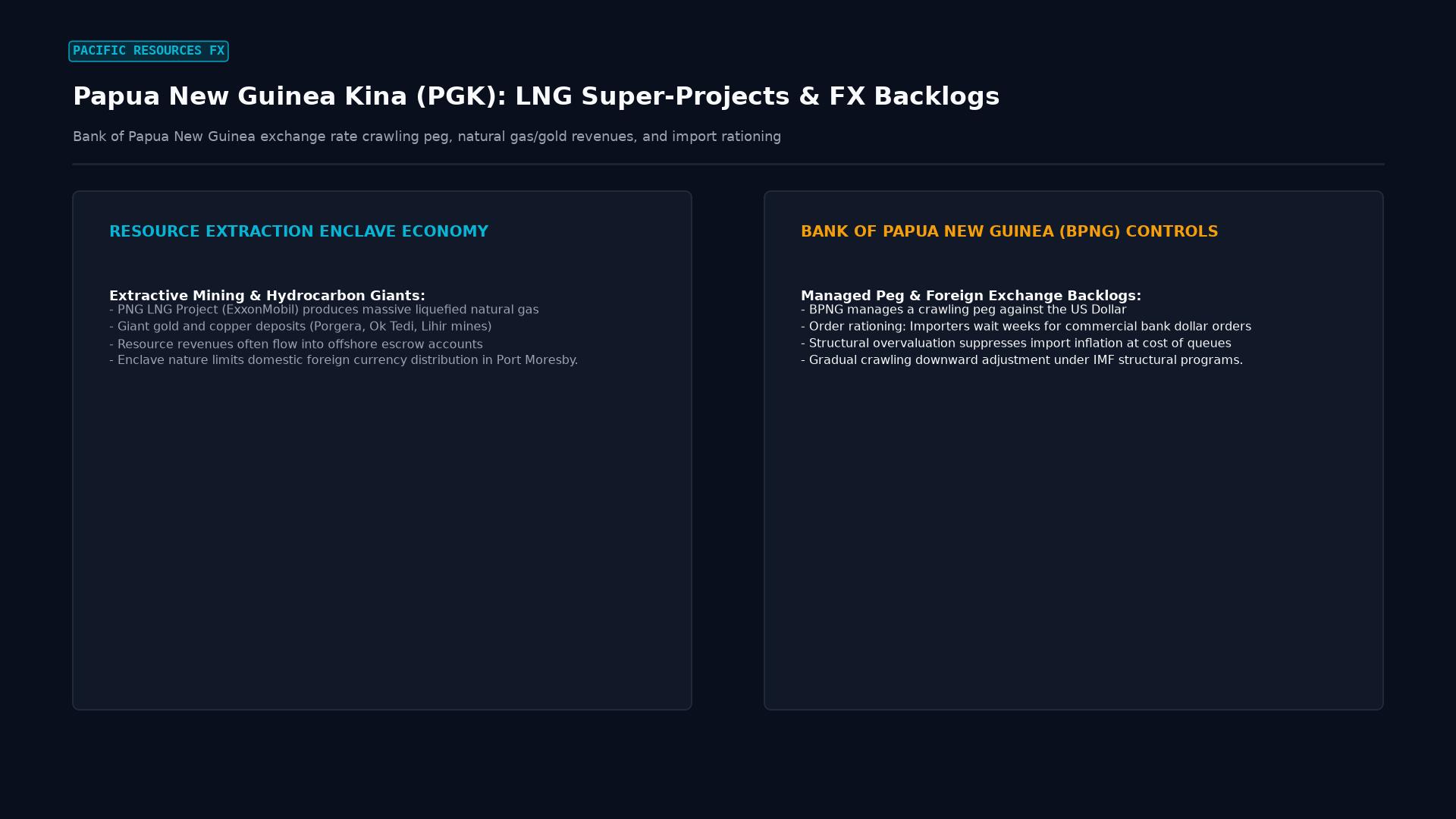 Figure: Bank of Papua New Guinea exchange rate crawling peg, natural gas/gold revenues, and import rationing
Historical Context and Currency Evolution
The monetary history of Papua New Guinea reflects the nation’s transition from colonial administration to independent sovereign governance.
Pre-Independence and the Australian Currency Link
Before independence, the territory used a succession of colonial currencies, including German New Guinea marks, British pounds, and Australian pounds. Following the 1966 decimalization in Australia, the Australian Dollar (AUD) became the legal tender across the Territory of Papua and New Guinea.
The Introduction of the Kina (April 19, 1975)
Papua New Guinea established the Bank of Papua New Guinea under the Central Banking Act of 1973. On April 19, 1975, five months before formal political independence from Australia, the BPNG issued the Kina and Toea, initially exchanging with the Australian dollar at par ($1\text{ Kina} = 1\text{ AUD}$).
A dual-currency circulation period operated until December 31, 1975, when the Australian dollar ceased to be legal tender within Papua New Guinea.
Australian Colonial Administration
Territory of Papua and New Guinea uses AUD
                    │
                    ▼
April 19, 1975: Introduction of Kina & Toea
Fixed 1:1 parity with Australian Dollar (AUD)
                    │
                    ▼
1975-1994: The "Hard Kina" Strategy
Pegged basket to minimize imported inflation;
High reserves supported strong exchange rate
                    │
                    ▼
October 1994: Float and Macroeconomic Crisis
Severe fiscal deficits and Bougainville mine closure
force official devaluation and free float
                    │
                    ▼
2014-Present: Administrative Trading Bands & Crawling Peg
BPNG restricts FX market to manage import costs,
leading to structural currency queues and IMF reform
The “Hard Kina” Era (1975 to 1994)
From independence through the early 1990s, PNG policymakers pursued the “Hard Kina” strategy. Because Papua New Guinea imported virtually all manufactured goods, fuel, and processed food, authorities believed currency depreciation would immediately spark imported inflation without boosting domestic manufacturing.
Under this strategy:
- The Kina was pegged against a trade-weighted basket of international partner currencies.
- Domestic interest rates were kept aligned with foreign rates to prevent capital outflows.
- Large foreign exchange reserve buffers were maintained to guarantee full convertibility.
The 1994 Currency Crisis and Transition to Floating
The Hard Kina policy collapsed in 1994 due to unsustainable fiscal deficits, declining commodity revenues, and the closure of the massive Panguna copper mine on Bougainville Island. Foreign exchange reserves dropped to critical levels.
In October 1994, the government devalued the Kina by 12% and abandoned the fixed peg, allowing the currency to float. The Kina depreciated steadily over the following decade, dropping from near-parity with the US dollar to lows below $0.25$ USD per Kina in 2002.
Macroeconomic Profile and Currency Dynamics
Papua New Guinea’s macroeconomic framework is defined by a deep structural duality: a capital-intensive extractives sector on one side, and an agricultural, informal economy on the other.
1. Dual Economic Structure: Enclave Resources vs. Agriculture
The commercial economy is divided into two disconnected segments:
+-----------------------------------------------------------------------------------+
|                        PAPUA NEW GUINEA DUAL ECONOMY                               |
+-----------------------------------+-----------------------------------------------+
| THE RESOURCE SECTOR (ENCLAVE)     | THE NON-RESOURCE SECTOR                       |
+-----------------------------------+-----------------------------------------------+
| - Liquefied Natural Gas (PNG LNG) | - Agriculture, Forestry, and Fisheries        |
| - Gold (Porgera, Lihir mines)     | - Palm Oil, Coffee, Cocoa, Copra              |
| - Copper and Silver               | - Employs >80% of domestic labor force        |
| - Highly capital-intensive        | - Heavily reliant on local Kina pricing       |
| - Revenues held in offshore escrow| - Vulnerable to high costs of imported inputs  |
+-----------------------------------+-----------------------------------------------+
The resource sector generates over 80% of national export earnings, led by ExxonMobil’s PNG LNG project and large open-pit gold mines. However, because foreign resource developers maintain project agreements allowing export proceeds to remain in offshore escrow accounts to service external debt, foreign revenues do not automatically flow into domestic interbank foreign exchange markets.
2. Commodity Price Dependency and Fiscal Windfalls
The value of the Kina is fundamentally linked to international prices for liquefied natural gas, crude oil, gold, copper, and agricultural commodities like palm oil and coffee. Surges in global energy prices generate royalty streams and corporate tax revenues paid into the government treasury, temporarily increasing US dollar supplies in the interbank market.
Conversely, declines in energy or precious metal prices squeeze foreign exchange liquidity, pressuring domestic banks and draining BPNG international reserves.
The 2014 Trading Band and Foreign Exchange Queuing
In June 2014, the Bank of Papua New Guinea made a historic intervention that reshaped the currency’s microstructure for the following decade.
Introduction of the 75 Basis Point Band
Responding to sustained Kina depreciation against the US dollar, BPNG introduced an official exchange rate band. It mandated that commercial banks could only execute foreign exchange transactions within a tight margin of 75 basis points around the central bank’s published reference rate:
$$\text{Trading Band} = \text{BPNG Reference Rate} \pm 0.75%$$
This policy effectively transformed the de jure floating Kina into a de facto overvalued peg against the US dollar.
       Commercial Importers Demand USD
       (Fuel, Food, Heavy Machinery)
                     │
                     ▼
       BPNG Restricts Foreign Exchange Supply
       (Intervention Sales Capped to Preserve Reserves)
                     │
                     ▼
       Commercial Banks Prohibited from Raising USD Price
       (Bound by 75 bps Regulatory Margin)
                     │
                     ▼
       Market Cannot Clear via Price Adjustment
                     │
                     ▼
       Formation of Structural FX Order Queues
       Orders Queued for 3 to 12 Months at Commercial Banks
The Foreign Exchange Queue (Order Backlog)
Because the official exchange rate was fixed above its true market-clearing equilibrium, the demand for foreign currency to pay for imports exceeded the available supply of US dollars in the banking system.
Because banks were legally prohibited from adjusting the price of the dollar upward to balance supply and demand, the market cleared through quantity rationing. An extensive backlog of unfilled import orders accumulated:
- Commercial importers faced waiting times of 3 to 12 months to obtain US dollars to pay overseas suppliers.
- Letters of credit (LCs) were difficult to establish without pre-funded offshore currency balances.
- Multinational corporations operating in PNG experienced restrictions when repatriating local Kina earnings, leading to dividend accumulation within domestic bank deposits.
The IMF Extended Credit Facility (ECF) Reforms
In 2023, the government of Papua New Guinea entered into a multi-year economic program with the International Monetary Fund (IMF) supported by an Extended Credit Facility (ECF) and Extended Fund Facility (EFF).
A core requirement of the reform framework is addressing structural imbalances in the foreign exchange market:
- Gradual Crawling Depreciation: BPNG commenced a measured, scheduled crawling peg depreciation of the PGK against the USD to bring the official rate closer to its fundamental equilibrium.
- Transition Back to De Facto Market Clearing: Increasing central bank intervention sales to clear outstanding legacy order queues.
- Interest Rate Transmission: Modernizing the BPNG monetary policy framework to make the Kina Facility Rate (KFR) an active tool for managing domestic inflation and liquidity.
Trading and Market Microstructure of the PGK
Trading the Papua New Guinea Kina differs fundamentally from trading liquid G10 or primary emerging market currencies.
1. Authorized Dealer Oligopoly
Foreign exchange dealing in Papua New Guinea is strictly restricted to institutions licensed as Authorized Foreign Exchange Dealers by the BPNG. The market is concentrated among a small group of commercial banks:
- Bank South Pacific (BSP Financial Group): The dominant domestic retail and commercial lender.
- Kina Bank: A major publicly listed domestic commercial bank.
- Westpac PNG: Domestic subsidiary of the Australian banking major.
- ANZ PNG: Focusing primarily on institutional and resource sector clients.
2. Quotation Conventions
In foreign exchange markets, the Kina is conventionally quoted as an indirect quote, showing the amount of foreign currency purchased per one Kina (PGK/USD):
Indirect Quote:
PGK/USD = 0.2520

Meaning:
1 Kina = 0.2520 US Dollars

Direct Interbank Calculation (USD/PGK):
USD/PGK = 1 / 0.2520 = 3.9683 Kina per 1 USD
Traders must note whether a quoted price reflects PGK/USD or USD/PGK, as cross-border documentation and domestic central bank releases frequently alternate between the two notations.
+------------------------------------------------------------------------------------+
|                         G10 VS. PGK MARKET COMPARISON                              |
+------------------------------------+-----------------------------------------------+
| CHARACTERISTIC                     | PAPUA NEW GUINEA KINA (PGK)                   |
+------------------------------------+-----------------------------------------------+
| Market Depth                       | Shallow, frontier market                      |
| Liquidity                          | Illiquid; subject to rationing and backlogs   |
| Settlement Mechanism               | Bilateral gross settlement via BPNG KinaKats  |
| Off-shore Derivative Coverage      | Highly illiquid; limited non-deliverable      |
|                                    | forward (NDF) presence in Singapore/Sydney    |
| Capital Convertibility             | Restricted; requires BPNG tax clearance and   |
|                                    | commercial documentation of underlying trade  |
+------------------------------------+-----------------------------------------------+
Key Takeaways
- Official Currency of Papua New Guinea: The Kina (PGK), subdivided into 100 toea, was introduced in 1975, replacing the Australian Dollar at par ahead of national independence.
- Issuing Central Bank: The Bank of Papua New Guinea (BPNG) regulates monetary policy, issues banknotes and coins, and controls foreign exchange licensing.
- Resource Export Anchor: The economy relies heavily on capital-intensive natural resource exports, including liquefied natural gas (LNG), gold, copper, and crude oil, alongside agricultural exports like coffee and palm oil.
- Exchange Rate Management: Following a float in 1994, BPNG introduced tight administrative bands in 2014, pegging the currency closely to the US dollar and creating structural foreign exchange order queues.
- IMF Economic Reforms: PNG is executing a planned crawling peg adjustment to remove the overvaluation gap, eliminate import rationing, and re-establish currency convertibility.
- Strict Capital and FX Controls: Trading is limited to domestic authorized dealer banks, requiring documented commercial trade backing and regulatory clearances for capital repatriation.
Frequently Asked Questions (FAQ)
What do the words “Kina” and “Toea” mean?
“Kina” is a traditional term from the Tolai language of New Britain, referring to valuable polished pearl oyster shells that were cut, polished, and traded as currency and status symbols throughout the Highlands and coastal regions. “Toea” refers to precious cowrie shells historically used as currency along the southern Papuan coastline. Papua New Guinea adopted these traditional names in 1975 to establish a national monetary identity reflecting its cultural heritage.
Why do businesses face delays when converting Kina to US dollars?
Businesses in Papua New Guinea often experience foreign exchange delays because of administrative controls introduced by the central bank in 2014. By imposing a narrow 75-basis-point trading band around the official reference rate, the Kina was held above its market-clearing price. Because commercial banks cannot raise the price of foreign currency to match demand, available US dollar reserves are rationed. Importers must wait in queues until foreign currency inflows from mining exports or BPNG reserve interventions are distributed to commercial dealers.
Is the Papua New Guinea Kina freely tradable on international retail forex brokers?
No. The Papua New Guinea Kina is a restricted frontier currency that is not freely tradable on standard retail forex trading platforms. It does not settle on Continuous Linked Settlement (CLS) networks and cannot be transferred without trade documentation. International transactions involving the Kina are managed through authorized domestic banks in Port Moresby or settled via specialized offshore Non-Deliverable Forward (NDF) contracts arranged by institutional banks in Sydney or Singapore for corporate clients hedging mining or LNG infrastructure exposures.
Ready to trade forex?
Open a free demo account with a regulated broker. Practice with virtual funds before risking real money.