PIPS
A pip (Percentage in Point or Price Interest Point) is the standardized unit of measurement expressing the smallest conventional price change in a foreign exchange currency pair.
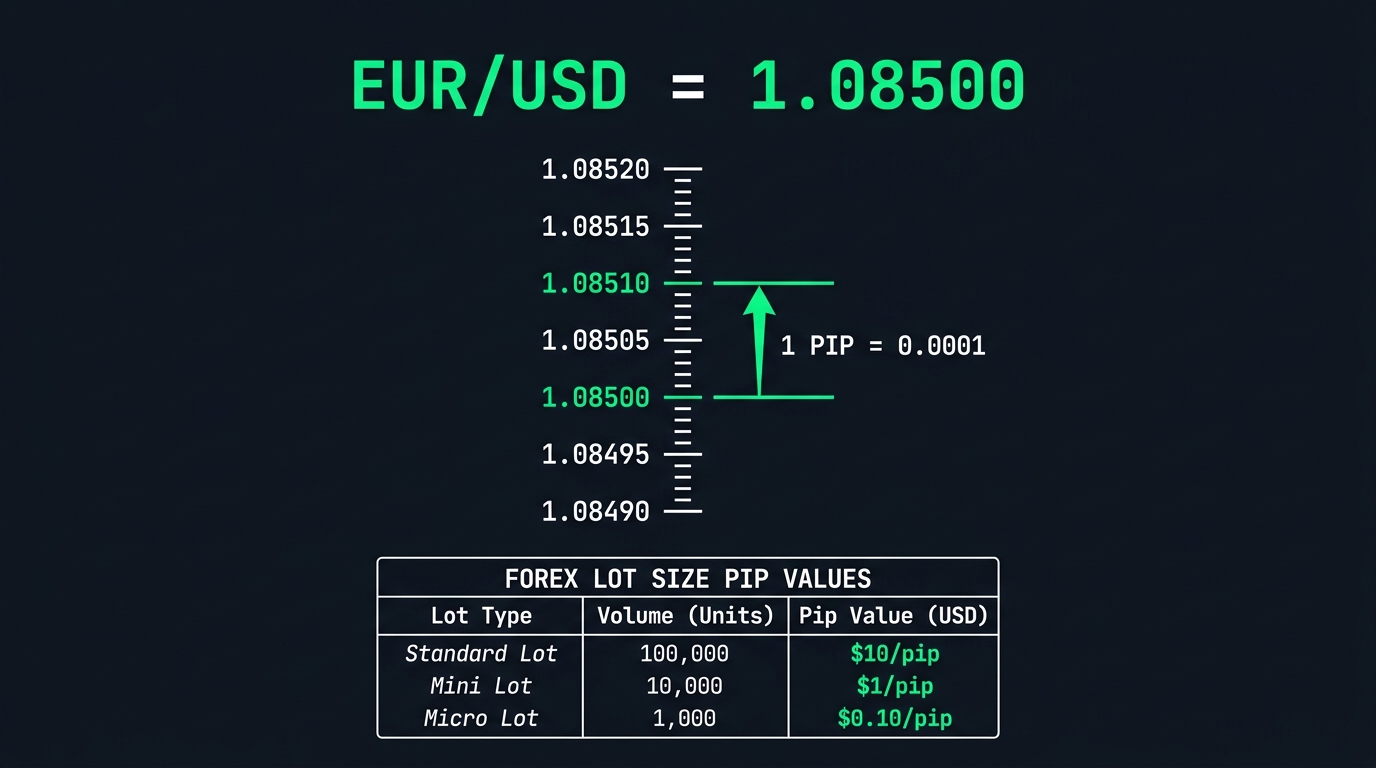
What is a Pip (Percentage in Point)?
In foreign exchange trading, a pip, an acronym for Percentage in Point or Price Interest Point, is the standardized unit of measurement used to quantify the change in value between two currencies.
Historically, a pip represented the smallest increment by which a currency quote could fluctuate in interbank wholesale foreign exchange markets. For the vast majority of currency pairs, a single pip corresponds to a price movement in the fourth decimal place ($0.0001$), which is equivalent to one-hundredth of one percent ($1/100$ of $1%$), or one basis point ($1\text{ bps}$).
A major exception occurs in currency pairs involving the Japanese Yen (JPY) and a few other selected currencies, where exchange rates are traditionally quoted to only two decimal places. In these pairs, one pip corresponds to a price change in the second decimal place ($0.01$).
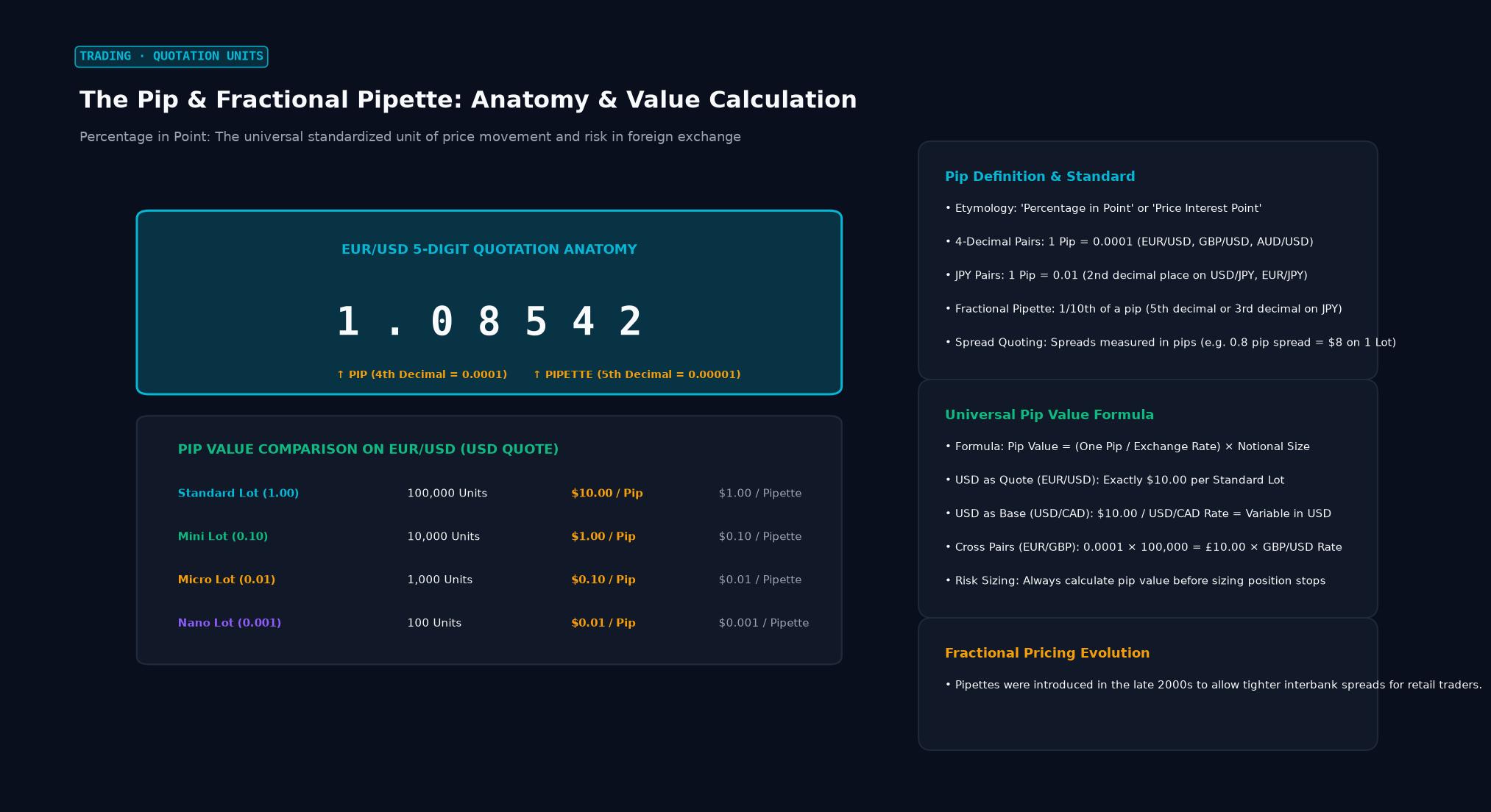 Figure: Percentage in Point: The universal standardized unit of price movement and risk in foreign exchange
Fractional Pips (Pipettes): The Rise of Electronic Pricing
With the development of high-frequency electronic communications networks (ECNs) and aggregated multi-bank liquidity feeds, retail and institutional brokers began quoting exchange rates with greater precision. This led to the introduction of fractional pips, commonly known as pipettes.
EUR/USD Quoted to 5 Decimals:
       1 . 0 8 5 4 3
                   ▲
                   │
                   └── Fractional Pip (Pipette = 3 tenths of a pip)
                 ▲
                 │
                 └──── Standard Pip Location (4th Decimal)
A pipette is exactly one-tenth of a standard pip ($0.1\text{ pip}$):
- In four-decimal pairs, a pipette appears as the fifth decimal digit ($0.00001$).
- In Japanese Yen pairs, a pipette appears as the third decimal digit ($0.001$).
On modern trading terminals (such as MetaTrader, cTrader, or Bloomberg FIT), brokers display the pipette as a smaller, subscripted, or superscripted final numeral. Fractional pricing allows liquidity providers to quote tighter bid-ask spreads (such as $0.6$ or $1.2$ pips rather than rounded integer spreads like $1$ or $2$ pips), reducing transaction costs for active traders.
Mathematical Derivation of Pip Value
While pips represent price increments on a chart, traders must translate pips into cash currency to manage risk, determine profit and loss, and establish correct position sizing.
The financial value of a pip depends on three variables:
- The currency pair traded.
- The trade volume (lot size).
- The base currency of the trader’s funded account.
+------------------------------------------------------------------------------------+
|                         STANDARD FOREX LOT CLASSIFICATIONS                         |
+---------------------+-----------------------+--------------------------------------+
| LOT DESIGNATION     | CONTRACT UNITS        | PIP VALUE (EUR/USD in USD Account)   |
+---------------------+-----------------------+--------------------------------------+
| Standard Lot        | 100,000 Units         | $10.00 per pip                       |
| Mini Lot            | 10,000 Units          | $1.00 per pip                        |
| Micro Lot           | 1,000 Units           | $0.10 per pip                        |
| Nano Lot            | 100 Units             | $0.01 per pip                        |
+---------------------+-----------------------+--------------------------------------+
Scenario 1: Account Currency Matches the Quote (Counter) Currency
When the account’s base currency is identical to the quote currency of the pair (the second currency in the pair symbol), the calculation is straightforward. The pip value is fixed and does not fluctuate with the exchange rate:
$$\text{Pip Value} = \text{Pip Decimal Increment} \times \text{Position Units}$$
Example: EUR/USD in a USD Account
- Lot Size: 1 Standard Lot ($100,000$ base units).
- Pip Increment: $0.0001$.
$$\text{Pip Value} = 0.0001 \times 100,000 = $10.00 \text{ per pip}$$
If the trader opens a 2.5 standard lot position ($250,000$ units), each pip movement equals:
$$\text{Pip Value} = 0.0001 \times 250,000 = $25.00 \text{ per pip}$$
Scenario 2: Account Currency Matches the Base Currency
When the account currency is the base currency (the first currency in the pair symbol), such as trading USD/CAD or USD/CHF in a USD-denominated account, the pip value fluctuates inversely with the exchange rate:
$$\text{Pip Value (in USD)} = \frac{\text{Pip Increment}}{\text{Exchange Rate}} \times \text{Position Units}$$
Example: USD/CAD at 1.3650
- Lot Size: 1 Standard Lot ($100,000$ units).
- Current Exchange Rate: $1.3650$.
$$\text{Pip Value} = \frac{0.0001}{1.3650} \times 100,000 = \frac{10}{1.3650} = $7.326 \text{ USD}$$
Scenario 3: Japanese Yen Pairs in a USD Account
For pairs such as USD/JPY, the pip increment is $0.01$:
$$\text{Pip Value (in USD)} = \frac{0.01}{\text{USD/JPY Rate}} \times \text{Position Units}$$
Numerical Walkthrough: USD/JPY at 155.00
- Lot Size: 1 Standard Lot ($100,000$ units).
- Current Exchange Rate: $155.00$.
$$\text{Pip Value} = \frac{0.01}{155.00} \times 100,000 = \frac{1,000}{155.00} = $6.4516 \text{ USD}$$
When the Japanese Yen strengthens and the exchange rate drops to $140.00$, the pip value rises:
$$\text{Pip Value at 140.00} = \frac{1,000}{140.00} = $7.1428 \text{ USD}$$
Scenario 4: Cross Currency Pairs
When neither the base nor quote currency matches the trader’s account denomination (e.g., trading EUR/GBP in a USD account), the pip value is calculated in the quote currency first, then converted to the account currency using the prevailing market exchange rate:
Step 1: Calculate Pip Value in Quote Currency (GBP)
1 Standard Lot EUR/GBP = 0.0001 x 100,000 = £10.00 GBP per pip

Step 2: Convert Quote Currency (GBP) to Account Currency (USD)
Assume GBP/USD Rate = 1.2800
Pip Value in USD = £10.00 x 1.2800 = $12.80 USD per pip
Pips in Risk Management and Position Sizing
In professional trading, pips form the foundation of mathematical position sizing. Professional risk management dictates that a trader should never determine trade size based on subjective feelings or static lot sizes. Instead, position size must be derived directly from the stop-loss distance in pips relative to capital at risk.
       Step 1: Determine Capital Risk Threshold
       (e.g., 1.0% of a $50,000 Account = $500 Max Risk)
                            │
                            ▼
       Step 2: Identify Technical Stop-Loss in Pips
       (e.g., Support Level Sits 25 Pips Below Entry)
                            │
                            ▼
       Step 3: Solve for Maximum Position Lot Size
       Units = Risk Capital / (Stop Loss Pips x Pip Value per Unit)
                            │
                            ▼
       Result: Execute Exact Math-Driven Order Volume
The Position Sizing Formula
To calculate the permissible trade volume:
$$\text{Position Volume (Lots)} = \frac{\text{Account Capital} \times \text{Risk Percentage}}{\text{Stop-Loss Distance (in Pips)} \times \text{Pip Value per Standard Lot}}$$
Applied Practical Example:
- Trading Account Equity: $$100,000$ USD
- Maximum Permitted Risk per Trade: $1.5%$ ($$1,500$ USD)
- Currency Pair: EUR/USD (where $1\text{ Standard Lot Pip Value} = $10.00$)
- Technical Chart Stop-Loss Distance: $40\text{ pips}$
$$\text{Permissible Lots} = \frac{$1,500}{40 \times $10.00} = \frac{$1,500}{$400} = 3.75 \text{ Standard Lots}$$
By executing exactly 3.75 standard lots, the trader guarantees that if the market hits the stop-loss order 40 pips away, the realized loss will equal the planned $$1,500$ risk budget, preserving portfolio equity.
Measuring Trading Costs: Spread and Slippage in Pips
Pips serve as the universal metric for evaluating execution efficiency and broker transaction overhead.
+------------------------------------------------------------------------------------+
|                         TRADING FRICTION MEASURED IN PIPS                          |
+-------------------+----------------------------------------------------------------+
| FRICTION TYPE     | IMPACT ON PROFITABILITY                                        |
+-------------------+----------------------------------------------------------------+
| Bid-Ask Spread    | Immediate negative hurdle upon trade entry.                    |
|                   | Example: Buying at 1.0852 when bid is 1.0850 = 2.0 Pip Hurdle.|
+-------------------+----------------------------------------------------------------+
| Execution Slippage| Difference between requested price and executed fill price.    |
|                   | High news volatility can cause 5 to 20 pips of slippage.       |
+-------------------+----------------------------------------------------------------+
| Commission Equiv. | ECN commissions expressed in pip terms (e.g., $3.50/lot round  |
|                   | turn on EUR/USD is equivalent to a 0.35 pip spread cost).      |
+-------------------+----------------------------------------------------------------+
Calculating Profit and Loss (P&L) from Pips
To compute the total profit or loss on a closed foreign exchange position:
$$\text{Gross P&L (USD)} = (\text{Exit Price} - \text{Entry Price}) \times \frac{\text{Total Position Units}}{\text{Exchange Rate Factor}}$$
For direct USD quote pairs (e.g., EUR/USD):
$$\text{Gross P&L} = \text{Total Pips Gained or Lost} \times \text{Pip Value per Lot} \times \text{Number of Lots}$$
If a trader goes long 5.0 standard lots of EUR/USD at $1.0820$ and closes the position at $1.0885$:
- Pips Gained: $1.0885 - 1.0820 = 0.0065 = 65\text{ pips}$
- P&L: $65 \times $10.00 \times 5.0 = $3,250\text{ USD}$ profit.
Key Takeaways
- Standard Forex Metric: A pip (Percentage in Point) is the standard unit of currency price fluctuation, typically equaling $0.0001$ in four-decimal pairs and $0.01$ in two-decimal Japanese Yen pairs.
- Fractional Pipettes: Modern electronic brokers quote an extra decimal place ($0.00001$ or $0.001$), known as a pipette or fractional pip, allowing for sub-pip spread pricing.
- Dynamic Cash Valuation: While one standard lot on EUR/USD carries a constant $$10.00$ pip value in a USD account, pairs where the USD is the base currency (such as USD/CAD or USD/JPY) have pip values that adjust inversely with the exchange rate.
- Foundation of Risk Control: Institutional risk frameworks use pip stop-loss distances to calculate position size, ensuring that portfolio capital exposure remains constant regardless of market volatility.
- Transaction Cost Benchmark: Spreads, slippage, and ECN commissions are measured in pips, allowing traders to evaluate transaction overhead across competing brokers and liquidity venues.
Frequently Asked Questions (FAQ)
Why do Japanese Yen (JPY) pairs have pips in the second decimal place instead of the fourth?
Currency pairs involving the Japanese Yen use the second decimal place ($0.01$) for a pip because the historical purchasing power of a single Yen was comparable to one cent ($0.01$) in major Western currencies like the US Dollar, British Pound, or Euro. Because one USD typically buys more than 100 Japanese Yen, quoting the Yen to four decimal places was unnecessary in early foreign exchange markets. A move from $150.00$ to $150.01$ represents a one-pip change, carrying the same proportional percentage impact as a move from $1.0850$ to $1.0851$ in EUR/USD.
What is the difference between a pip and a basis point (bps)?
In foreign exchange trading for pairs quoted to four decimal places (like EUR/USD), one pip and one basis point (bps) represent the exact same mathematical value: $0.0001$, or one-hundredth of one percent ($0.01%$). The term “pip” is used primarily in retail and interbank spot foreign exchange trading. In contrast, “basis point” is used across broader financial markets, including central bank interest rates, fixed income bond yields, and swap spreads (for instance, a central bank raising interest rates by 25 basis points from $5.00%$ to $5.25%$).
How do I calculate the pip value for gold (XAU/USD) or crude oil?
While commodities like spot gold (XAU/USD) and crude oil (WTI or Brent) are traded on foreign exchange platforms, they are quoted in dollars and cents rather than traditional currency pips. For spot gold (XAU/USD), price movements are measured in dollars and cents per troy ounce. Most brokers treat a $$0.01$ move in gold as one pip (or point), while others treat a $$0.10$ or $$1.00$ movement as a full point. On a standard 100-ounce gold contract, a $$0.01$ price shift equals $$1.00$ USD in cash value, and a $$1.00$ change in the price of gold equals $$100.00$ USD of profit or loss.
Ready to trade forex?
Open a free demo account with a regulated broker. Practice with virtual funds before risking real money.