Profit & Loss (P&L)
Profit & Loss (P&L)—frequently written as PnL—is the foundational financial metric that quantifies the net monetary gain or loss generated from trading, investing, or commercial operations over a defined period, divided into realized and unrealized (floating) components.
What Is Profit & Loss (P&L)?
In financial trading, corporate accounting, and portfolio management, Profit & Loss (P&L)—universally abbreviated as PnL—is the primary measure of bottom-line financial performance. It represents the net algebraic difference between aggregate revenues (or trade gains) and total expenses (or trade losses) incurred across a designated period.
In active trading markets (including spot forex, equities, commodities, and derivatives), P&L exists in two continuous states:
- Unrealized P&L (Floating / Mark-to-Market): The paper profit or loss generated by currently active, unsettled positions. It fluctuates tick-by-tick in real time as market quotations move.
- Realized P&L (Booked / Settled): The permanent cash gain or loss crystallized the moment an open position is officially closed through an offsetting transaction or delivery. Once realized, the funds are credited or debited directly to the account cash balance.
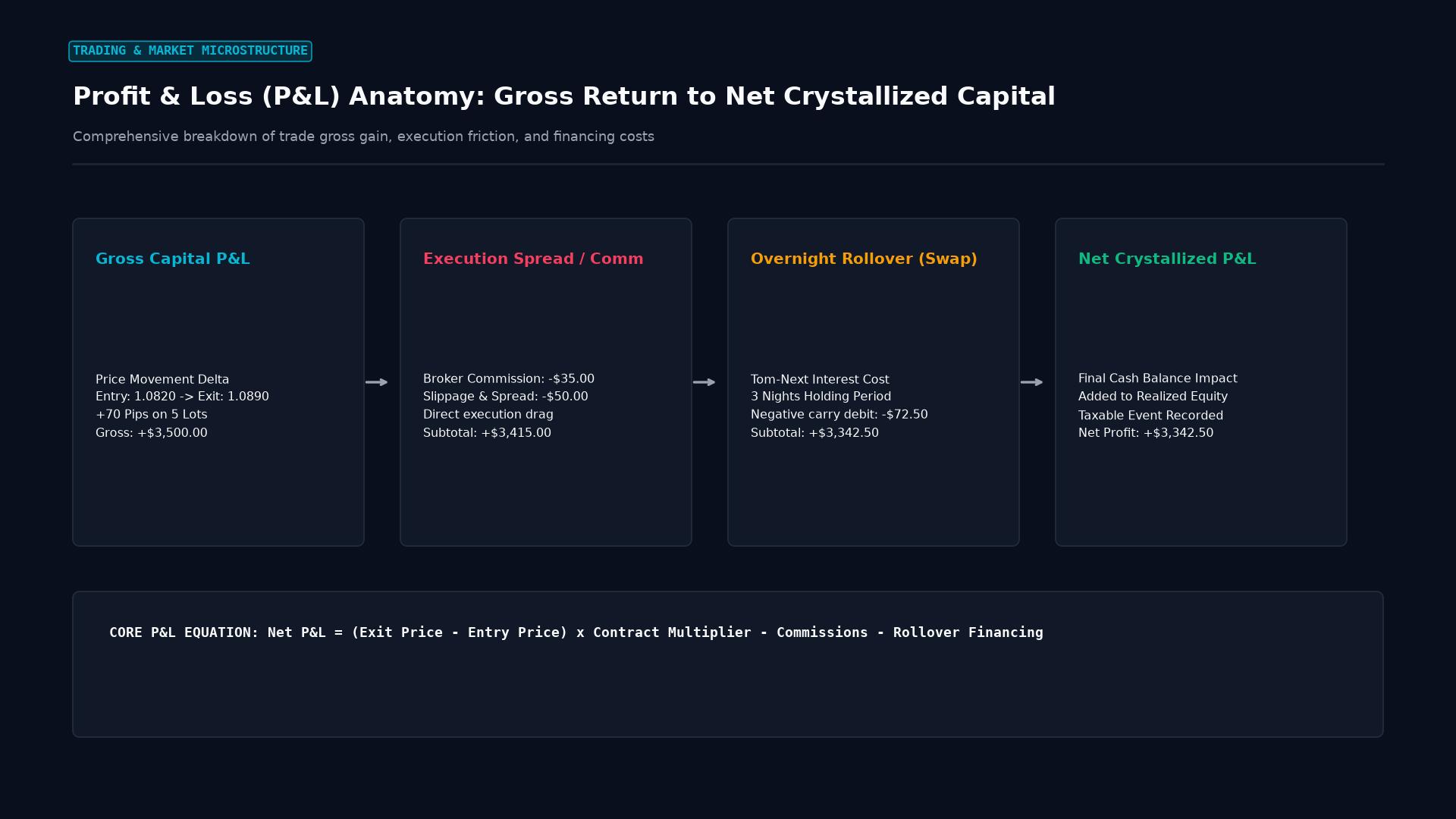 Figure: P&L lifecycle: gross capital returns adjusted for bid-ask spreads, commissions, and overnight financing swaps to derive net crystallized cash P&L.
Realized vs. Unrealized P&L: Structural Comparison
Understanding the operational boundary between realized and unrealized performance is essential for risk control:
| Operational Dimension | Unrealized P&L (Floating / MTM) | Realized P&L (Closed / Booked) |
|---|---|---|
| Position Status | Active, open market commitment. | Closed via offsetting trade or expiration. |
| Cash Availability | Cannot be withdrawn; subject to immediate market reversal. | Fully settled; immediately available for withdrawal or new allocation. |
| Account Metric Impact | Directly impacts Account Equity tick-by-tick. | Permanently adjusts the static Account Balance. |
| Margin Interaction | Determines Margin Level % and buffers against Margin Calls. | Reconciles margin collateral; unlocks tied-up maintenance margin. |
| Tax Liability | Tax-deferred in most cash jurisdictions until realized. | Triggers a statutory taxable capital gains or loss event. |
$$\text{Account Equity} = \text{Account Balance} + \text{Unrealized P&L}$$
$$\text{Free Margin} = \text{Account Equity} - \text{Used Margin}$$
Calculating P&L in Foreign Exchange
In foreign exchange trading, calculating P&L requires converting price movement into currency units based on lot size, pip movement, and exchange rates:
$$\text{Gross P&L (in Quote Currency)} = (\text{Exit Price} - \text{Entry Price}) \times \text{Position Notional}$$
Example 1: Direct Pair (Account Denominated in Quote Currency)
- A trader buys 2.0 standard lots ($200,000) of EUR/USD at 1.0820 and sells to close at 1.0875 (+55 pips).
- Because the account is in USD (the quote currency): $$\text{P&L} = (1.0875 - 1.0820) \times 200{,}000 = 0.0055 \times 200{,}000 = \mathbf{+$1{,}100 \ \text{USD}}$$
Example 2: Indirect Pair (Converting Cross-Currency P&L to Base)
- A trader buys 1.0 standard lot of EUR/GBP at 0.8550 and exits at 0.8600 (+50 pips).
- Account is in USD.
- Step 1: Calculate P&L in Quote Currency (GBP): $$\text{P&L in GBP} = (0.8600 - 0.8550) \times 100{,}000 = \mathbf{+£500 \ \text{GBP}}$$
- Step 2: Convert GBP profit to USD at prevailing GBP/USD spot rate (e.g., 1.2700): $$\text{P&L in USD} = £500 \times 1.2700 = \mathbf{+$635 \ \text{USD}}$$
Net P&L: Factoring in Transaction Frictions
Gross trading profit does not equal the money that enters a trader’s bank account. Net P&L deducts all operational friction:
$$\text{Net P&L} = \text{Gross P&L} - (\text{Commissions} + \text{Spread Costs} + \text{Financing/Swap Fees})$$
| Friction Component | Calculation Impact | Mitigation Technique |
|---|---|---|
| Bid-Ask Spread | Immediate negative P&L incurred upon trade entry. | Trade during peak London/New York session overlap when spreads are tightest. |
| Rollover / Swap Fees | Daily debit or credit applied at 5:00 PM EST for positions held overnight. | Align trades with positive carry interest differentials, or trade intraday. |
| Broker Commission | Fixed dollar per lot charged by ECN/STP brokers (e.g., $7/lot round-turn). | Negotiate institutional volume discounts with prime brokers. |
Real-World Case Study: The Danger of Confusing Unrealized with Realized P&L
In early 2020, an independent commodity trader held an aggressive long position of 50 contracts of Crude Oil futures during the onset of global pandemic lockdowns:
- The Floating Drawdown: As crude oil prices plunged from $50/barrel to $20/barrel, the trader’s unrealized P&L plummeted to -$1,500,000.
- The Cognitive Error: Believing that “it is only a paper loss until I sell,” the trader refused to realize the loss, transferring emergency personal savings into the brokerage account to prevent liquidation.
- The Historic Anomaly: On April 20, 2020, physical storage at Cushing, Oklahoma ran completely out of capacity. For the first time in history, the May WTI contract plunged into negative territory, settling at -$37.63 per barrel.
- The Forced Liquidation: The brokerage risk engine automatically executed forced market sell orders as account equity was completely wiped out.
- The Result: The paper loss instantly converted into a catastrophic realized P&L of -$2,800,000, bankrupting the trader. The event proved that unrealized P&L is not an imaginary figure—it represents real-time capital solvency.
Frequently Asked Questions
Can my unrealized P&L exceed my account balance?
Yes, in the negative direction if you are trading without guaranteed stop-losses during extreme weekend gaps or flash crashes. However, under modern regulatory frameworks (such as ESMA rules in Europe or ASIC in Australia), regulated retail brokers are mandated to provide Negative Balance Protection, ensuring you cannot lose more than your deposited balance.
What is Daily P&L vs. Inception-to-Date (ITD) P&L?
- Daily P&L: The change in your total account equity over the past 24-hour trading session (from yesterday’s 5:00 PM EST close to today’s close).
- Inception-to-Date (ITD) P&L: The cumulative net profit or loss generated across the entire lifetime of the trading account since its initial opening deposit.
How is trading P&L taxed in the United States?
In the US, retail spot forex trading typically falls under IRC Section 988 (taxed as ordinary income at your marginal bracket). However, traders can elect to opt out of Section 988 into IRC Section 1256, which taxes eligible futures and currency contracts under an advantageous 60/40 blend (60% long-term capital gains, 40% short-term capital gains).
Ready to trade forex?
Open a free demo account with a regulated broker. Practice with virtual funds before risking real money.