Ratio Spread
A ratio spread is an advanced multi-leg options strategy that involves the simultaneous purchase of a specific number of options contracts and the sale (writing) of a larger number of options contracts of the exact same type, underlying asset, and expiration date at a different strike price.
What Is a Ratio Spread?
In quantitative derivatives trading, a ratio spread (commonly termed a front spread) is an asymmetric, multi-leg options strategy engineered to capitalize on moderate directional movements while drastically reducing upfront capital outlay or establishing a net cash credit.
Unlike a standard vertical spread (such as a 1:1 bull call spread where one contract is bought and exactly one contract is sold), a ratio spread involves an unbalanced ratio of contracts—most commonly a 2:1 ratio or 3:2 ratio:
- The trader buys a smaller number of contracts at a strike price closer to the current market price (In-the-Money or At-the-Money).
- The trader sells (writes) a larger number of contracts of the exact same type (calls or puts) and expiration date at a strike price further out-of-the-money.
Because the trader sells more contracts than they purchase, the premium collected from the multiple short legs often completely offsets the cost of the long leg, allowing the position to be entered for zero cost (even money) or a net cash credit. However, the extra unsold short leg exposes the position to naked tail risk if the underlying asset stages an extreme, runaway move.
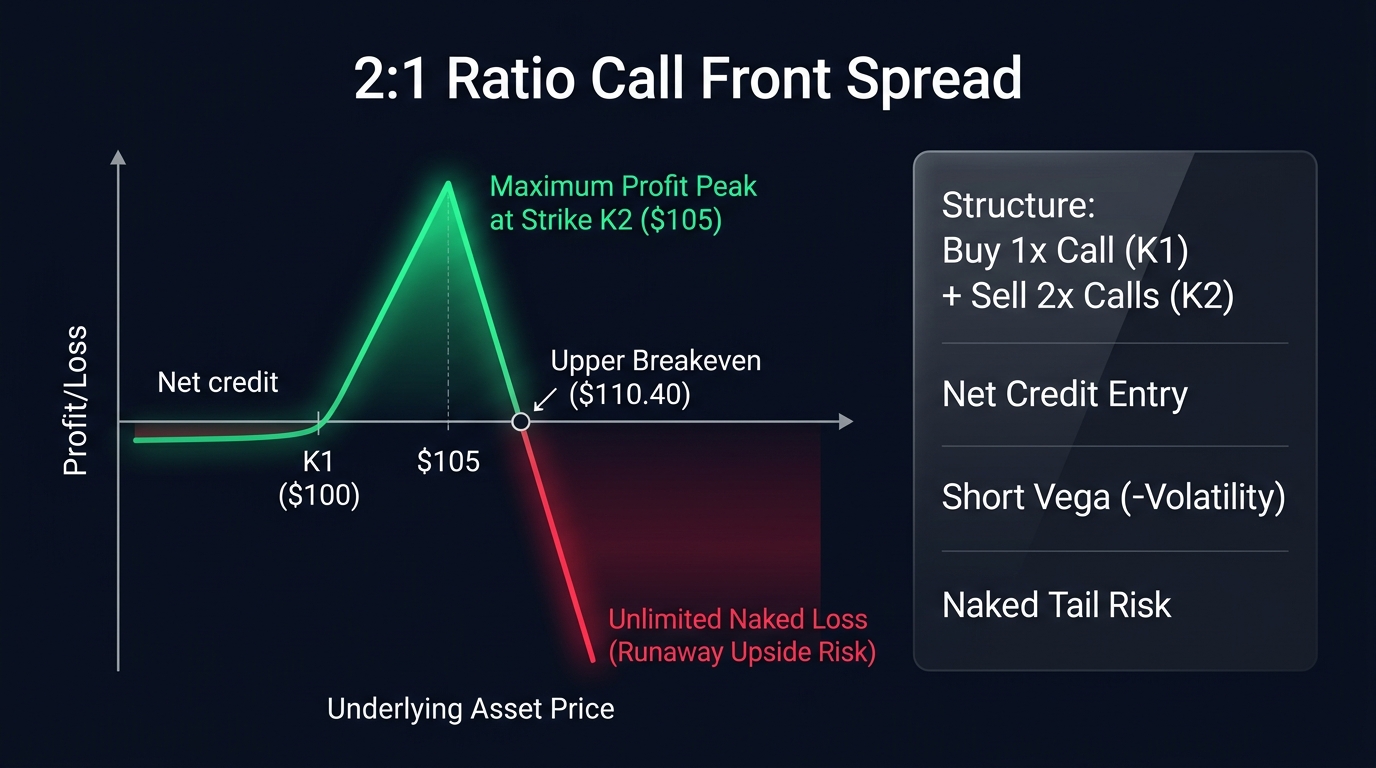
                    2:1 RATIO CALL SPREAD ARCHITECTURE

  Underlying Spot Price: $100.00
  -------------------------------------------------------------
  Leg 1 (Long):  BUY 1x $100 Call  ---> Pays $4.00 Debit (-$400)
  Leg 2 (Short): SELL 2x $105 Calls ---> Collects $2.20 x 2 = +$4.40 Credit (+$440)
  -------------------------------------------------------------
  NET ENTRY: +$0.40 Net Cash Credit Received (+$40 per spread)

  [PAYOFF STATES AT EXPIRATION]
  - If Price < $100: All options expire worthless; KEEP $0.40 Credit!
  - If Price = $105: MAXIMUM PROFIT PEAK ($5.00 spread + $0.40 = $5.40 / $540)
  - If Price > $110.40: Upper Breakeven breached; UNLIMITED NAKED LOSS!
The Two Primary Archetypes: Call vs. Put Ratio Spreads
Ratio spreads are deployed in either call or put variations depending on the trader’s directional bias:
1. Ratio Call Spread (2:1 Call Front Spread)
- Construction: Buy 1 lower-strike Call ($K_1$) $+$ Sell 2 higher-strike Calls ($K_2$).
- Market Outlook: Mildly to moderately bullish. The trader anticipates that the asset will advance toward $K_2$ by expiration, but will not explode significantly past it.
- Downside Risk: Zero (if established for a net credit). If the market collapses, the trader retains the net credit.
- Upside Risk: Mathematically Unlimited. Because one short call is naked (uncovered by the single long call), runaway parabolic rallies will generate severe losses beyond the upper breakeven.
2. Ratio Put Spread (2:1 Put Front Spread)
- Construction: Buy 1 higher-strike Put ($K_2$) $+$ Sell 2 lower-strike Puts ($K_1$).
- Market Outlook: Mildly to moderately bearish. The trader anticipates a gentle downward drift or consolidation, but does not expect a catastrophic market crash.
- Upside Risk: Zero (if established for a credit). If the stock rallies, all puts expire worthless, and the trader keeps the credit.
- Downside Risk: Substantial. If the market plunges below the lower breakeven point, the trader faces mounting naked losses down to zero.
Payoff Profile and Key Formulas
For a standard 2:1 Ratio Call Spread entered at a net credit ($C_{\text{net}}$):
$$\text{Maximum Profit} = (K_2 - K_1) + C_{\text{net}}$$
$$\text{Maximum Profit Location} = \text{Exactly at Strike } K_2 \text{ at Expiration}$$
$$\text{Upper Breakeven Price} = K_2 + (K_2 - K_1) + C_{\text{net}} = 2K_2 - K_1 + C_{\text{net}}$$
                     2:1 RATIO CALL SPREAD PAYOFF PROFILE

    Profit ($)
        ^
   +$540|                         * Max Profit Peak ($540 at $105 Strike)
        |                        / \
        |                       /   \
     +$40+---------------------*     \
        |                      |      * Breakeven ($110.40)
      $0+----------------------+-------\---------------------> Underlying Price ($)
        |                     $100    $105\
        |                     Strike  Strike\
        v                                    \ (Naked Call Risk Accelerates)
      Loss                                    v Unlimited Downside!
Strategic Comparison: Ratio Spread vs. Bull Call Spread vs. Iron Condor
Quantitative desks contrast ratio spreads against traditional option combinations based on volatility and tail exposure:
| Strategy | Structure | Upfront Capital | Profit Zone | Worst-Case Tail Risk | Volatility Exposure (Vega) |
|---|---|---|---|---|---|
| Ratio Call Spread (2:1) | Buy 1 ATM Call $+$ Sell 2 OTM Calls | Zero / Net Credit | Moderately higher price | Unlimited to the upside | Negative Vega ($\nu < 0$) above short strike |
| Standard Bull Call Spread | Buy 1 ATM Call $+$ Sell 1 OTM Call | Net Debit Paid | Any price above short strike | Strictly Capped (Limited to debit paid) | Minimal net Vega |
| Iron Condor | 4-Leg Defined-Risk Credit Spread | Net Credit Collected | Range-bound sideways | Strictly Capped by outer protective wings | Negative Vega across all strikes |
Real-World Case Study: Ratio Call Spread on Tech Earnings
In October 2023, an options trader analyzed a major enterprise software stock trading at $200 ahead of quarterly earnings:
- The View: The trader expected a positive earnings report that would drive the stock up 4% to 5% toward $210, but believed an aggressive 10%+ rally was impossible given macroeconomic head-winds. Implied Volatility (IV) was highly elevated ahead of the report.
- The Execution: The trader initiated a 2:1 Ratio Call Spread expiring in 3 weeks:
- Buy 10x $200 Calls for $6.00 ($6,000 debit).
- Sell 20x $210 Calls for $3.20 ($6,400 credit).
- Net Credit Collected: $400 USD ($0.40 per spread).
- The Outcome: The company reported solid numbers, and the stock rallied to close at $209.50 on expiration Friday.
- Financial Result:
- The short $210 Calls expired completely worthless ($0.00).
- The long $200 Calls were worth $9.50 intrinsic value ($9,500 total).
- Total Realized Profit: $9,500 + $400 initial credit = +$9,900 USD on a zero-down trade.
- The Risk Realized: Had the stock surged unexpectedly to $230 on a blowout AI forecast, the position would have suffered a severe loss of -$9,600, illustrating why disciplined traders only deploy ratio spreads with active stop-loss exits.
Frequently Asked Questions
What happens if an asset drops to zero in a Ratio Call Spread?
If the asset collapses to zero, both the long call and the two short calls expire completely out-of-the-money with zero value. If you established the ratio spread for a net credit, you keep 100% of that cash credit as profit. If entered for a small debit, your maximum loss is strictly limited to that debit.
Does a ratio spread require a margin account?
Yes, absolutely. Because a 2:1 ratio spread involves writing more short options than long options, the extra short contract is classified as an uncovered (naked) option. Brokerage risk gateways mandate a top-tier margin account (Tier 3 or Portfolio Margin) with substantial free collateral to absorb potential assignment obligations.
What is a “Backspread”?
A backspread (or reverse ratio spread) is the exact opposite of a ratio spread. In a backspread, the trader sells fewer contracts near the money and buys a larger number of contracts further out-of-the-money (e.g., Sell 1 ATM Put, Buy 2 OTM Puts). It is a long-volatility strategy that profits from violent, explosive market breakouts.
Ready to trade forex?
Open a free demo account with a regulated broker. Practice with virtual funds before risking real money.