Recession
A recession is a significant, pervasive, and sustained decline in economic activity across an entire economy, typically marked by contracting gross domestic product (GDP), rising unemployment, and declining industrial production.
A recession represents a contractionary phase in the business cycle where aggregate macroeconomic activity shrinks for an extended period. Rather than an isolated downturn in a single industry, a true recession permeates consumer demand, corporate earnings, retail trade, industrial output, and the labor market.
In global currency markets, recessions trigger massive capital reallocations. Currency traders track recession indicators closely because central bank responses—such as aggressive emergency interest rate cuts and quantitative easing—reshape global interest rate differentials and ignite multi-month forex trends.
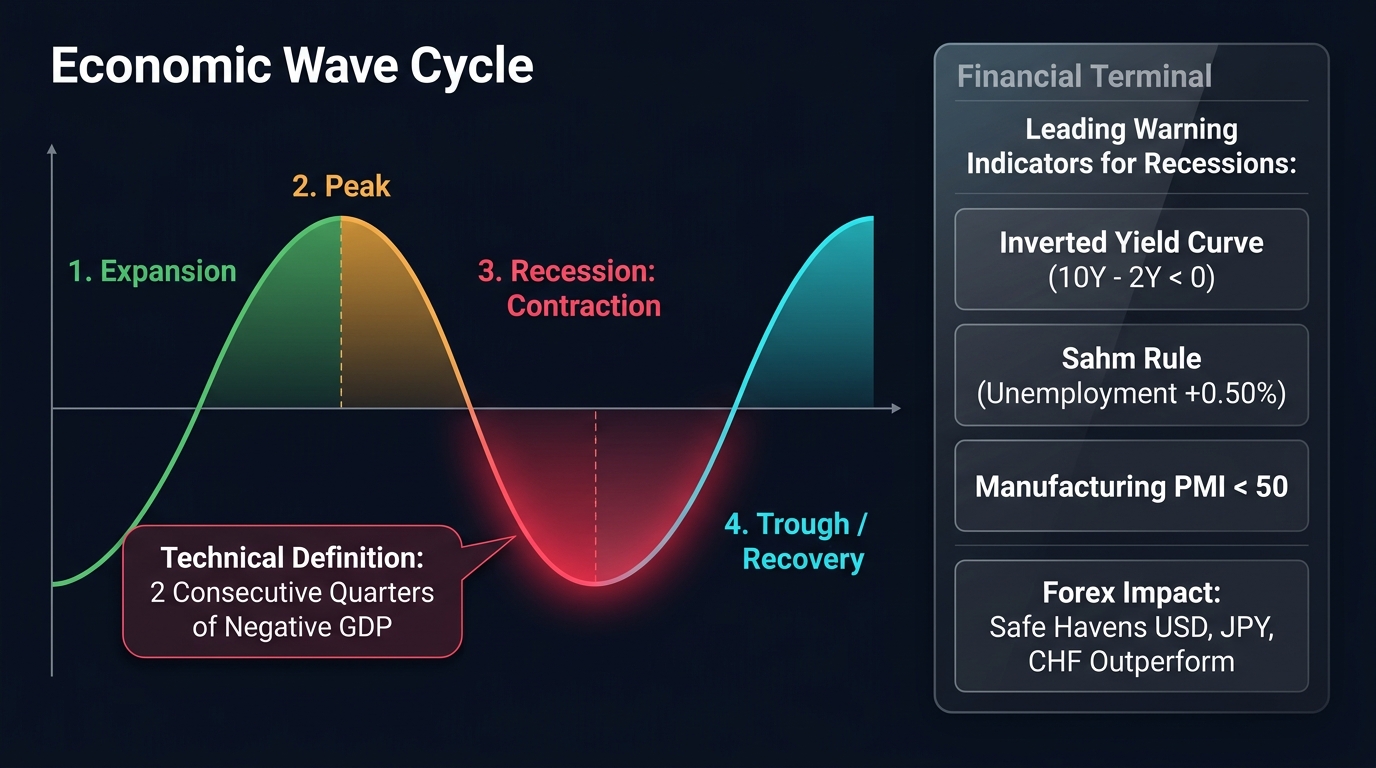
How Economists Define a Recession
There are two primary frameworks used to identify and declare a recession:
1. The Practical Rule of Thumb: Two Consecutive Quarters of Negative GDP
In widespread media and financial commentary, a technical recession is defined as two consecutive quarters of negative real Gross Domestic Product (GDP) growth. While simple to track, this backward-looking rule has limitations: an economy might experience massive job losses while technical GDP is distorted by volatile export data or inventory hoarding.
2. The Official NBER Framework
In the United States, recessions are officially determined by the Business Cycle Dating Committee of the National Bureau of Economic Research (NBER). The NBER defines a recession as “a significant decline in economic activity spread across the economy, lasting more than a few months.”
The committee evaluates three core criteria—depth, diffusion, and duration—across six monthly economic indicators:
- Real personal income less government transfers
- Non-farm payroll employment and household survey employment
- Real personal consumption expenditures
- Wholesale and retail sales adjusted for price changes
- Industrial production index
- Monthly Gross Domestic Output (GDO)
Proven Warning Signals: The Recession Predictors
Financial markets anticipate recessions months before official statistics confirm them. Macro currency traders monitor specific leading indicators to position ahead of the curve:
| Leading Indicator | Economic Mechanism | Typical Lead Time |
|---|---|---|
| Yield Curve Inversion | 10-year Treasury yields drop below 2-year or 3-month yields, signaling expectations of future rate cuts | 6 to 18 months before recession onset |
| The Sahm Rule | 3-month moving average of national unemployment rises by $\ge 0.50%$ above its 12-month low | Real-time confirmation of recession start |
| Manufacturing PMI $< 50$ | Purchasing Managers’ Index contracts, reflecting shrinking factory orders and corporate destocking | 3 to 6 months lead time |
| Conference Board LEI | Leading Economic Index tracks credit, building permits, stock prices, and consumer expectations | 4 to 8 months lead time |
Forex Market Dynamics During a Recession
Recessions alter currency valuations through interest rate expectations, risk sentiment, and international terms of trade:
The “Dollar Smile” Theory
Developed by former Morgan Stanley currency strategist Stephen Jen, the Dollar Smile explains why the U.S. dollar behaves paradoxically during recessions:
- Left Side of the Smile (Global Recession): When a global recession or financial panic strikes, international capital rushes into U.S. Treasuries and cash for safety, driving the USD higher despite weak domestic conditions.
- Bottom of the Smile (Synchronized Growth): During stable, quiet global economic expansion, capital leaves the dollar to pursue higher returns in emerging markets and Europe, weakening the USD.
- Right Side of the Smile (U.S. Outperformance): When the U.S. economy leads global growth, aggressive Fed rate hikes pull foreign capital into the USD, driving it higher.
Safe-Haven vs. Pro-Cyclical Currencies
- Safe-Haven Assets (USD, JPY, CHF): Benefit from flight-to-safety flows and the liquidation of carry trades. When recession strikes, carry traders rapidly close positions, buying back low-yielding funding currencies like the Japanese Yen and Swiss Franc.
- Pro-Cyclical & Commodity Currencies (AUD, NZD, CAD): Suffer heavy devaluation during global recessions. As industrial manufacturing declines, raw commodity prices (copper, iron ore, crude oil) plummet, diminishing export revenues for resource-rich nations.
Central Bank Playbook: Counter-Cyclical Intervention
When a recession materializes, central banks enact aggressive counter-cyclical monetary policy:
- Aggressive Policy Rate Cuts: Lowering overnight interest rates toward the Zero Lower Bound to reduce commercial loan costs.
- Quantitative Easing (QE): Purchasing government debt on open markets to flatten long-term yields and stimulate bank lending.
- Emergency Liquidity Facilities: Opening foreign exchange swap lines with allied central banks to prevent dollar funding shortages.
Practical Example: Trading Recession Expectations on AUD/JPY
The AUD/JPY currency pair is considered the definitive risk-barometer in foreign exchange:
- Macro Backdrop: China’s manufacturing PMI contracts to 48.0, while commodity prices fall 25%. Global yield curves invert, signaling an imminent worldwide recession.
- The Catalysts Align:
- The Australian dollar weakens as export demand for iron ore slumps and the Reserve Bank of Australia signals rate cuts.
- The Japanese yen surges as global asset managers liquidate carry trades and seek refuge in domestic Japanese government bonds.
- Execution: A swing trader shorts AUD/JPY at 96.50 as it breaks below a 6-month horizontal support level:
- Stop-Loss: Placed above the broken breakdown structure at 98.20 (risking 170 pips).
- Take-Profit: Targeted at major psychological support at 89.00 (targeting 750 pips).
- Resolution: Over the next four months, global recession fears deepen. AUD/JPY drops to 88.50, delivering a better than 4:1 reward-to-risk return.
Key Takeaways
- Broad Economic Contraction: A recession is a pervasive, multi-month contraction in output, employment, and trade across an entire economy.
- Predictive Indicators: Inverted yield curves, the Sahm Rule, and sub-50 manufacturing PMIs provide reliable advance warnings.
- Currency Polarization: Recessions favor safe-haven currencies (USD, JPY, CHF) while hammering commodity-linked exporters (AUD, CAD, NZD).
- The Dollar Smile: The U.S. dollar strengthens during extreme global recessions due to its global reserve status and deep treasury liquidity.
- Monetary Response: Central banks fight recessions through swift interest rate reductions and balance sheet expansion.
Frequently Asked Questions
What is the difference between a recession and a depression?
A recession is a normal, cyclical contraction in the business cycle lasting typically between six and eighteen months. An economic depression is a prolonged, severe contraction characterized by a decline in GDP exceeding 10%, catastrophic unemployment rates above 20%, and systemic banking failures that can last for years.
How do currency pairs react to an inverted yield curve?
An inverted yield curve typically prompts institutional currency managers to reduce exposure to high-beta, emerging market, and commodity currencies. Capital rotates toward defensive liquidity anchors like the USD and CHF in anticipation of equity market drawdowns and central bank rate cuts.
Does a country’s currency always weaken when it enters a recession?
Not necessarily. While a domestic recession usually prompts rate cuts that weaken a currency, the U.S. dollar and Japanese Yen often appreciate during recessions because of their international roles as global safe havens and funding currencies.
Ready to trade forex?
Open a free demo account with a regulated broker. Practice with virtual funds before risking real money.