Stagflation
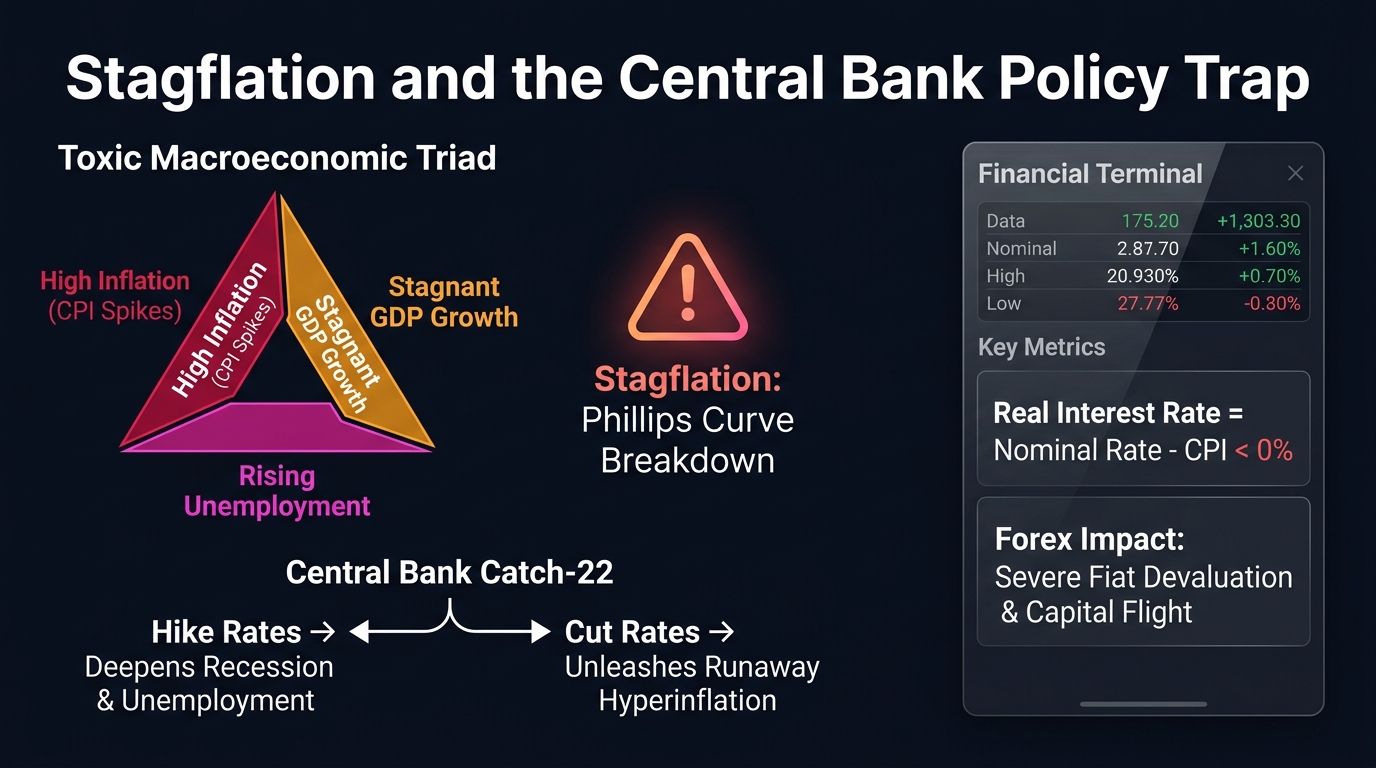
Stagflation is a toxic macroeconomic condition characterized by the simultaneous combination of stagnant economic growth, rising unemployment, and high consumer price inflation.
Stagflation—a term coined in 1965 by British politician Iain Macleod—represents one of the most destructive and difficult economic environments in modern macroeconomic history. It describes an economy plagued by two opposing economic ailments at the exact same time: stagnant or negative economic growth accompanied by stubborn, high inflation and rising joblessness.
For central bankers and currency markets, stagflation is a worst-case scenario. It invalidates traditional monetary policy playbooks, leaving central banks caught in an impossible policy trap that erodes national currency purchasing power and destabilizes foreign exchange valuations.
The Economic Paradox: Breaking the Phillips Curve
Prior to the 1970s, mainstream economic theory relied heavily on the Phillips Curve, which asserted an inverse relationship between inflation and unemployment:
Traditional Phillips Curve Trade-Off:
High Growth / Low Unemployment  ───►  High Inflation
Low Growth / High Unemployment   ───►  Low Inflation / Deflation
Under classical Keynesian economics, stagflation was considered mathematically impossible. Policymakers assumed that when unemployment rose, consumer demand would contract, automatically bringing prices down.
The 1970s global oil crises shattered this assumption. When global crude oil prices quadrupled following OPEC embargoes, production and transportation costs exploded across all industries. Companies were forced to cut workers while simultaneously raising product prices to survive, creating sky-high unemployment alongside double-digit inflation.
Primary Causes of Stagflation
Stagflation is almost never caused by organic consumer demand. Instead, it stems from structural disruptions:
- Negative Supply-Side Shocks: A sudden, catastrophic spike in the cost of critical commodities—such as crude oil, natural gas, fertilizer, or microchips—instantly drives up manufacturing and logistics costs while dampening consumer discretionary spending.
- Excessive Monetary Expansion Followed by Supply Bottlenecks: Flooding an economy with massive fiscal stimulus and ultra-low interest rates while production capacity is constrained creates an imbalance where “too much money chases too few goods.”
- De-Globalization and Trade Barriers: Imposing punitive tariffs, sanctions, or regulatory mandates fragments supply chains, structurally raising import costs while stunting domestic productivity.
The Central Bank Policy Dilemma
Stagflation places monetary authorities in an agonizing “Catch-22” where every conventional policy lever carries destructive side effects:
| Policy Choice | Central Bank Action | Intended Goal | Destructive Side Effect |
|---|---|---|---|
| Option A: The Inflation Fight | Aggressive Interest Rate Hikes | Cool consumer demand and restore price stability | Pushes heavily indebted businesses into bankruptcy, deepening the recession and surging unemployment. |
| Option B: The Growth Rescue | Emergency Rate Cuts & Liquidity Injection | Stimulate business investment and support jobs | Unleashes a second wave of hyperinflation, completely unanchoring inflation expectations and destroying currency value. |
Historically, central banks are forced to choose Option A—as Federal Reserve Chairman Paul Volcker did in 1979–1981 by hiking the Fed Funds rate to an unprecedented 20%, deliberately inducing a deep domestic recession to break the psychological back of inflation.
How Stagflation Impacts Currency Markets
In foreign exchange markets, currencies facing domestic stagflation typically suffer steep depreciation against commodities and peer currencies:
- Erosion of Real Yields: Even if a central bank hikes benchmark rates to 5%, an inflation rate of 10% yields a real interest rate of $-5%$ ($\text{Nominal Rate} - \text{Inflation Rate}$). International asset managers dump bonds and cash denominated in currencies with deeply negative real yields.
- Capital Flight into Hard Assets: Investors rotate capital away from fiat currencies suffering from stagflation into tangible inflation hedges such as gold, commodities, and currencies of net energy exporters (such as the Norwegian Krone or Canadian Dollar).
- Vulnerability of Import-Dependent Economies: Nations that import their energy and food (such as the UK, Japan, and the Eurozone) experience severe terms-of-trade degradation, depressing their exchange rates.
Practical Example: The British Pound Crisis (2022–2023)
The United Kingdom’s economic struggles in 2022 and 2023 provide a modern blueprint of stagflation in currency trading:
- The Shock: Following European geopolitical conflicts, European natural gas and electricity prices surged to record levels. UK headline CPI touched 11.1% in October 2022.
- Economic Stagnation: Simultaneously, UK real GDP stalled, consumer confidence plummeted to historical lows, and domestic productivity contracted.
- The Pound’s Collapse: The Bank of England was caught between a rock and a hard place, hiking interest rates into an economy that was already shrinking. Foreign investors doubted the UK’s ability to maintain high rates without triggering a housing collapse.
- Market Outcome: In September 2022, an unfinanced fiscal stimulus package unleashed a panic in UK government gilts. GBP/USD collapsed in a matter of weeks from 1.3000 down to an all-time low of 1.0350—a historic 2,600-pip rout driven by stagflation fears and fiscal credibility loss.
Key Takeaways
- The Toxic Triad: Stagflation combines stagnant economic output, high unemployment, and stubborn price inflation.
- Supply-Side Genesis: Typically triggered by severe commodity supply shocks (energy, food) or broken supply chains rather than economic overheating.
- The Central Bank Trap: Central banks cannot stimulate growth without accelerating inflation, nor can they fight inflation without deepening the recession.
- Real Yield Destruction: High inflation drives real yields into negative territory, prompting institutional capital to dump the afflicted currency.
- Commodity Currencies Resilient: Net resource and energy-exporting nations tend to outperform import-reliant currencies during global stagflation regimes.
Frequently Asked Questions
Can stagflation resolve itself naturally?
Rarely. Without intervention, stagflation can entrench itself through a “wage-price spiral,” where workers demand higher wages to keep up with living costs, and businesses raise prices further to cover labor costs. Overcoming stagflation usually requires painful monetary tightening to kill inflation, coupled with supply-side economic reforms.
What is the difference between stagflation and inflation?
Inflation simply means rising prices, which commonly occurs during strong, booming economic expansions when unemployment is very low. Stagflation is a specific crisis where prices surge while the underlying economy is actively shrinking and unemployment is high.
How do forex traders protect themselves against stagflation?
Forex traders hedge stagflation by shorting currencies of energy-importing nations and longing currencies of commodity exporters (like CAD and AUD), while allocating capital toward physical gold (XAU/USD), which historically preserves purchasing power during stagflationary regimes.
Ready to trade forex?
Open a free demo account with a regulated broker. Practice with virtual funds before risking real money.