Retail Prices Index (RPI)
The Retail Prices Index (RPI) is a long-standing British measure of consumer inflation published monthly by the Office for National Statistics (ONS) that tracks changes in the retail cost of a representative basket of household goods and services, historically incorporating mortgage interest payments.
What Is the Retail Prices Index (RPI)?
The Retail Prices Index (RPI) is the oldest continuous measure of consumer price inflation in the United Kingdom. First developed in 1947 to calculate the post-World War II cost of living for British working-class households, the index is published monthly by the Office for National Statistics (ONS).
While the modern Consumer Prices Index (CPI) is the official headline metric targeted by the Bank of England’s Monetary Policy Committee (targeting a 2.0% annual rate), the RPI remains deeply entrenched across British financial and legal infrastructure. It serves as the statutory benchmark for indexing coupon payments on over £500 billion of UK Index-Linked Gilts (sovereign bonds), calculating annual regulated rail fare increases, determining student loan interest rates, and setting commercial property lease escalation clauses.
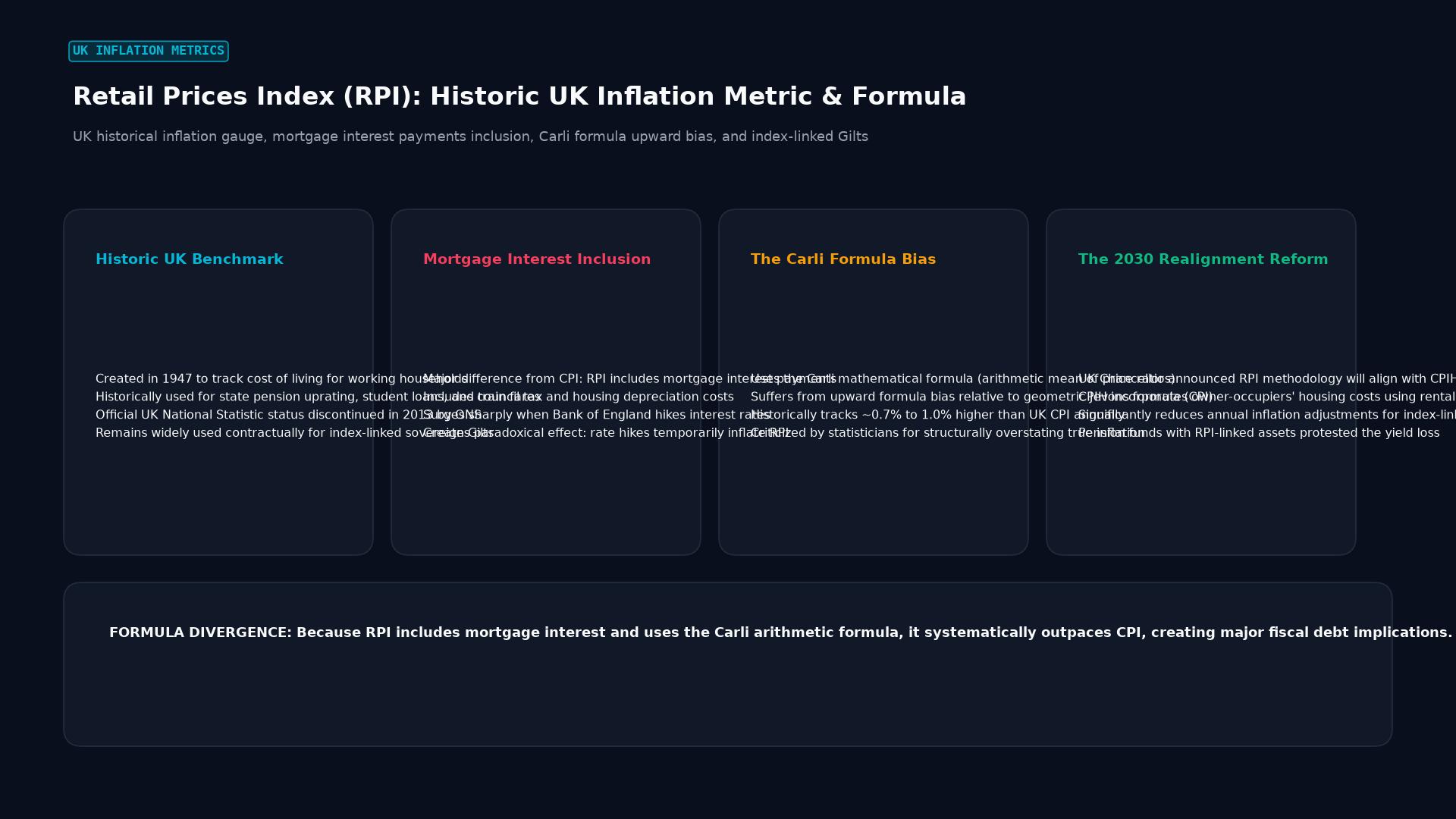 Figure: UK historical inflation gauge, mortgage interest payments inclusion, Carli formula upward bias, and index-linked Gilts
RPI vs. CPI: The Structural and Mathematical Divide
The Retail Prices Index consistently reports an annual inflation rate that is 0.7% to 1.2% higher than the headline Consumer Prices Index (CPI). This persistent divergence stems from two structural factors:
1. The “Formula Effect” (Carli vs. Jevons)
The most controversial element of RPI is its underlying mathematical formula:
- The Carli Formula (RPI): RPI calculates price changes using an arithmetic mean of price relatives: $$\text{Carli Index} = \frac{1}{n} \sum_{i=1}^n \left(\frac{P_{i,t}}{P_{i,0}}\right)$$ The Carli formula suffers from a mathematically proven upward statistical bias because it fails the time-reversal test (if prices bounce back and forth, the Carli index drifts upward artificially).
- The Jevons Formula (CPI): CPI utilizes a geometric mean: $$\text{Jevons Index} = \left(\prod_{i=1}^n \frac{P_{i,t}}{P_{i,0}}\right)^{\frac{1}{n}}$$ The geometric mean accounts for consumer substitution (consumers buying cheaper alternatives when a specific good’s price spikes), producing a statistically stable and lower inflation reading.
2. The Housing Component Difference
- Included in RPI: Directly includes Mortgage Interest Payments (MIPs), house depreciation, Council Tax, and estate agent fees. When the Bank of England raises interest rates, mortgage payments rise, causing the RPI to paradoxically increase in the short term.
- Excluded from CPI: Completely excludes mortgage interest payments and owner-occupier housing capital costs, aligning with international harmonized standards.
Detailed Comparison: UK Inflation Measures
The operational differences between RPI, CPI, and CPIH are summarized below:
| Feature | Retail Prices Index (RPI) | Consumer Prices Index (CPI) | CPIH |
|---|---|---|---|
| Statistical Formula | Carli (Arithmetic) — Has upward bias. | Jevons (Geometric) — Accounts for substitution. | Jevons (Geometric) |
| Housing Costs | Includes Mortgage Interest, Council Tax, Depreciation. | Excluded entirely. | Includes Owner-Occupiers’ Housing via Rental Equivalence. |
| Population Exclusions | Excludes top 4% highest earners and low-income pensioners. | Covers all private UK households, foreign tourists, institutions. | Covers all private UK households and communal institutions. |
| Official Status | De-listed: Stripped of “National Statistic” status in 2013. | Official National Statistic; Bank of England policy target. | ONS preferred comprehensive headline inflation measure. |
| Financial Role | UK Index-Linked Gilts, rail fares, student loan interest. | State pension “Triple Lock”, public sector pensions, wage talks. | Broad economic monitoring and national accounting. |
The Great Gilt Controversy and the 2030 Reform
Because the Carli formula flaw produces artificially elevated inflation prints, the UK Statistics Authority formally stripped RPI of its official “National Statistic” status in 2013, declaring it an inadequate and flawed measure.
However, the UK government could not easily abolish RPI:
- The UK Debt Management Office (DMO) has issued hundreds of billions of pounds in Index-Linked Gilts whose prospectuses legally mandate that coupon and principal repayments be indexed specifically to the RPI.
- In November 2020, the UK Chancellor announced that starting in 2030 (upon the maturity of legacy long-term gilts), the ONS will officially align the calculation methodology of RPI with CPIH, permanently eliminating the Carli formula effect.
- Institutional pension funds—which hold long-term index-linked gilts to match liabilities—challenged the decision in the UK High Court, arguing the reform would reduce future gilt coupon payouts by over £100 billion. The High Court upheld the government’s reform in 2022.
Real-World Case Study: The 2022 Inflation Spike and Index-Linked Gilts
During the 2022 European energy crisis, UK inflation surged to 40-year highs, creating a monumental divergence between RPI and CPI:
- The Inflation Prints: In October 2022, UK headline CPI printed at 11.1% YoY. Meanwhile, due to soaring housing costs and the Carli formula effect, the RPI printed at a staggering 14.2% YoY (+310 basis points higher).
- The Fiscal Shock: Because over 25% of the UK government’s total national debt is in index-linked gilts tied directly to RPI, the UK Treasury suffered an unprecedented surge in sovereign debt servicing costs:
- Monthly UK government debt interest payments exploded to a record £19.4 billion in June 2022.
- The RPI surge accounted for over £40 billion in additional government borrowing, severely constraining the UK budget.
- The Forex Reaction: Foreign exchange traders shorted the British Pound (Cable plunging toward 1.0350) as international investors realized the UK government was caught in a fiscal vice between RPI-indexed debt obligations and economic recession.
Frequently Asked Questions
Why does the Bank of England target CPI instead of RPI?
In December 2003, Chancellor Gordon Brown officially instructed the Bank of England to target CPI (2.0%) rather than RPI. The primary reason was that RPI includes mortgage interest payments. If the central bank hiked rates to fight inflation, mortgage costs would rise, causing RPI to rise higher—creating a perverse, contradictory policy feedback loop.
How does RPI affect UK student loans?
In the United Kingdom, interest rates on Plan 2 student loans are legally pegged to the March RPI inflation print plus an added margin of up to 3%. When RPI spiked to 9.0% in early 2022, maximum student loan interest rates theoretically surged toward 12%, forcing the government to step in with emergency statutory caps.
What is the “Triple Lock” on UK State Pensions?
The UK State Pension “Triple Lock” is a government commitment guaranteeing that state pensions rise annually by whichever is highest: average UK earnings growth, the Consumer Prices Index (CPI), or 2.5%. Notice that the government switched the benchmark from the higher RPI to the lower CPI in 2011 to save billions in state expenditure.
Ready to trade forex?
Open a free demo account with a regulated broker. Practice with virtual funds before risking real money.