SKK
SKK (Slovak Koruna) was the official historical currency of the Slovak Republic from 1993 until January 1, 2009, when Slovakia adopted the Euro at a conversion rate of 30.1260 SKK per Euro.
What was the Slovak Koruna (SKK)?
The Slovak Koruna (ISO code: SKK, symbol: Sk) was the official national currency of the Slovak Republic from February 8, 1993, until January 1, 2009, when Slovakia officially adopted the European Union’s single currency, the Euro (EUR).
Subdivided into 100 halierov (singular: halier, symbol: h), the currency was issued, managed, and defended by the nation’s central bank, the National Bank of Slovakia (Národná banka Slovenska - NBS).
On January 1, 2009, the Slovak Koruna was permanently retired from legal tender status at a fixed conversion rate mandated by the Council of the European Union:
$$\text{Official Conversion Rate}: 1 \text{ EUR} = 30.1260 \text{ SKK}$$
The monetary history of the Slovak Koruna represents one of the most successful post-communist macroeconomic stabilization and European convergence stories in Central Europe. In less than sixteen years, Slovakia managed the dissolution of Czechoslovakia, executed structural economic reforms, established the world’s highest per-capita automotive manufacturing hub, and satisfied all nominal Maastricht convergence criteria to become the second post-communist country (after Slovenia) to enter the Eurozone.
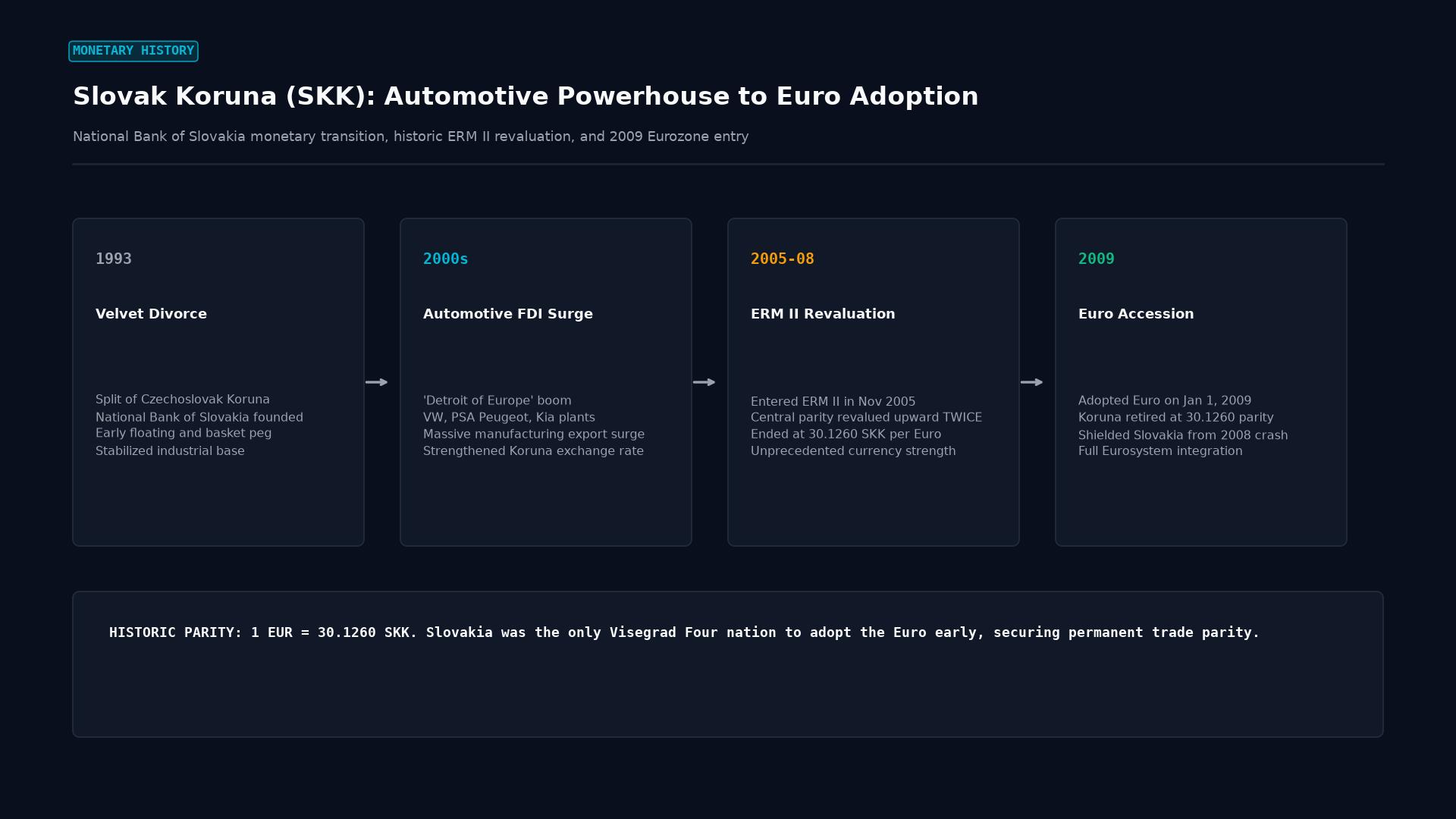 Figure: National Bank of Slovakia monetary transition, historic ERM II revaluation, and 2009 Eurozone entry
The Birth of the Koruna: The “Velvet Divorce” (1993)
The modern Slovak Koruna was born from the peaceful dissolution of the Czech and Slovak Federal Republic, an event known historically as the Velvet Divorce.
January 1, 1993: Political Dissolution of Czechoslovakia
Slovakia and Czech Republic become separate sovereign nations;
Temporary agreement to maintain a common currency union
                      │
                      ▼
February 8, 1993: Monetary Dissolution
Currency union collapses due to diverging fiscal & capital flows;
Czechoslovak banknotes stamped with adhesive tax stamps (Kolky)
                      │
                      ▼
Mid-1993: Independent Banknotes Issued
NBS issues original Slovak Koruna series designed by Jozef Bubák
                      │
                      ▼
October 1998: Transition to Market Float
NBS scraps basket peg (DEM/USD) to absorb Russian financial shock
                      │
                      ▼
2000-2006: The "Detroit of Europe" FDI Boom
Flat tax reforms and massive automotive manufacturing investments;
Rapid productivity growth drives strong Koruna appreciation
                      │
                      ▼
November 2005 - July 2008: ERM II & Euro Convergence
Koruna enters ERM II; central parity revalued upward twice;
Final conversion rate fixed at 30.1260 SKK/EUR
                      │
                      ▼
January 1, 2009: Full Eurozone Accession
Euro becomes official currency of the Slovak Republic
The Failed Currency Union and Adhesive Stamps (Kolky)
When the federation divided on January 1, 1993, political leaders initially agreed to maintain a monetary union using the legacy Czechoslovak Koruna (CSK) for at least six months.
However, capital flight from Slovak banks toward Prague began immediately, draining Slovak foreign exchange reserves.
Within five weeks, the monetary union collapsed:
- On February 8, 1993, the currency was formally split into the Czech Koruna (CZK) and the Slovak Koruna (SKK) at an initial parity of 1:1.
- Because newly designed national banknotes were not yet printed, the monetary authorities utilized a temporary measure: adhesive revenue stamps (kolky) were pasted onto old federal Czechoslovak banknotes of 100, 500, and 1,000 korunas to distinguish Slovak legal tender from Czech currency.
- Between late 1993 and 1995, the newly established National Bank of Slovakia replaced stamped notes with an independent banknote series designed by Slovak artist Jozef Bubák, depicting historical figures including Prince Pribina, Cyril and Methodius, and Anton Bernolák.
Monetary Policy Evolution: From Basket Peg to Float
During its 16-year lifespan, the National Bank of Slovakia transitioned through multiple monetary policy regimes to combat inflation and anchor capital flows.
+------------------------------------------------------------------------------------+
|                         NBS MONETARY REGIME TIMELINE                               |
+-------------------+----------------------------------------------------------------+
| TIME PERIOD       | EXCHANGE RATE REGIME & OPERATIONAL MECHANISM                   |
+-------------------+----------------------------------------------------------------+
| 1993 to 1998      | Currency Basket Peg: Fixed initially to a basket of five partner|
|                   | currencies, consolidated in 1994 into a two-currency basket:    |
|                   | 60% Deutsche Mark (DEM) and 40% US Dollar (USD) with ±7% bands.|
+-------------------+----------------------------------------------------------------+
| October 1998 to   | Managed Floating Regime: NBS abandoned the basket peg following|
| November 2005     | the 1998 Russian financial crisis and speculative pressure.   |
|                   | Shifted to direct inflation targeting and interbank smoothing. |
+-------------------+----------------------------------------------------------------+
| November 2005 to  | Exchange Rate Mechanism II (ERM II): Anchored to the Euro      |
| December 2008     | within a standard ±15% fluctuation corridor, preparing for     |
|                   | complete nominal Maastricht convergence.                       |
+-------------------+----------------------------------------------------------------+
The 1998 Float and Structural Economic Turnaround
In late 1998, high fiscal deficits under the administration of Vladimír Mečiar, combined with regional contagion from the Russian debt default, depleted NBS foreign exchange reserves. On October 1, 1998, the central bank abolished the fixed basket peg, allowing the Koruna to float freely.
Following parliamentary elections in late 1998, a reform-minded coalition led by Mikuláš Dzurinda implemented aggressive structural overhauls:
- Banking Sector Restructuring: Bad loans in state commercial banks (such as VÚB and Slovenská sporiteľňa) were cleaned up and privatized to major European banking groups (Erste Group, Intesa Sanpaolo, Raiffeisen).
- The 19% Flat Tax Reform: In 2004, Slovakia enacted a landmark tax package introducing a uniform 19% rate across personal income tax, corporate tax, and VAT, turning the country into an attractive destination for foreign capital in Central Europe.
The “Detroit of Europe” and Koruna Appreciation
The implementation of structural reforms and accession to the European Union on May 1, 2004, triggered an influx of foreign direct investment (FDI), centered on export automotive manufacturing.
+------------------------------------------------------------------------------------+
|                         SLOVAK AUTOMOTIVE CLUSTER EXPANSION                        |
+-------------------+----------------------------------------------------------------+
| MANUFACTURER      | MANUFACTURING ASSEMBLY INVESTMENT                              |
+-------------------+----------------------------------------------------------------+
| Volkswagen Group  | Bratislava plant (flagship production of premium SUVs: Porsche |
|                   | Cayenne, VW Touareg, Audi Q7).                                 |
+-------------------+----------------------------------------------------------------+
| Stellantis (PSA)  | Trnava manufacturing facility (high-volume compact platforms). |
+-------------------+----------------------------------------------------------------+
| Kia Motors        | Žilina assembly plant (first European production facility for  |
|                   | the Hyundai-Kia Group).                                        |
+-------------------+----------------------------------------------------------------+
| Industrial Impact | Slovakia became the world's leading per-capita automotive      |
|                   | producer, exceeding 180 vehicles produced per 1,000 citizens.  |
+-------------------+----------------------------------------------------------------+
As multinational corporations built modern supply chains across western and northern Slovakia, industrial productivity expanded rapidly.
Surging export revenues generated sustained commercial demand for the Slovak Koruna, transitioning the currency from a historically weak, depreciating asset into a rapidly appreciating regional performer.
       Automotive Mega-Plants & Tier-1 Suppliers Open Operations
                                │
                                ▼
       Massive FDI Inflows (€Billions Converted to Korunas)
                                │
                                ▼
       Rapid Productivity Growth & Expanding Export Surpluses
                                │
                                ▼
       Structural Appreciation Pressure on the Slovak Koruna
       (EUR/SKK Drops from 44.00 in 2002 to below 31.00 in 2008)
The Road to the Euro: ERM II and Upward Revaluations
On November 28, 2005, Slovakia entered the European Exchange Rate Mechanism II (ERM II), the formal waiting room for Eurozone adoption.
Under standard ERM II rules, a candidate currency must maintain stability within a $\pm 15%$ band around an agreed central parity without severe tensions or devaluations for at least two consecutive years.
+------------------------------------------------------------------------------------+
|                         SLOVAK KORUNA ERM II CENTRAL PARITY SHIFTS                 |
+-------------------+-----------------------+----------------------------------------+
| DATE              | CENTRAL PARITY (EUR)  | DRIVER OF ADJUSTMENT                   |
+-------------------+-----------------------+----------------------------------------+
| November 28, 2005 | 38.4550 SKK/EUR       | Initial entry parity into ERM II.      |
+-------------------+-----------------------+----------------------------------------+
| March 19, 2007    | 35.4424 SKK/EUR       | First upward revaluation (8.5% shift)  |
|                   |                       | to absorb heavy appreciation pressure. |
+-------------------+-----------------------+----------------------------------------+
| May 28, 2008      | 30.1260 SKK/EUR       | Second upward revaluation (15% shift)  |
|                   |                       | setting the final conversion rate.     |
+-------------------+-----------------------+----------------------------------------+
The Historic Dual Revaluations
Most emerging market currencies entering currency bands struggle with depreciation pressure. The Slovak Koruna experienced the opposite: intense, unyielding appreciation pressure.
Slovakia’s productivity surge was so rapid that the Koruna threatened to break through the upper strong boundary of the ERM II corridor:
- In March 2007, European monetary authorities and the NBS agreed to revalue the central parity upward by 8.5%, adjusting the anchor from 38.4550 to 35.4424 SKK per Euro.
- In May 2008, as capital continued to pour into Slovak assets ahead of final Eurozone approval, the central parity was revalued upward a second time by an extraordinary 15%, setting the benchmark at 30.1260 SKK per Euro.
On July 8, 2008, the Council of the European Union gave final legal approval for Slovakia to join the Eurozone on January 1, 2009, fixing the final conversion rate permanently at the prevailing ERM II central parity: 30.1260 SKK/EUR.
The Transition to the Euro (January 1, 2009)
The changeover to the single currency was executed with precision:
- Dual Circulation Period: Between January 1 and January 16, 2009, both Slovak Koruna cash and Euro cash circulated side by side. Cash change was given exclusively in Euros, withdrawing the Koruna from physical retail commerce in two weeks.
- Mandatory Dual Price Display: To protect consumers from rounding abuses and opportunistic price hikes by merchants, the Slovak government mandated dual price display on all store receipts, price tags, and bank statements from August 2008 until January 2010.
- Permanent Banknote Redemption: Under the central bank’s statutory rules, the National Bank of Slovakia in Bratislava guarantees the exchange of historical Slovak Koruna banknotes for Euros indefinitely and free of charge, preserving historical wealth.
Key Takeaways
- Historical Sovereign Currency: The Slovak Koruna (SKK, symbol: Sk) served as legal tender from the 1993 dissolution of Czechoslovakia until Euro adoption on January 1, 2009.
- The Velvet Divorce Split: Emerged following the collapse of a brief currency union with the Czech Republic, utilizing adhesive tax stamps (kolky) on federal banknotes as a transitional bridge.
- Manufacturing FDI Transformation: Structural reforms and a 19% flat tax in 2004 turned Slovakia into a major global automotive hub (Volkswagen, Stellantis, Kia), driving export surpluses.
- Unique ERM II Dynamics: Unlike most candidate currencies that struggle with weakness, strong economic fundamentals forced European authorities to revalue the Koruna’s ERM II central parity upward twice.
- Irrevocable Conversion Parity: Officially retired at the final rate of 1 EUR = 30.1260 SKK, making Slovakia the 16th member of the Eurozone.
- Indefinite Central Bank Redemption: The National Bank of Slovakia honors and exchanges historical Slovak Koruna banknotes for Euros indefinitely.
Frequently Asked Questions (FAQ)
Can I still exchange old Slovak Koruna banknotes today?
Yes. Under the rules enacted by the National Bank of Slovakia (NBS), historical Slovak Koruna paper banknotes (from the 1993–2008 series) can be redeemed for Euros at the central bank’s headquarters in Bratislava indefinitely, without an expiration date and free of processing fees, at the official conversion rate of 30.1260 SKK per Euro. However, Slovak Koruna circulating metal coins are no longer redeemable, as the statutory deadline for coin redemption expired in January 2014.
Why was the Slovak Koruna revalued upward twice inside the ERM II mechanism?
The Slovak Koruna was revalued upward twice within the Exchange Rate Mechanism II (ERM II) because Slovakia’s economy was experiencing massive productivity gains and export growth. Foreign direct investment into world-class automotive manufacturing plants created overwhelming commercial demand for the Koruna. As market participants realized Slovakia would successfully adopt the Euro, international capital inflows repeatedly pushed the Koruna to the upper ceiling of its permitted fluctuation band. To prevent market distortion, European finance ministers and the NBS revalued the central parity higher, first to 35.4424 in 2007 and then to 30.1260 in 2008.
Did Slovakia benefit from replacing the Koruna with the Euro during the 2008–2009 Global Financial Crisis?
Yes. Slovakia adopted the Euro on January 1, 2009, at the peak of the Global Financial Crisis following the collapse of Lehman Brothers. While neighboring Central European currencies that kept their own floating money, such as the Polish Zloty, Hungarian Forint, and Czech Koruna, suffered currency devaluations of 20% to 30% and speculative capital flight, Slovakia was protected by the Eurosystem umbrella. Adopting the Euro eliminated foreign exchange transaction risk for Slovakia’s massive automotive export sector, locked in low interest rates, and provided immediate liquidity access through the European Central Bank.
Ready to trade forex?
Open a free demo account with a regulated broker. Practice with virtual funds before risking real money.