Squeeze
A financial or macroeconomic condition where capital, credit, or asset supply is severely restricted—either by a central bank tightening monetary policy to raise borrowing costs or by market forces trapping traders in crowded positions and forcing aggressive liquidation.
What Is a Squeeze?
In macroeconomic and financial terminology, the term squeeze describes any structural environment where a severe restriction of supply, liquidity, or credit creates acute financial distress for market participants, forcing sharp price adjustments.
Depending on the operational context, a squeeze manifests in two primary forms:
- Central Bank Monetary Squeeze (Credit Squeeze): A deliberate policy maneuver by a central bank to combat rampant inflation by contracting the broad money supply and elevating benchmark interest rates. By making commercial credit expensive and scarce, the central bank intentionally “squeezes” liquidity out of the economy to cool aggregate demand.
- Market Trading Squeeze: A market dynamic where speculative traders holding crowded, highly leveraged positions (either short or long) are trapped by an unexpected price movement. As losses mount and margin calls trigger, their forced, synchronized liquidations aggressively accelerate the price move, inflicting severe capital destruction.
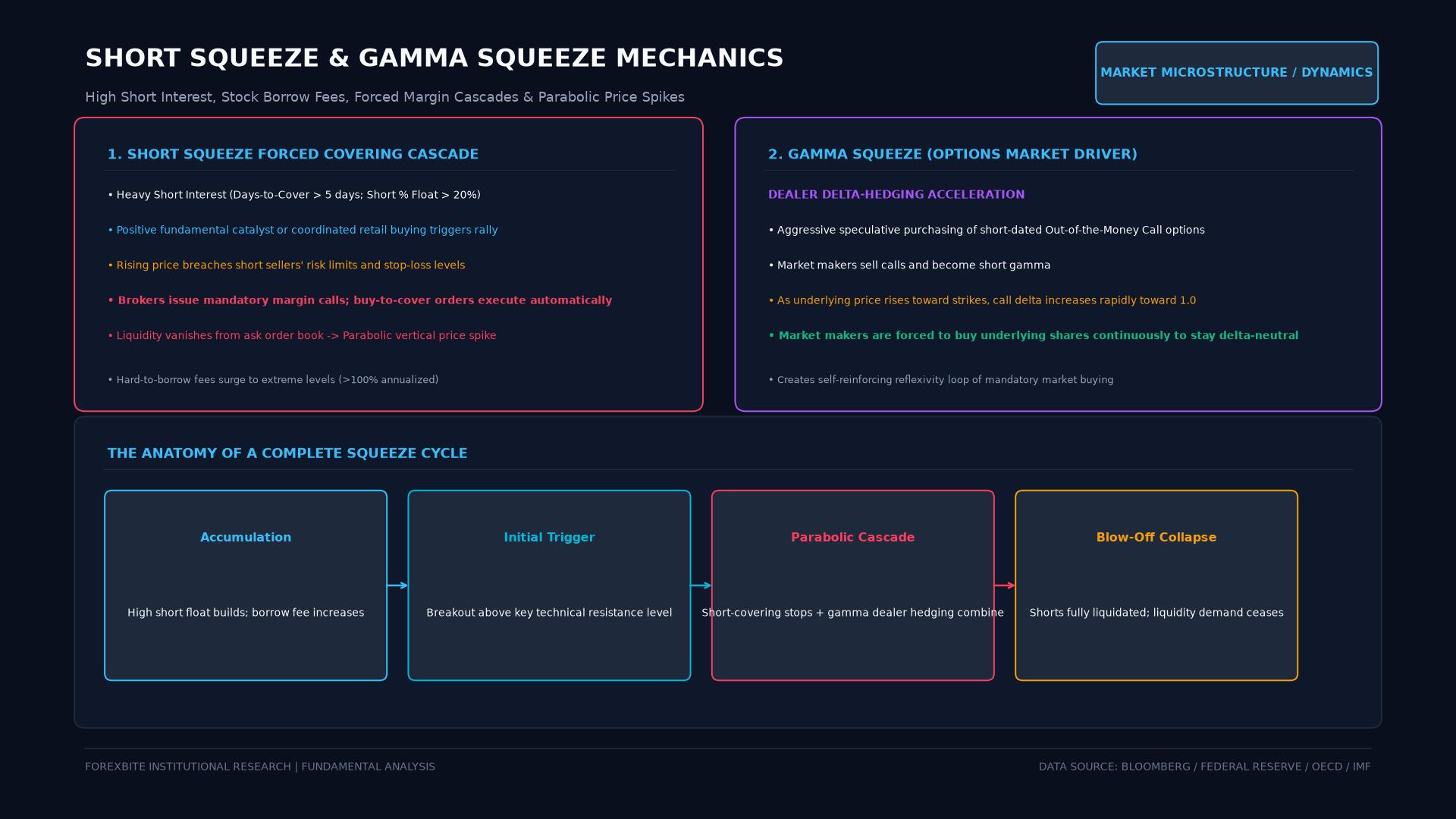 Figure: Market microstructure dynamics of short squeezes and options gamma squeezes, detailing high short interest ratios, dealer delta-hedging reflexivity, forced margin liquidations, and parabolic price surges.
The Taxonomy of Financial Squeezes
Because the word “squeeze” is applied across multiple disciplines, institutional analysts categorize squeezes into distinct operational classes:
| Squeeze Category | Primary Driver | Impacted Parties | Market Consequences |
|---|---|---|---|
| Monetary Squeeze | Central bank quantitative tightening and rapid interest rate hikes | Commercial banks, corporate borrowers, consumers | Economic slowdown, rising bond yields, strong domestic currency |
| Liquidity Squeeze | Sudden freezing of interbank lending or repo collateral channels | Commercial financial institutions, broker-dealers | Cash hoardings, widening interbank spreads (TED spread), asset fire sales |
| Short Squeeze | Unexpected price surges forcing crowded short sellers to cover | Bearish hedge funds, short-biased speculators | Parabolic upward price spikes decoupling from fundamentals |
| Long Squeeze | Rapid price drops triggering cascading stop-losses on leveraged longs | Bullish margin traders, leveraged commodity buyers | Sudden, vertical cascade lower as margin calls trigger automated selling |
Mechanics: The Central Bank Credit Squeeze
When a central monetary authority initiates a squeeze, it alters the fundamental price and availability of money.
In a modern fiat monetary framework, the central bank manipulates three core levers:
- Open Market Sales: The central bank sells government debt from its balance sheet to commercial primary dealers, extracting central bank reserves from the private banking system.
- Interest Rate Policy Corridor: By elevating the rate paid on reserve balances (IORB) or discount window lending rates, the central bank establishes an elevated floor under all interbank lending.
- Credit Contraction: With commercial bank reserves restricted, banks tighten underwriting standards and elevate prime lending rates, making capital scarce for speculative enterprise.
Impact on Foreign Exchange Markets
A domestic central bank squeeze typically sparks a powerful bullish trend in the national currency. Higher benchmark yields generate an attractive positive carry, drawing international capital flows away from looser jurisdictions into the squeezing currency (e.g., the U.S. Dollar during aggressive Fed tightening cycles).
Real-World Institutional Case Study: Paul Volcker’s Historic 1979–1981 Fed Squeeze
The most famous monetary squeeze in modern economic history was orchestrated by Federal Reserve Chairman Paul Volcker between 1979 and 1981:
       FEDERAL FUNDS RATE - THE VOLCKER SQUEEZE (1979–1981)

 22% ──┐                                         ┌─── Peak: 20.00% (June 1981)
       │                                         │
 18% ──┼                                        /│
       │                         _..-''`\      / │
 14% ──┼─-.._             _.-''`         \    /  │
       │     `'--------'                  '--'   │
 10% ──┼ (Oct 1979: Volcker Pivot)               │
       └─────────────────────────────────────────┴─────────────────────
1979 1980 1981- The Macro Crisis: By late 1979, U.S. consumer price inflation was raging at an annualized rate of nearly 14.8%, severely eroding global confidence in the U.S. Dollar.
- The Policy Squeeze: On October 6, 1979, Volcker announced that the Fed would stop targeting interest rates directly and instead strictly cap the growth of the money supply (M1). The Fed choked off bank reserves, sending the Federal Funds rate skyrocketing to an unprecedented 20.00% in 1981.
- The Domestic Fallout: The acute credit squeeze plunged the U.S. economy into a severe double-dip recession, pushing unemployment above 10% and bankrupting debt-reliant industries.
- The Long-Term Outcome: The brutal monetary squeeze permanently broke the back of inflation, anchoring price expectations for the next four decades and sparking a massive secular bull market in the U.S. Dollar (DXY).
Identifying an Approaching Squeeze in Financial Markets
Macro fund managers monitor real-time indicators to detect stress before a squeeze erupts:
- Repo Market Spreads (SOFR / GC Spreads): When overnight repurchase agreement (repo) rates spike above the central bank’s target range, it indicates a severe deficit of cash collateral in the financial plumbing (as seen in the September 2019 U.S. Repo Crisis).
- TED Spread and FRA-OIS Spreads: Widening spreads between interbank lending rates and risk-free Treasury yields reflect mounting counterparty distrust and an impending interbank liquidity squeeze.
- Extreme Speculative Imbalance in COT Data: When net speculative positioning in an asset hits the 99th historical percentile, the probability of an explosive short or long squeeze reaches maximum vulnerability.
Frequently Asked Questions
What is the difference between a short squeeze and a long squeeze?
In a short squeeze, trapped short sellers are forced to buy back an asset as prices rise, driving the market parabolically higher. In a long squeeze, over-leveraged buyers are hit with margin calls as prices decline, forcing them to sell aggressively into a falling market, causing prices to collapse in a vertical downward cascade.
Why do central banks intentionally risk causing a recession with a monetary squeeze?
Central banks consider runaway inflation to be far more destructive to long-term national wealth than a temporary economic recession. If inflation expectations become unanchored, currency purchasing power collapses, destroying savings and capital investment. Central banks execute a monetary squeeze to restore price stability, even if it induces short-term economic pain.
How can retail forex traders protect themselves during a market squeeze?
Retail traders should strictly avoid maintaining unhedged positions against central bank policy shifts, never trade without guaranteed stop-loss orders in illiquid hours, and avoid heavily crowded trades where positioning data (such as retail sentiment indices) shows 80% to 90% of traders clustered on one side.
Ready to trade forex?
Open a free demo account with a regulated broker. Practice with virtual funds before risking real money.