Commission
A commission is a direct transaction fee charged by a broker or trading platform to execute an order on behalf of a trader. In retail forex, brokers typically offer either standard spread-only accounts with no commission or ECN/STP accounts featuring raw interbank spreads paired with a fixed commission per lot.
Understanding Broker Commissions
In financial trading, a commission is the explicit fee a broker or execution venue assesses to facilitate the matching, routing, and clearing of a trade. While commissions are the traditional standard across equity, bond, and futures exchanges, their structure in over-the-counter (OTC) retail foreign exchange displays unique characteristics.
Because the spot foreign exchange market has no single centralized exchange, retail brokerages deploy two distinct commercial revenue models:
- Spread-Only Pricing (Dealing Desk / Standard Accounts): The broker charges zero explicit commissions. Instead, the broker earns revenue by adding an internal markup (typically 1.0 to 2.5 pips) directly onto the raw interbank bid-ask spread.
- Raw Spread Plus Commission (ECN / STP Accounts): The broker passes direct interbank prices straight to the client with razor-thin spreads (often 0.0 to 0.3 pips on EUR/USD during peak sessions). To generate revenue, the broker charges an unbundled, fixed cash commission for every lot transacted.
Understanding how commissions interact with spreads is critical for traders because transaction friction represents the single largest operational cost over a trader’s career.
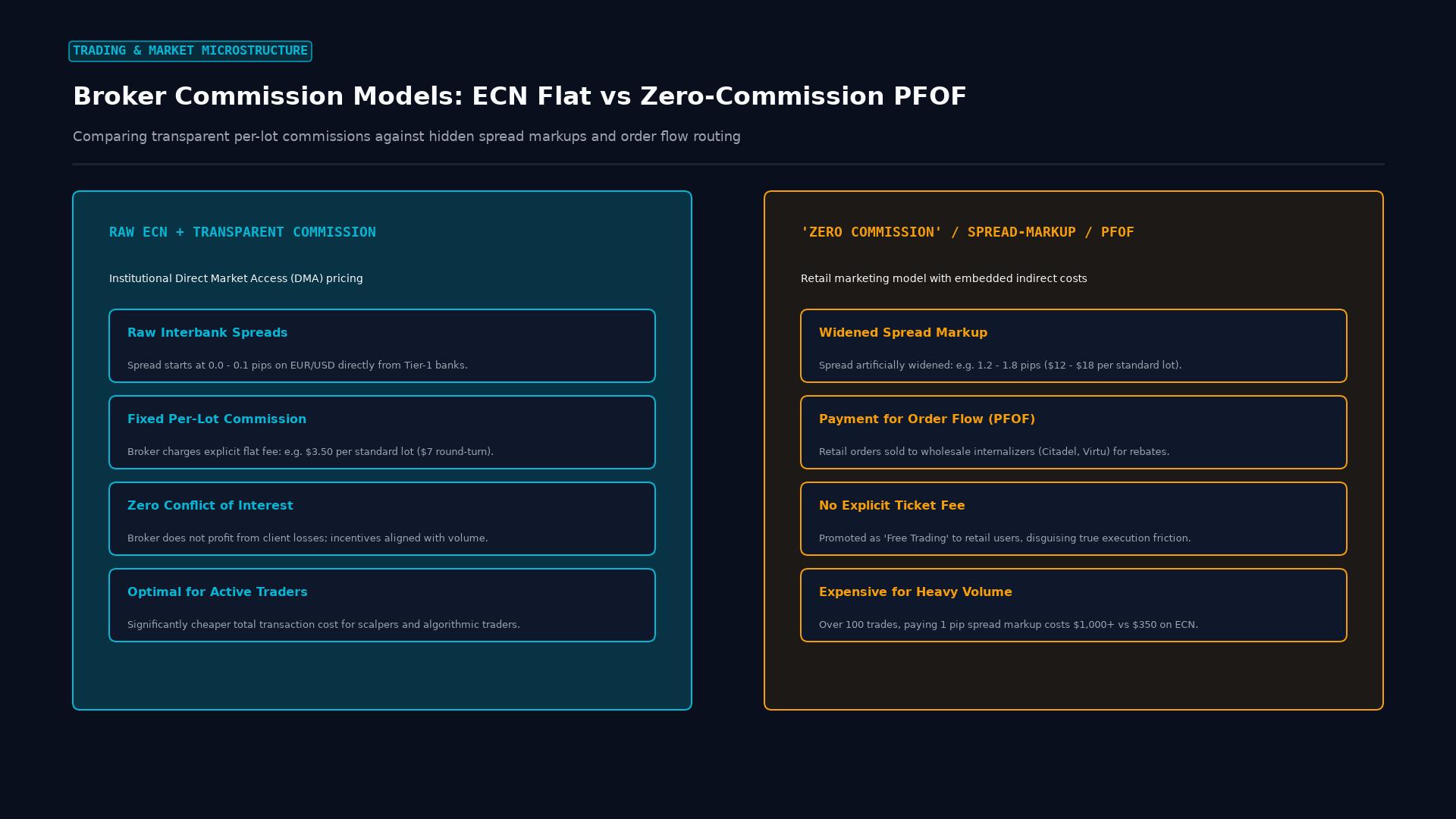 Figure: Brokerage revenue comparison: transparent flat per-lot commissions on raw interbank ECN spreads versus ‘Zero-Commission’ models monetized via spread markups and Payment for Order Flow (PFOF).
Commission Structures: Per-Side vs. Round-Turn
When comparing brokerage commission schedules, traders must distinguish between two standard quoting conventions:
- Per-Side Commission (Half-Turn): The fee charged for a single transaction—either opening the position or closing it. For example, a broker may quote a commission of “$3.50 per standard lot per side.”
- Round-Turn Commission (Round-Trip): The total combined fee required to complete a full trading cycle—both opening the position and subsequently closing it. In the example above, the round-turn commission equals $7.00 per standard lot ($3.50 open + $3.50 close).
Some trading platforms (such as MetaTrader 4 and 5) deduct the entire round-turn commission ($7.00) immediately upon opening the trade, while other platforms deduct half upon entry and the remaining half upon liquidation.
Standard Account vs. ECN Account: Cost Comparison
To determine whether a commission-based ECN account or a commission-free standard account offers superior value, an active trader must calculate the all-in cost of execution:
$$ \text{Total Transaction Cost} = \text{Spread Cost} + \text{Commission Cost} $$
Consider trading 1 Standard Lot of EUR/USD (100,000 units, where 1 pip = $10.00):
Account A: Standard Account (Zero Commission)
- Quoted Spread: 1.4 pips
- Commission: $0.00
- Cost to Open and Close: $$ 1.4 \text{ pips} \times $10.00/\text{pip} = $14.00 $$
Account B: ECN Account (Raw Spread + Commission)
- Quoted Raw Spread: 0.2 pips
- Commission: $6.00 round-turn per lot
- Cost to Open and Close: $$ (0.2 \text{ pips} \times $10.00/\text{pip}) + $6.00 = $2.00 + $6.00 = $8.00 $$
In this scenario, trading through the commission-based ECN account saves the trader $6.00 per standard lot (a 43% cost reduction). For an active day trader or scalper executing 50 lots per month, choosing the commission-based structure yields annual savings exceeding $3,600.
Which Account Type Suits Your Trading Style?
The choice between paying commissions or wider spreads depends on your trading methodology:
Who Benefits from ECN Commission Accounts?
- Scalpers and High-Frequency Traders: Traders targeting tight profit margins of 5 to 15 pips require the lowest possible bid-ask spread to enter and exit quickly without price resistance.
- Algorithmic Traders (Expert Advisors): Automated trading robots frequently rely on precise technical levels and tight stop-losses that would be distorted by marked-up retail spreads.
- High-Volume Day Traders: As demonstrated above, cumulative commission savings compound into thousands of dollars for active traders.
Who Benefits from Standard Spread-Only Accounts?
- Long-Term Swing and Position Traders: Traders targeting wide price targets of 150 to 500 pips over multi-day or multi-week horizons are relatively indifferent to a 1-pip spread difference, preferring the simplicity of zero separate commission charges on their statements.
- Micro-Lot Beginners: Traders starting with small account deposits ($100 to $500) trading micro-lots (0.01 lots = $0.07 commission) often find spread-only accounts easier to calculate mentally.
Additional Hidden Trading Costs
While commissions and spreads represent the primary visible fees, traders should account for supplementary costs:
- Rollover Swap Rates: The overnight financing charge applied to leveraged positions held past 5:00 PM EST, reflecting national interest rate differentials plus broker financing markups.
- Slippage: The difference between the requested order price and the actual execution price during volatile news releases, representing an implicit execution penalty.
- Deposit and Inactivity Fees: Administrative charges levied by certain brokerages for dormant accounts or specific payment withdrawal methods.
Key Takeaways
- A commission is a fixed transaction fee charged by a broker to execute orders.
- Retail forex accounts generally split into commission-free standard accounts (with marked-up spreads) and ECN accounts (with raw spreads plus fixed commissions).
- Commission is quoted either per-side (half-turn) or per full cycle (round-turn).
- For active intraday traders and scalpers, raw spread ECN accounts almost universally deliver lower all-in transaction costs than spread-only accounts.
- Swing traders holding multi-day positions can comfortably utilize standard accounts where overnight swap rates matter more than entry spreads.
FAQ
Are commission-free brokers truly free? No. Brokers offering “zero-commission” trading embed their profit directly into the bid-ask spread. You pay the fee invisibly every time you buy at the marked-up ask price and sell at the marked-up bid price.
Can commissions be negotiated with a broker? Yes. High-volume retail traders and institutional desks can frequently negotiate tiered commission discounts or volume-based cash rebates with ECN brokers once monthly turnover exceeds 50 to 100 standard lots.
Where can I see the commission charged on MetaTrader? In MetaTrader 4 and MetaTrader 5, open the “Trade” tab in the Terminal/Toolbox window at the bottom of the screen. Look for the dedicated “Commission” column, which displays the exact cash deduction for each open and closed trade.
Ready to trade forex?
Open a free demo account with a regulated broker. Practice with virtual funds before risking real money.