Trailing Stop Order
A trailing stop order is a dynamic stop-loss that automatically moves in the direction of a profitable trade, maintaining a set distance (in pips or percentage) from the current market price. It locks in gains as the trade moves in your favor while still allowing the position to run if the trend continues.
The Problem Trailing Stops Solve
Every trend trader faces the same dilemma: exit too early and miss the majority of a big move; hold too long and give back significant profits when the trend reverses. A fixed take-profit target captures a predetermined piece of the move but abandons everything beyond it. A trailing stop offers a middle path — it stays in the trade as long as the trend continues, and exits automatically when the reversal is confirmed.
The trailing stop transforms a binary exit decision (where exactly is my target?) into a dynamic one that adapts to actual market behavior.
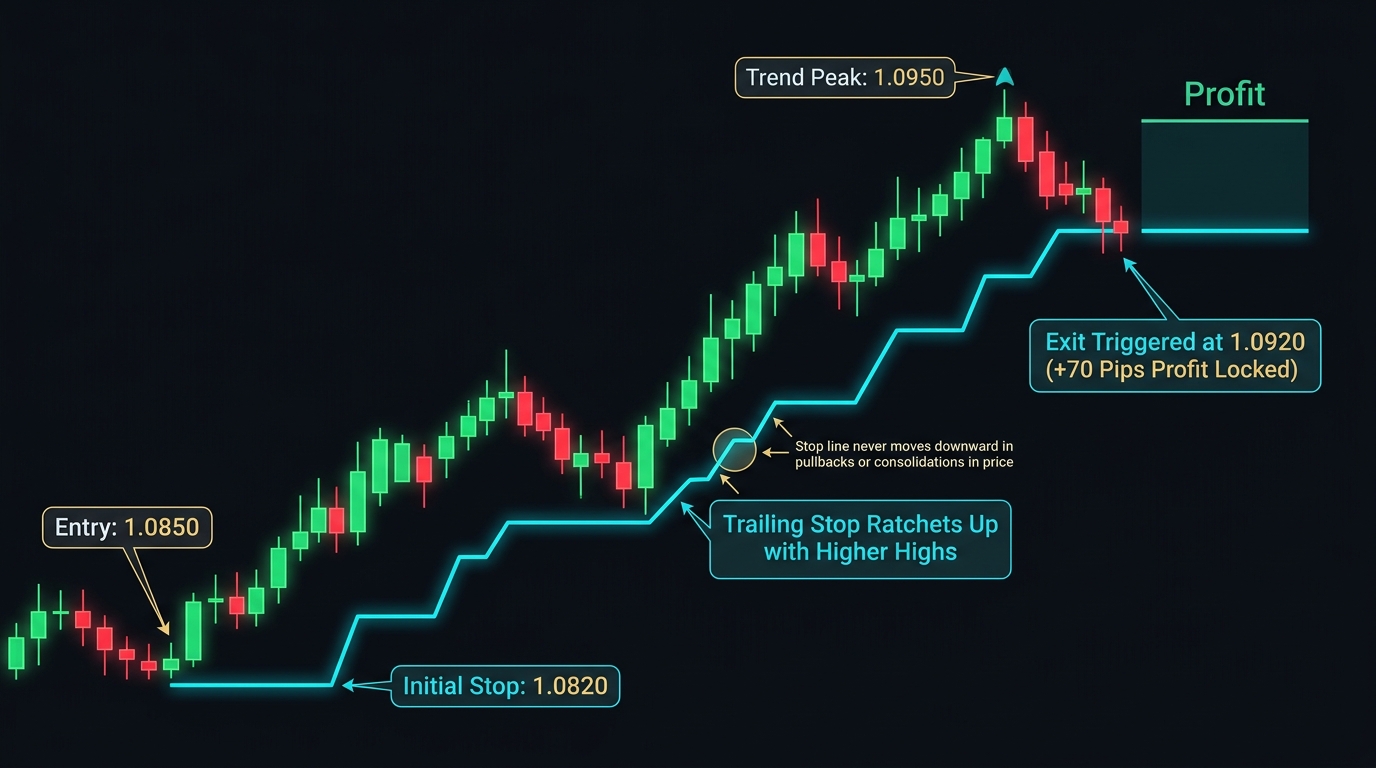
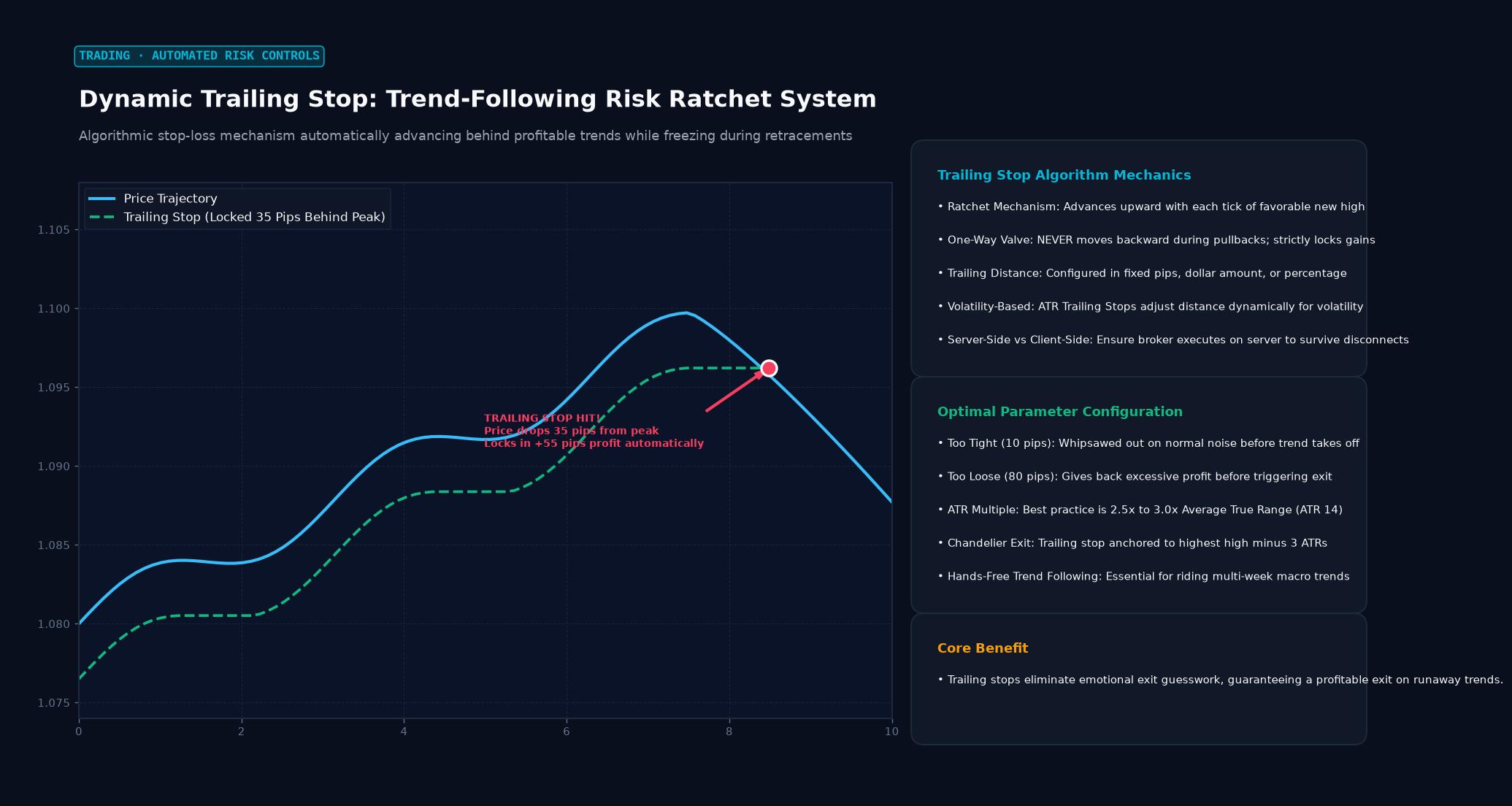 Figure: Algorithmic stop-loss mechanism automatically advancing behind profitable trends while freezing during retracements
How a Trailing Stop Works: Step by Step
The trailing stop is defined by its trail distance — how many pips (or what percentage) it stays behind the best price reached during the trade.
Example: Long EUR/USD at 1.0850, trailing stop set at 30 pips.
| Price Moves To | Trailing Stop Level | Gain Locked In |
|---|---|---|
| Entry: 1.0850 | 1.0820 | 0 pips |
| 1.0880 (+30) | 1.0850 | Breakeven |
| 1.0910 (+60) | 1.0880 | +30 pips |
| 1.0950 (+100) | 1.0920 | +70 pips |
| Reverses to 1.0920 | Triggered at 1.0920 | +70 pips profit |
The stop only moves in the favorable direction. When EUR/USD rises, the trailing stop rises with it. When price falls from 1.0950, the stop stays at 1.0920 — it does not move down. When price hits 1.0920, the trade closes with 70 pips profit.
Choosing the Trail Distance
This is the most important decision in trailing stop design. Too tight, and normal price fluctuations stop you out before the move completes. Too wide, and you give back too much of your gains before the exit triggers.
ATR-based trail distance: The most professional approach is to base the trail on the Average True Range (ATR) — typically 1.5× to 2× the ATR of the current period. On EUR/USD with a 4-hour ATR of 40 pips, a 60-80 pip trail distance makes sense. This automatically adjusts to current volatility conditions.
Fixed pip trail: Simpler but less adaptive. Works well if you know from experience what “normal” pullback size is for the pair you trade in your target timeframe.
Percentage trail: Some platforms express the trail as a percentage of price. Useful for higher-priced instruments but less intuitive for forex.
Trailing Stops vs. Manual Stop Management
Some traders prefer to manually move their stop-loss rather than using an automated trailing stop. The argument: a mechanical trailing stop doesn’t distinguish between a normal pullback in a continuing trend and an actual reversal. A manual trader can read the price action — if a pullback tests a key level but holds, they leave the stop in place; only if the structure breaks do they exit.
The counter-argument: manual management requires continuous attention and introduces emotional bias. It’s easy to rationalize not moving a stop when the trade is losing. Automated trailing stops are more disciplined and work perfectly for traders who can’t monitor positions continuously.
In practice, many swing traders combine both: use an automated trailing stop as a safety net but actively manage based on the chart at key decision points.
Trailing Stops Across Platforms
MetaTrader 4/5: Built-in trailing stop function available on all open positions. The trail is in points (which equals pips on 5-decimal brokers). Important: MT4/5 trailing stops only work when the platform is running. If your computer is off or disconnected, the trailing stop is not active — only a regular stop-loss at the last trailed position remains.
cTrader: Similar functionality with more granular control.
Dedicated VPS (Virtual Private Server): Many traders run their MT4 on a 24/7 VPS to ensure trailing stops function around the clock, even when their own computer is off.
Combining Trailing Stops with Partial Exits
A professional approach to position management: close half the position at a fixed target (e.g., 1:2 risk-reward), then trail the remaining half. This approach:
- Secures profit on the first half regardless of what happens next
- Converts the trailing half to a “free” trade (stop at breakeven)
- Allows the trailing half to capture extended moves without psychological pressure
The two-stage exit is more complex to manage but produces higher average win sizes on trending trades while limiting the regret of exiting entirely too early.
Key Takeaways
- Trailing stops automatically move in the direction of profit, locking in gains while allowing the trend to run
- The trail distance should match the pair’s volatility — ATR-based sizing is most professional
- MT4/5 trailing stops require the platform to be running; use a VPS for 24/7 coverage
- Combine trailing stops with partial exits for maximum flexibility
- Best suited for trend-following strategies; less effective in choppy, mean-reverting markets
FAQ
Does a trailing stop reverse my position if the market goes too far? No. A trailing stop closes the position — it does not reverse it. If you want a reverse position, you need a separate order.
Will my trailing stop trigger exactly at my trail distance? During normal market hours, yes. During gaps (Sunday open, news events), price can jump past the trigger level and fill at the next available price — similar to regular stop-loss slippage. Plan accordingly by reviewing open trailing stops before major events.
Ready to trade forex?
Open a free demo account with a regulated broker. Practice with virtual funds before risking real money.