Strip
An asymmetric volatility options strategy constructed by purchasing (or selling) two put options and one call option with the identical strike price and expiration date, creating a volatility position with a pronounced bearish directional skew.
What Is a Strip Option Strategy?
A strip is a specialized, asymmetric options combination designed for market environments where a trader expects a substantial surge in volatility, but believes the impending breakout is significantly more likely to resolve to the downside.
The strategy is engineered by combining three options on the same underlying asset sharing an identical strike price ($K$) and expiration date ($T$):
- Purchasing Two (2) At-The-Money Put Options
- Purchasing One (1) At-The-Money Call Option
By deploying a 2:1 ratio of puts to calls, the strip creates a modified straddle. If the asset explodes upward, the single long call option covers the total premium paid and generates upside profits. However, if the asset collapses downward—as anticipated—the double put allocation produces twice the profit velocity, doubling the rate of capital appreciation compared to a standard straddle.
(Note: In fixed income and commodities, the term “strip” also refers to a series of consecutive futures contracts or stripped zero-coupon Treasury bonds known as STRIPS).
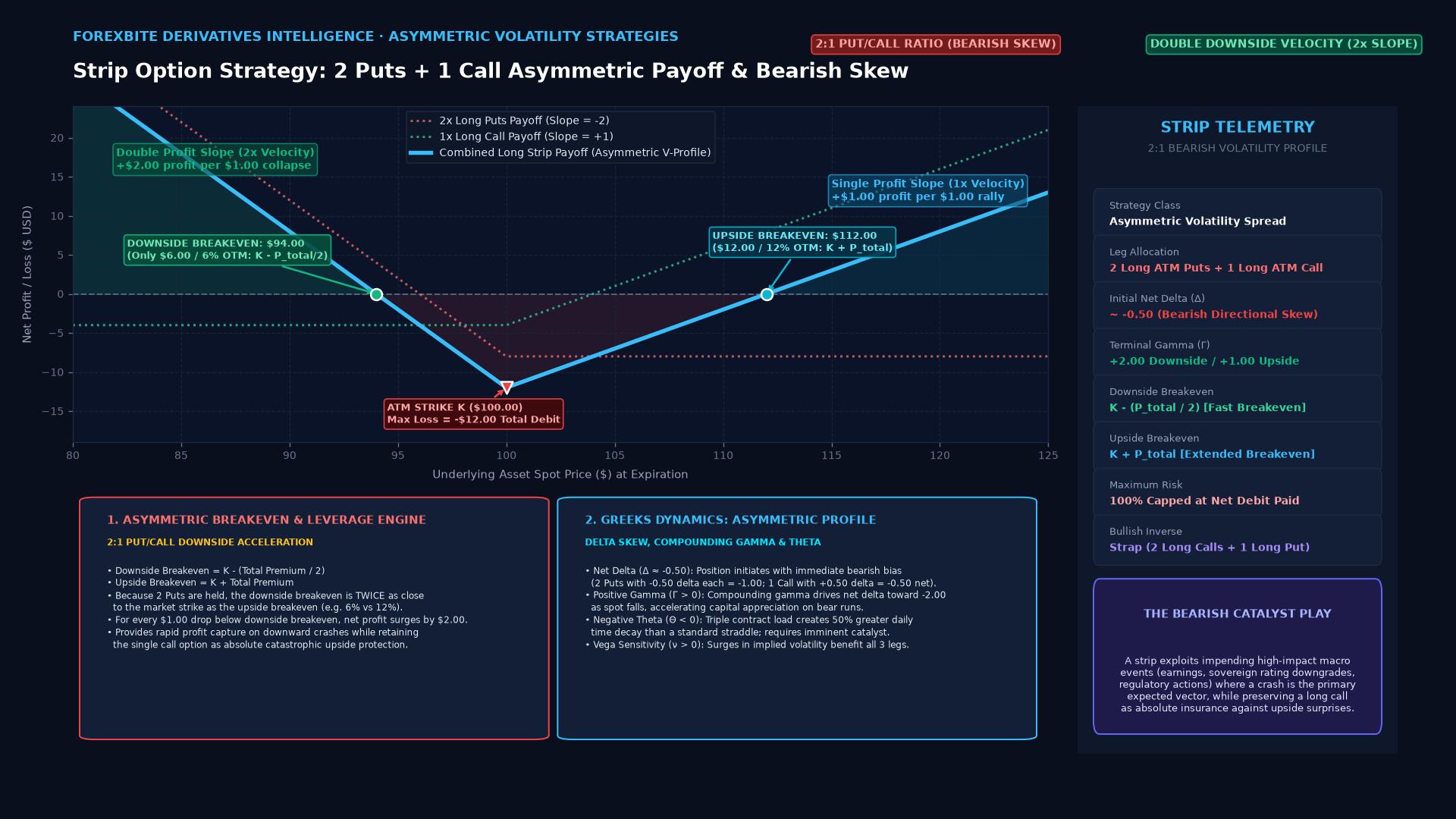 Figure: Asymmetric payoff diagram of a long strip option strategy (2 ATM puts + 1 ATM call), showing double downside profit velocity and extended upside breakeven.
The Mathematics of a Long Strip
A long strip requires an upfront cash debit equal to the combined cost of three contracts:
$$P_{\text{total}} = 2 \times \text{Premium}{\text{Put}} + \text{Premium}{\text{Call}}$$
1. Asymmetric Breakeven Thresholds
Because the trader holds twice as many puts as calls, the downside breakeven is significantly closer to the current market price than the upside breakeven:
$$\text{Downside Breakeven} = K - \frac{P_{\text{total}}}{2}$$
$$\text{Upside Breakeven} = K + P_{\text{total}}$$
2. Payoff Calculations at Expiration
$$\text{Payoff} = 2 \times \max\left(K - S_T, ; 0\right) + \max\left(S_T - K, ; 0\right) - P_{\text{total}}$$
- Maximum Risk: Strictly capped at the total premium paid ($P_{\text{total}}$). Occurs if the asset expires precisely at strike price $K$, rendering all three contracts worthless.
- Downside Acceleration: For every $1.00 the asset drops below the downside breakeven, the position gains $2.00 in net profit.
- Upside Acceleration: For every $1.00 the asset rises above the upside breakeven, the position gains $1.00 in net profit.
Concrete Numerical Example: Currency Strip on EUR/USD
Assume spot EUR/USD trades at 1.0800:
- Buy Two 1.0800 ATM Puts: $2 \times 70\text{ pips} = 140\text{ pips}$ ($0.0140$)
- Buy One 1.0800 ATM Call: $1 \times 70\text{ pips} = 70\text{ pips}$ ($0.0070$)
- Total Net Outlay ($P_{\text{total}}$): 210 pips ($0.0210$)
- Downside Breakeven: $1.0800 - (0.0210 / 2) = \mathbf{1.0695}$ (Only 105 pips away)
- Upside Breakeven: $1.0800 + 0.0210 = \mathbf{1.1010}$ (210 pips away)
Notice that EUR/USD only needs to fall 105 pips to reach profitability, whereas it must rally 210 pips to break even on the upside.
Strip vs. Strap vs. Straddle vs. Strangle
| Strategy | Contract Ratio (Puts : Calls) | Market Outlook / Bias | Downside Sensitivity | Upside Sensitivity |
|---|---|---|---|---|
| Strip | 2 Puts : 1 Call (Same Strike) | High Volatility with Bearish Skew | 2x Leverage (Fast gains) | 1x Leverage (Standard gains) |
| Strap | 1 Put : 2 Calls (Same Strike) | High Volatility with Bullish Skew | 1x Leverage (Standard gains) | 2x Leverage (Fast gains) |
| Straddle | 1 Put : 1 Call (Same Strike) | Pure Non-Directional Volatility | Symmetrical (1x) | Symmetrical (1x) |
| Strangle | 1 OTM Put : 1 OTM Call | Pure Volatility; Cheaper Outlay | Symmetrical (1x) | Symmetrical (1x) |
The Greeks of a Strip Strategy
Because of the 2:1 option imbalance, a strip does not exhibit delta-neutrality:
- Net Negative Delta ($\Delta < 0$): At inception, an ATM put carries roughly $-0.50$ delta, while an ATM call carries $+0.50$ delta. Combining two puts and one call creates an initial net delta of approximately $-0.50$, giving the position an immediate bearish orientation.
- Aggressive Positive Gamma ($\Gamma > 0$): As the asset falls, the delta of the two puts expands toward $-2.00$, causing profits to compound rapidly.
- Heavy Negative Theta ($\Theta < 0$): Because the trader holds three long option contracts, daily time decay is 50% higher than a standard straddle, requiring an imminent price move to avoid capital drag.
- Strong Positive Vega ($\mathcal{V} > 0$): The position benefits substantially from an expansion in Implied Volatility across all three contracts.
Real-World Institutional Case Study: Deploying a Strip Ahead of a Sovereign Rating Downgrade
In late 2011, during the height of the European sovereign debt crisis, macro hedge funds anticipated that credit rating agencies were preparing a coordinated multi-notch downgrade of French and Italian sovereign debt.
       MACRO CATALYST STRIP EXECUTION (EUR/USD)

 The Dilemma:
 - A sovereign downgrade would trigger a violent collapse in the Euro (High conviction).
 - However, if the European Central Bank unexpectedly launched an emergency
   unlimited bond-buying facility (OMT) at the same time, the Euro could squeeze violently.

 The Institutional Solution:
 - The desk executed a 2:1 Strip on EUR/USD options (2 Long Puts, 1 Long Call).

 The Outcome:
 1. S&P downgraded France and eight other European nations in January 2012.
 2. EUR/USD collapsed from 1.3000 to below 1.2650.
 3. The double put allocation generated an exceptional 180% return on invested premium,
    while the call option functioned as an absolute catastrophic hedge against an ECB surprise.
Frequently Asked Questions
Why buy a Strip instead of simply buying Put options?
Buying an outright put option leaves an investor completely exposed to a total loss if the market unexpectedly rallies. A strip includes a long call option that acts as a financial insurance policy: if the macroeconomic thesis is wrong and the market surges upward on unexpected positive news, the call option expands in value, covering the initial debit and preventing a capital wipeout.
What is the opposite of a Strip strategy?
The opposite bullish variation is called a Strap. A strap is constructed by purchasing two call options and one put option at the same strike price, creating an asymmetric volatility trade with double the profit velocity on an upward breakout.
Can an investor sell (write) a Short Strip?
Yes. A Short Strip involves selling two put options and selling one call option, collecting a large upfront premium credit. Traders write short strips when they expect an asset to remain range-bound with a slight upward drift, although this strategy exposes the seller to unlimited upside risk and double downside risk.
Ready to trade forex?
Open a free demo account with a regulated broker. Practice with virtual funds before risking real money.