Straddle
A non-directional, volatility-focused options strategy constructed by simultaneously purchasing (or selling) a call option and a put option with the identical strike price and expiration date on the same underlying asset.
What Is a Straddle?
A straddle is one of the most prominent market-neutral strategies in options trading. Instead of betting on whether an asset’s price will rise or fall, a straddle bets purely on the magnitude of price volatility.
The strategy is constructed by combining two identical options:
- Purchasing (or selling) an At-The-Money (ATM) Call Option.
- Simultaneously purchasing (or selling) an At-The-Money (ATM) Put Option with the exact same strike price ($K$) and expiration date ($T$).
A trader who initiates a Long Straddle expects the underlying asset to experience an explosive, violent price breakout in either direction, sufficient to surpass the cumulative premium paid for both options. Conversely, a trader who writes a Short Straddle expects the market to remain stagnant in a tight trading range, aiming to pocket the upfront options premium as time decay erodes both contracts.
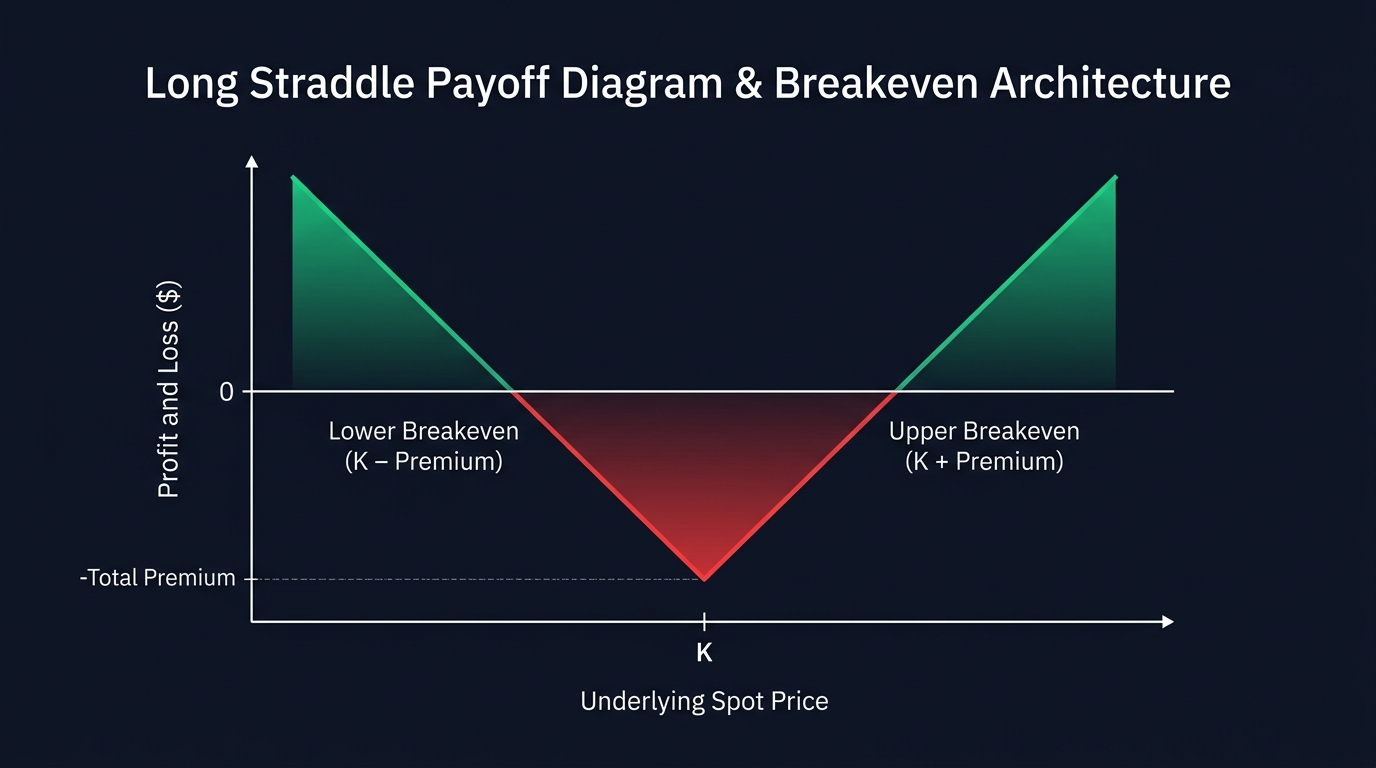
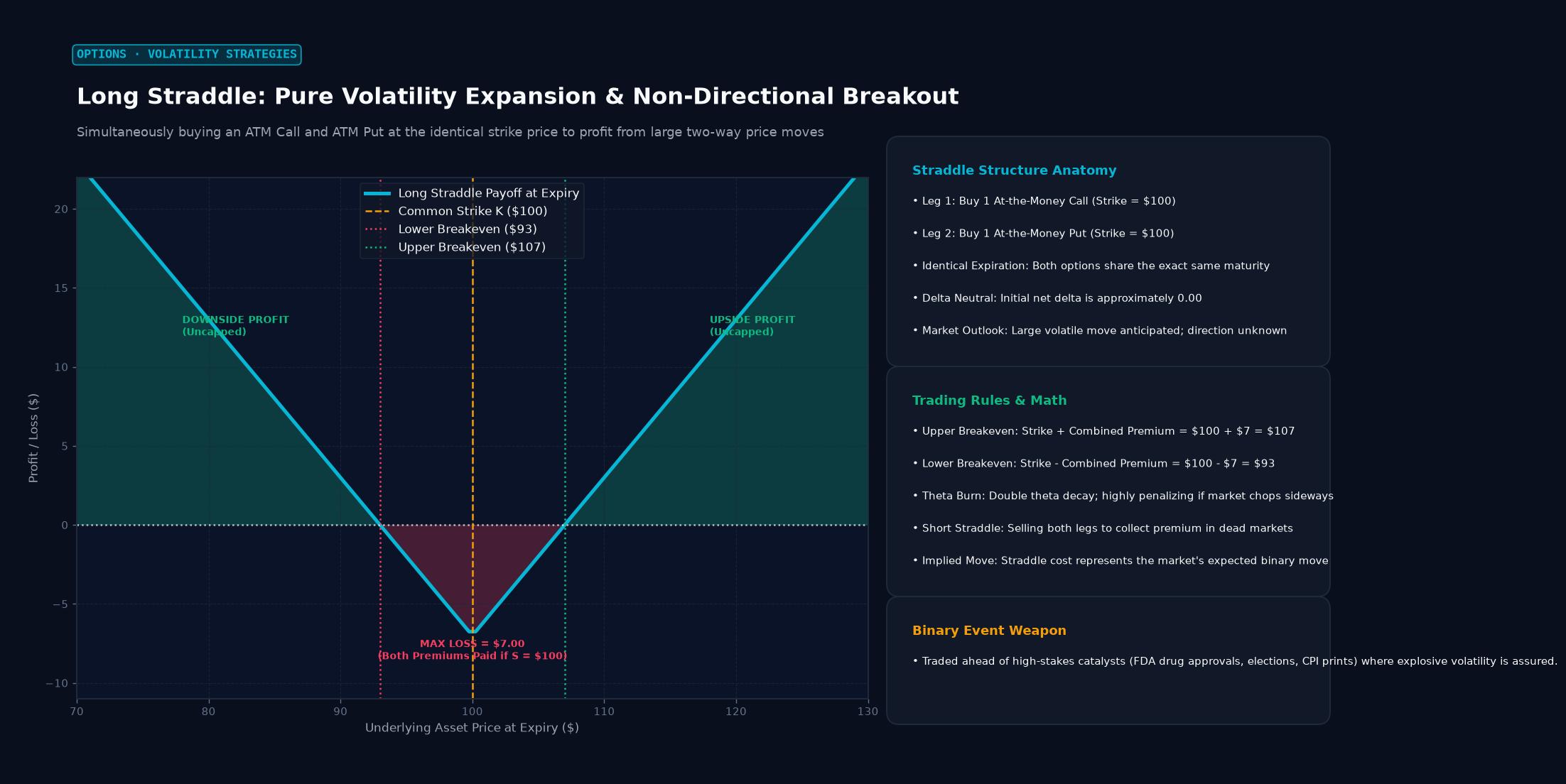 Figure: Simultaneously buying an ATM Call and ATM Put at the identical strike price to profit from large two-way price moves
The Mathematics of a Long Straddle
To achieve profitability on a Long Straddle, the price of the underlying asset must move far enough away from the strike price ($K$) to cover the total premium paid ($P_{\text{total}}$):
$$P_{\text{total}} = \text{Premium}{\text{Call}} + \text{Premium}{\text{Put}}$$
1. Dual Breakeven Points
A long straddle features two distinct breakeven thresholds at expiration:
$$\text{Upper Breakeven} = K + P_{\text{total}}$$
$$\text{Lower Breakeven} = K - P_{\text{total}}$$
2. Payoff Calculations at Expiration
$$\text{Payoff} = \max\left(S_T - K, ; 0\right) + \max\left(K - S_T, ; 0\right) - P_{\text{total}}$$
- Maximum Risk: Strictly capped at the total upfront debit paid ($P_{\text{total}}$). This maximum loss occurs if the asset closes precisely at strike price $K$ at expiration, causing both options to expire completely worthless.
- Maximum Profit Potential: Theoretically Unlimited on the upside (as an asset can rise infinitely) and Substantial on the downside (capped only by the asset price reaching zero).
Concrete Example: Straddle on EUR/USD Options
Assume spot EUR/USD trades at 1.0800:
- Buy 1.0800 ATM Call: Premium = 70 pips ($0.0070)
- Buy 1.0800 ATM Put: Premium = 70 pips ($0.0070)
- Total Premium Paid ($P_{\text{total}}$): 140 pips ($0.0140)
- Upper Breakeven: $1.0800 + 0.0140 = \mathbf{1.0940}$
- Lower Breakeven: $1.0800 - 0.0140 = \mathbf{1.0660}$
To generate a net profit by expiration, EUR/USD must either rally above 1.0940 or collapse below 1.0660.
The Greeks of a Straddle
A straddle’s sensitivity to market variables is governed by its option Greeks:
               THE GREEKS OF AN AT-THE-MONEY STRADDLE

 Metric               Long Straddle                 Short Straddle
 ────────────────────────────────────────────────────────────────────────
 Delta (Δ)            Near ZERO (Δ ≈ 0)             Near ZERO (Δ ≈ 0)
                      Directionally Neutral         Directionally Neutral

 Gamma (Γ)            POSITIVE (Γ > 0)              NEGATIVE (Γ < 0)
                      Accelerates winning leg       Accelerates losses on breakout

 Vega (V)             POSITIVE (V > 0)              NEGATIVE (V < 0)
                      Profits from rising IV        Profits from IV collapse

 Theta (Θ)            NEGATIVE (Θ < 0)              POSITIVE (Θ > 0)
                      Severe daily time decay       Earns daily premium decay
Long Straddle vs. Short Straddle vs. Long Strangle
| Strategy | Construction | Bias / Outlook | Max Profit | Max Loss |
|---|---|---|---|---|
| Long Straddle | Buy ATM Call + Buy ATM Put (Same Strike $K$) | Explosive volatility in either direction | Unlimited (Upside) / Substantial (Downside) | Strictly capped at total premium paid |
| Short Straddle | Sell ATM Call + Sell ATM Put (Same Strike $K$) | Minimal volatility; sideways range | Capped at net credit received | Theoretically Unlimited |
| Long Strangle | Buy OTM Call ($K_2$) + Buy OTM Put ($K_1$) | Massive volatility; cheaper premium than straddle | Unlimited (Upside) / Substantial (Downside) | Strictly capped at total premium paid (Cheaper than Straddle) |
Real-World Institutional Case Study: Trading Straddles and the “IV Crush”
Hedge funds and proprietary desks frequently purchase long straddles ahead of major binary macroeconomic events—such as U.S. Federal Reserve interest rate announcements, Consumer Price Index (CPI) releases, or high-profile tech corporate earnings.
       THE VOLATILITY CRUSH PHENOMENON (IMPLIED VS. REALIZED)

 Pre-Announcement (T - 1 Day):
 - Anticipation of Fed decision drives Implied Volatility (IV) from 12% to 28%.
 - High IV inflates option premiums; 1-week EUR/USD straddle costs 160 pips.

 Post-Announcement (T + 1 Hour):
 - Federal Reserve announces a widely expected 25 bps rate hike.
 - Spot EUR/USD moves 65 pips higher.
 - The Event Uncertainty Ends: Implied Volatility instantly collapses from 28% to 11%.

 The Straddle Result:
 - Even though EUR/USD moved 65 pips, the 65-pip gain on the Call option was
   completely obliterated by the IV collapse (Vega loss) and Put expiration.
 - Net Outcome: The Long Straddle lost 75 pips despite correctly predicting
   a directional advance.
This dynamic illustrates the cardinal rule of professional options trading: buying a straddle requires not just a price move, but a move that exceeds the volatility priced into the market by the collective option-writing community.
Tactical Rules for Trading Straddles
- Avoid High-IV Traps: Never buy long straddles when Implied Volatility is already trading at the 90th percentile of its annual range. The subsequent “volatility crush” will erode contract value even if the market breaks out.
- Close Before Expiration: In a long straddle, dynamic gamma makes early profit-taking attractive. If a sharp move occurs days before expiration, close the winning leg or liquidate the entire structure before theta decay accelerates exponentially.
- Deploy Delta Hedging: Institutional market makers who sell short straddles to collect theta continuously buy and sell underlying spot futures to keep portfolio delta at zero, immunizing themselves against trending moves.
Frequently Asked Questions
What is the biggest danger of buying a long straddle?
The two greatest hazards are Theta Decay (Time Decay) and Volatility Crush (IV Crush). Every day that passes without a significant price move permanently deducts cash value from both options. Furthermore, if market uncertainty resolves and implied volatility drops, both options lose value simultaneously even if the underlying asset drifts moderately.
Why are straddles more expensive than strangles?
A straddle uses At-The-Money (ATM) options, which carry the highest time value and greatest extrinsic value of all option strikes. A strangle uses Out-of-The-Money (OTM) options, which are cheaper because they require larger price moves to achieve intrinsic value.
Can straddles be executed in retail forex trading?
Yes, provided the trader has an account with a broker that offers genuine vanilla currency options (such as Saxo Bank or Interactive Brokers). While standard retail MetaTrader platforms only trade spot margin contracts, exchange-traded currency options (CME FX options) and OTC vanilla options desks support automated multi-leg straddle order tickets.
Ready to trade forex?
Open a free demo account with a regulated broker. Practice with virtual funds before risking real money.