TND
The ISO 4217 currency code for the Tunisian Dinar, the official legal tender of the Republic of Tunisia, managed by the Central Bank of Tunisia under strict capital and convertibility controls.
TND (Tunisian Dinar)
The Tunisian Dinar (ISO code: TND) is the official currency of the Republic of Tunisia. Subdivided into 1,000 millimes (distinguishing it from decimalized currencies that divide into 100 subunits), the dinar was established in 1958, replacing the Tunisian franc following national independence from France. It is issued, regulated, and defended by the Central Bank of Tunisia (Banque Centrale de Tunisie, or BCT).
In international finance and macroeconomic analysis, the Tunisian dinar is defined by its closed capital account and non-convertible status. Tunisian law strictly restricts the export and import of physical dinar banknotes, prohibits residents from holding foreign bank accounts without explicit regulatory authorization, and mandates that foreign exchange transactions be justified by legitimate commercial trade invoices or authorized capital investments.
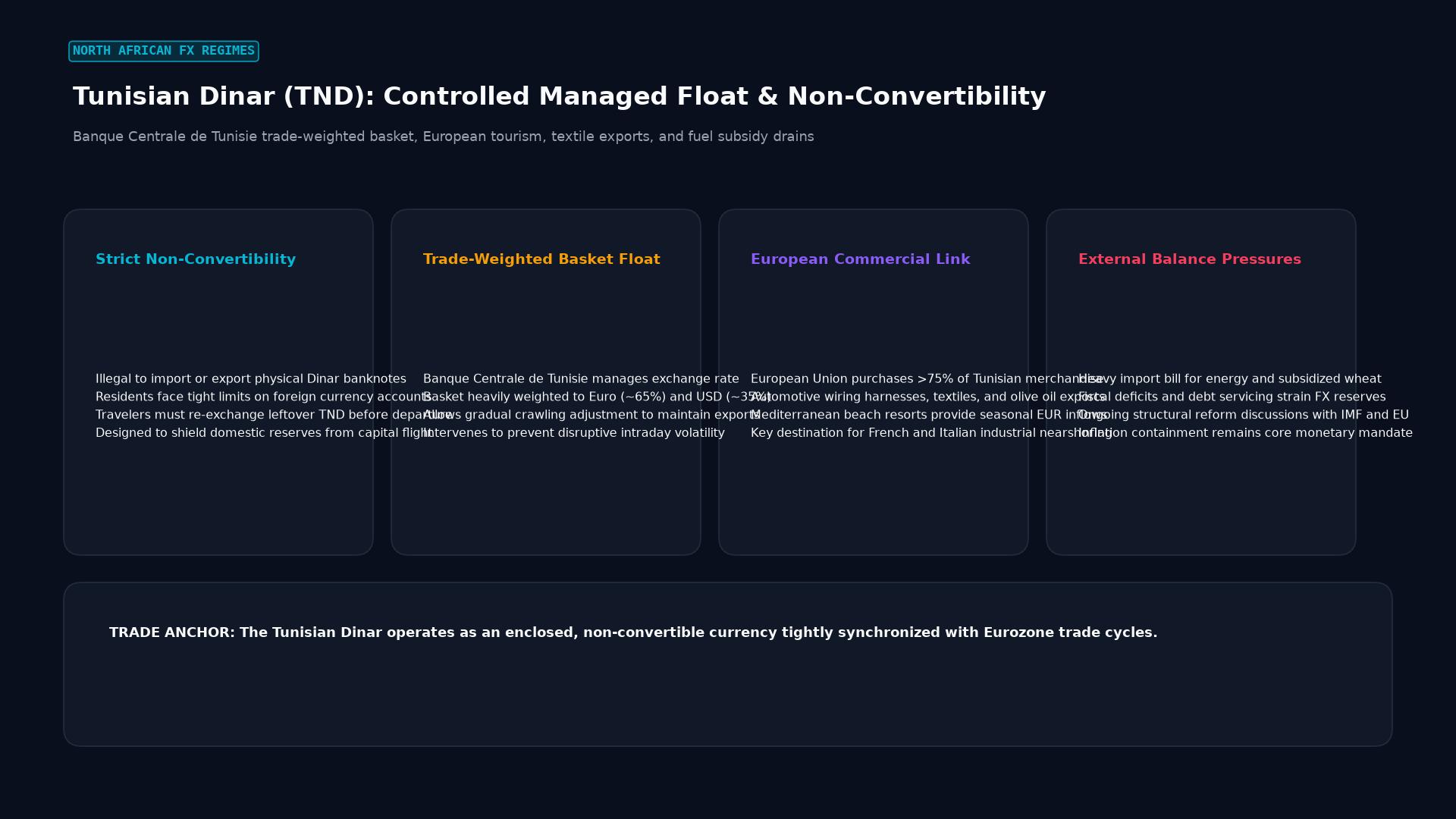 Figure: Banque Centrale de Tunisie trade-weighted basket, European tourism, textile exports, and fuel subsidy drains
Historical Origins and Currency Evolution
Tunisia operated within the French colonial franc zone for decades. Following full political independence in 1956, modern monetary sovereign institutions were established:
- Law No. 58-109 of October 18, 1958: This historic statute established the Central Bank of Tunisia and created the Tunisian dinar, establishing parity at 1 dinar = 1,000 French francs (old francs).
- Severance from the French Franc: Unlike the CFA franc zones in Sub-Saharan Africa, Tunisia opted for complete monetary sovereignty. Following the French devaluation in late 1958, Tunisia refused to devalue, breaking the fixed 1:1 link with the French franc and establishing independent exchange management.
- Decades of Closed-Account Stability: Through the 1970s and 1980s, strict state management ensured relatively stable purchasing power, although balance-of-payments crises prompted periodic structural adjustment agreements with the International Monetary Fund (IMF).
- Post-2011 Macroeconomic Pressures: Following the 2011 revolution, Tunisia faced severe macroeconomic headwinds, including industrial strikes in phosphate mining regions, tourism downturns following security events, expanding fiscal deficits, and rising sovereign debt service, resulting in continuous downward pressure on the dinar.
Monetary Policy Framework of the Banque Centrale de Tunisie
The BCT operates under an statutory mandate to maintain price stability while supporting overall economic development. It utilizes an interest rate targeting mechanism (the benchmark BCT key interest rate, or taux directeur) to influence interbank money market liquidity (taux du marché monétaire, or TMM).
The Exchange Rate Regime: Managed Crawling Basket
The BCT does not permit the dinar to float freely on global capital markets. Instead, it operates a managed crawling peg regime referencing a trade-weighted currency basket:
$$\text{Basket Index} = w_{\text{EUR}} \times \left(\frac{\text{EUR}_t}{\text{EUR}0}\right) + w{\text{USD}} \times \left(\frac{\text{USD}_t}{\text{USD}_0}\right)$$
While the BCT does not publicly publish the exact statistical weights of its reference basket, empirical econometric studies indicate:
- Euro (EUR): Holds approximately 60% to 70% of the basket weighting, reflecting the European Union’s dominance as Tunisia’s primary trading partner for manufacturing, textile exports, and tourism arrivals.
- US Dollar (USD): Holds roughly 30% to 40% of the basket weighting, reflecting dollar-denominated imports such as refined petroleum fuels, wheat, fertilizers, and sovereign external debt obligations.
The BCT intervenes regularly in the domestic interbank foreign exchange market (marché des changes interbancaire) by buying and selling foreign currency reserves to keep the dinar trading within an unpublished crawling band.
Core Economic Drivers of the Dinar
1. The Energy and Cereal Import Bill
Tunisia suffers from chronic structural deficits in domestic energy production and staple food supply. Refined hydrocarbons and soft wheat must be imported in vast quantities, predominantly denominated in US dollars. Spikes in global commodity prices quickly swell the national trade deficit, draining central bank foreign exchange reserves.
2. Phosphate Mining and Chemical Exports
Tunisia possesses vast natural phosphate deposits concentrated in the southern Gafsa basin (Compagnie des Phosphates de Gafsa, CPG). Phosphates and their downstream derivatives (phosphoric acid and chemical fertilizers) historically formed the cornerstone of industrial export receipts. Disruptions to railway transportation and mining operations have directly impaired hard-currency inflows over the past decade.
3. Tourism Receipts and Migrant Remittances
Tourism represents an indispensable pillar of foreign exchange liquidity, generating inflows during the summer European holiday season. Simultaneously, remittances sent home by hundreds of thousands of Tunisians residing in France, Italy, Germany, and the Gulf States provide an essential counter-cyclical safety net for the current account.
+------------------------------------------------------------------------+
|                Tunisian Current Account Balance Dynamics               |
+------------------------------------------------------------------------+
| Inflow Channels (+)                   | Outflow Channels (-)           |
| - Olive Oil and Dates Exports         | - Hydrocarbon & Gas Imports    |
| - Automotive Parts & Textiles (EU)    | - Soft Wheat & Grain Imports   |
| - Phosphate & Fertilizer Products     | - Capital Machinery Imports    |
| - European Tourism Expenditures       | - External Debt Amortization   |
| - Diaspora Remittances (EUR / USD)    | - Freight & Shipping Services  |
+------------------------------------------------------------------------+
Capital Controls and Regulatory Architecture
Tunisia enforces one of the strictest exchange control regimes in the Mediterranean basin, regulated under the Foreign Exchange and Foreign Trade Code (Code des Changes et du Commerce Extérieur):
- Non-Exportability of Banknotes: It is strictly illegal to import or export physical Tunisian dinar banknotes across international borders. Non-resident travelers departing Tunisia must convert any unspent dinars back into foreign currency before passing through customs, presenting official exchange receipts from authorized exchange bureaus or commercial banks.
- Convertible Dinar Accounts: Foreign companies, international non-governmental organizations, and non-resident foreign nationals are permitted to open “convertible dinar accounts” (comptes en dinars convertibles). These accounts are funded through foreign currency remittances and allow uninhibited reconversion into foreign currency.
- Resident Bank Account Restrictions: Tunisian resident individuals and domestic non-exporting corporations cannot maintain foreign-currency-denominated bank accounts or own overseas real estate without specific authorization from the Central Bank.
- Commercial Invoicing Protocols: Importers must provide commercial invoices, transport bills of lading, and import declarations to licensed intermediary banks (banques intermédiaires agréées) to obtain clearance for cross-border wire transfers.
Hedging Mechanisms: The Onshore Forward Market
Because the dinar is non-convertible and cannot trade on global futures exchanges (such as the Chicago Mercantile Exchange), international corporations with operations in Tunisia manage currency exposure through specific local mechanisms:
- Onshore Forward Exchange Contracts (Vente à Terme): Licensed commercial banks in Tunisia are permitted to quote forward exchange rates for legitimate commercial operations. Importers can hedge foreign exchange purchase commitments up to 12 months forward, while exporters can sell anticipated export receipts forward.
- Forward Pricing Formula: $$F = S \times \left[\frac{1 + (r_{\text{TND}} \times \frac{d}{360})}{1 + (r_{\text{foreign}} \times \frac{d}{360})}\right]$$ Where $S$ is the spot rate, $r_{\text{TND}}$ is the Tunisian interbank interest rate, $r_{\text{foreign}}$ is the foreign reference rate (such as Euribor or SOFR), and $d$ is the contract tenor in days.
- Offshore Non-Deliverable Forwards (NDF): A limited, low-liquidity offshore NDF market exists in London and Paris, traded primarily by international investment banks and sovereign credit funds, settling net cash flows strictly in US dollars.
Comprehensive Comparison: North African Currencies
| Metric | Tunisian Dinar (TND) | Moroccan Dirham (MAD) | Algerian Dinar (DZD) | Egyptian Pound (EGP) |
|---|---|---|---|---|
| Central Bank | Banque Centrale de Tunisie | Bank Al-Maghrib | Banque d’Algérie | Central Bank of Egypt |
| Exchange Regime | Managed crawling basket | Managed horizontal band | Managed float | Managed float / Flexible |
| Convertibility | Non-convertible | Non-convertible | Strictly non-convertible | Partially convertible |
| Primary Anchor | EUR (~65%) / USD (~35%) | EUR (60%) / USD (40%) | Oil / Gas export pricing | Flexible market clearing |
| Subunit | 1,000 millimes | 100 centimes | 100 centimes | 100 piastres |
Frequently Asked Questions
Why is the Tunisian Dinar divided into 1,000 millimes instead of 100 cents?
The Tunisian dinar follows the historical Arabic monetary convention common in the Middle East and North Africa (seen also in Kuwait, Bahrain, Oman, and Iraq), where the primary currency unit is divided into 1,000 smaller units. In Tunisia, this subunit is called the millime (from the Latin millesimus, meaning thousandth), enabling fine-grained domestic pricing for everyday goods.
Can travelers take Tunisian dinars outside the country?
No. Exporting Tunisian dinar banknotes outside the country is strictly forbidden by Tunisian customs law. Travelers visiting Tunisia are advised to exchange foreign currency into dinars in moderate increments as needed, retain all formal exchange receipts, and convert remaining dinars back into hard currency at airport exchange counters prior to international passport control.
Can institutional investors access TND via standard Western forex brokers?
No. Because of tight capital controls and non-convertibility mandates enforced by the Central Bank of Tunisia, TND is not available on standard retail or institutional margin-trading forex platforms. Exposure to Tunisian assets is typically executed via local banking subsidiaries or specialized over-the-counter forward arrangements directly linked to validated commercial or infrastructure contracts.
Ready to trade forex?
Open a free demo account with a regulated broker. Practice with virtual funds before risking real money.