TOP
The ISO 4217 currency code for the Tongan Paʻanga, the official legal tender of the Kingdom of Tonga, pegged to a trade-weighted basket of foreign currencies by the National Reserve Bank of Tonga.
TOP (Tongan Paʻanga)
The Tongan Paʻanga (ISO code: TOP) is the official sovereign currency of the Kingdom of Tonga, a Polynesian archipelago nation comprising more than 170 islands in the South Pacific. Subdivided into 100 seniti (cents), the paʻanga was introduced on April 3, 1967, replacing the pre-decimal Tongan pound at a conversion rate of 1 pound = 2 paʻanga (or 1 paʻanga = 10 Australian shillings). It is issued and administered by the central monetary authority, the National Reserve Bank of Tonga (NRBT, or Pangike Pule Fakafonua ’o Tonga).
Within international macroeconomics, the paʻanga exemplifies the monetary and exchange-rate mechanics of a small island developing state (SIDS). The currency’s external stability is maintained via an adjustable peg to a trade-weighted basket of major currencies, shielding a highly open, import-dependent economy from single-currency volatility while absorbing substantial cross-border remittance flows from Tongan diasporas residing in New Zealand, Australia, and the United States.
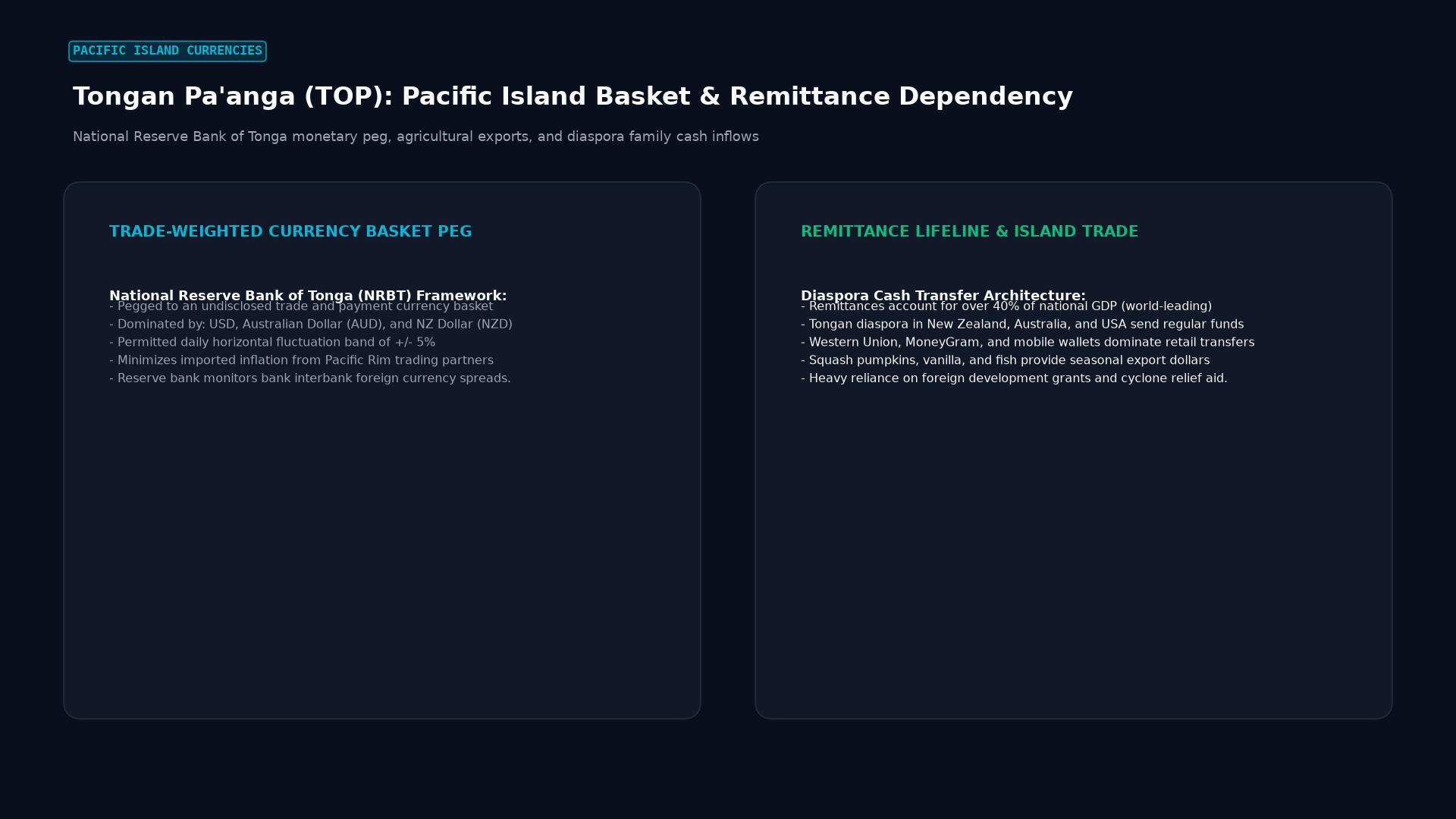 Figure: National Reserve Bank of Tonga monetary peg, agricultural exports, and diaspora family cash inflows
Historical Context and Monetary Genesis
Prior to the formalization of modern central banking in Tonga, the archipelago utilized British and Australian colonial currency arrangements:
- The Tongan Pound Era: Between 1921 and 1967, the Kingdom operated under the Tongan pound, issued initially by the British-administered Government of Tonga Treasury. The Tongan pound was historically maintained at parity with the Australian pound.
- Decimalization in 1967: On April 3, 1967, Tonga decimalized its monetary system, introducing the paʻanga. The name paʻanga refers to a traditional Polynesian vine seed (Entada phaseoloides) historically prized in traditional game playing, dance ornamentation, and ceremonial trade.
- Establishment of the NRBT (1989): For over two decades following decimalization, the currency was issued under the authority of the Treasury and Bank of Tonga (a commercial joint venture). In July 1989, the National Reserve Bank of Tonga Act established a fully sovereign central banking institution, transferring all currency issuance, reserve management, and prudential supervisory powers to the NRBT.
- Shift from Direct Australian Dollar Parity: Initially, the paʻanga was pegged at a 1:1 parity with the Australian dollar. However, severe depreciation of the Australian dollar in the mid-1980s imported unwanted inflationary pressures into Tonga. In February 1991, the NRBT severed the unilateral 1:1 AUD link and adopted a multi-currency peg basket.
Monetary Policy Framework of the National Reserve Bank of Tonga
The National Reserve Bank of Tonga operates with statutory objectives focused on maintaining domestic price stability, ensuring adequate foreign exchange reserves to cover vital national imports, and promoting a sound financial system.
The Basket Peg Mechanism
The central bank determines the daily official exchange rate of the paʻanga by linking it to a trade-weighted basket of four primary currencies:
- Australian Dollar (AUD)
- New Zealand Dollar (NZD)
- United States Dollar (USD)
- Fijian Dollar (FJD)
       Theoretical Basket Valuation Equation:

       V_TOP = w_AUD * E_AUD + w_NZD * E_NZD + w_USD * E_USD + w_FJD * E_FJD

       Where:
       w_i = Weights assigned based on bilateral trade share and remittance origins
       E_i = Bilateral exchange rates against individual basket currencies
The NRBT retains statutory authority to adjust the basket weights or apply an adjustment factor (a crawling element or discretionary realignment) if structural balance-of-payments imbalances emerge or if real effective exchange rate (REER) overvaluation threatens external competitiveness.
Foreign Exchange Reserve Coverage
Because Tonga produces few manufactured consumer products and relies completely on imported petroleum products for domestic electricity generation and marine transport, maintaining import reserve cover is the primary operational benchmark of the central bank:
- Target Reserve Metric: The NRBT targets maintaining gross official foreign exchange reserves equivalent to a minimum of 3 to 4 months of total merchandise imports.
- During periods of heavy aid disbursement or surging remittances, reserve cover has frequently exceeded 7 to 9 months of imports, providing a substantial cushion against external shocks.
Macroeconomic Drivers of the Tongan Paʻanga
1. Remittance Inflows: The Economic Lifeblood
Tonga has one of the highest ratios of personal remittance inflows to gross domestic product in the global economy, frequently exceeding 35% to 40% of national GDP.
- Large Tongan communities reside in Auckland, Sydney, Melbourne, Honolulu, and California.
- Remittance flows exhibit pronounced seasonal peaks around the annual church donation conferences (Misinale in August–October), the school term beginnings in January, and Christmas holidays.
- Because these inflows arrive in NZD, AUD, and USD, commercial banks in Nukuʻalofa accumulate substantial foreign balances that are subsequently converted into paʻanga via the NRBT window.
2. Extreme Vulnerability to Climate and Geopolitical Shocks
As demonstrated by catastrophic natural events, such as Cyclone Gita in 2018 and the massive underwater eruption of the Hunga Tonga-Hunga Haʻapai volcano and subsequent tsunami in January 2022, Tonga’s economic output can be severely disrupted in hours:
- Agricultural crops (vanilla, squash, watermelons, root crops) and artisanal fisheries can be destroyed.
- Infrastructure repair requires massive emergency imports of building supplies, fuel, and heavy equipment.
- Such crises require the NRBT to draw down international reserves while coordinating with international financial institutions (Asian Development Bank, World Bank, IMF) and bilateral sovereign donors (Australia, New Zealand, Japan) for emergency concessional financing.
3. Agricultural Exports and Tourism
Beyond remittances, Tonga’s autonomous foreign exchange earnings rely on niche agricultural exports:
- Squash Pumpkin: Exported primarily to the Japanese winter market.
- Vanilla Beans: Premium-grade organic bourbon vanilla exported to culinary markets in the US and Europe.
- Tourism: Concentrated around seasonal whale-watching expeditions in the Vavaʻu island group.
Comparison: South Pacific Island Currencies
| Currency Code | Country | Issuing Central Bank | Exchange Regime | Primary Reserve Anchor |
|---|---|---|---|---|
| TOP | Tonga | National Reserve Bank of Tonga | Basket peg (adjustable) | AUD, NZD, USD, FJD |
| FJD | Fiji | Reserve Bank of Fiji | Basket peg | AUD, NZD, USD, JPY, EUR |
| WST | Samoa | Central Bank of Samoa | Basket peg | NZD, AUD, USD, EUR |
| VUV | Vanuatu | Reserve Bank of Vanuatu | Basket peg | AUD, NZD, USD, EUR |
| SBD | Solomon Islands | Central Bank of Solomon Islands | Basket peg with crawl | USD, AUD, NZD |
Practical Constraints and Foreign Exchange Operations
For international companies, NGOs, and expatriates interacting with the Tongan financial system, the following practical realities govern paʻanga transactions:
- Absence of International Derivatives: There are no forward, futures, or options contracts traded on international exchanges for the Tongan paʻanga. Foreign exchange risk cannot be hedged through conventional OTC derivatives outside specialized commercial bank bilateral arrangements in Nukuʻalofa.
- Exchange Control Regulations: The NRBT enforces exchange control guidelines. While current account transactions (paying for imported goods and services) are largely liberalized, capital account outflows (such as large overseas capital investments or offshore transfers by domestic residents) require formal central bank documentation and clearance.
- Authorized Dealers: The domestic foreign exchange market is dominated by a small group of licensed commercial institutions, including Westpac Bank Tonga, Bank of South Pacific (BSP) Tonga, and Tonga Development Bank.
Frequently Asked Questions
What does the word “Paʻanga” mean?
The term paʻanga is the native Tongan name for the large seeds of the Entada phaseoloides vine. Historically, these large brown seeds were used in traditional games (lafo) and hung around the neck as ornamentation. When Tonga decimalized its currency in 1967, the term was adopted as the sovereign unit of account to reflect national cultural heritage.
Why is the Tongan paʻanga pegged to a basket rather than solely to the US Dollar?
A single-currency peg to the US dollar would expose Tonga’s domestic price level to severe distortion whenever the dollar appreciated or depreciated against the Australian and New Zealand currencies. Because Tonga imports the vast majority of its consumer goods, food products, and construction materials from Australia and New Zealand, and receives major remittance flows from families living in Auckland and Sydney, incorporating the AUD and NZD into a currency basket ensures greater real macroeconomic stability.
Can tourists exchange TOP outside the South Pacific region?
It is very difficult to exchange Tongan paʻanga banknotes outside Tonga, Fiji, New Zealand, or Australia. International airport currency counters outside the immediate Pacific region rarely stock or buy paʻanga due to its low trading volume. Travelers are strongly advised to convert unspent paʻanga back into major international currencies (such as AUD, NZD, or USD) before departing Fuaʻamotu International Airport in Tonga.
Ready to trade forex?
Open a free demo account with a regulated broker. Practice with virtual funds before risking real money.