Triangular Arbitrage
Triangular arbitrage is a quantitative trading strategy that exploits pricing discrepancies between three different currency pairs, executing three concurrent transactions to lock in an instantaneous, risk-free profit.
Triangular arbitrage is an advanced financial strategy that capitalizes on temporary pricing imbalances among three interconnected currency pairs in the foreign exchange market. By converting an initial currency through two intermediary currencies and back into the original currency, an arbitrageur exploits discrepancies where cross-exchange rates diverge from their theoretical mathematical parity.
In theory, triangular arbitrage delivers pure, riskless profit with zero directional exposure to the broader market. In practice, because modern financial markets are populated by sophisticated high-frequency trading (HFT) algorithms operating in microseconds, these pricing inefficiencies exist for only fractions of a second before automated order flow restores market equilibrium.
The Mathematical Foundation of Triangular Arbitrage
In an efficient foreign exchange market, the exchange rate of a currency cross must equal the mathematical quotient of the two currencies quoted against a common third base (most commonly the U.S. dollar).
Consider the classic triad of EUR/USD, GBP/USD, and the cross pair EUR/GBP. The theoretical synthetic cross rate is defined by:
$$\text{Theoretical EUR/GBP} = \frac{\text{EUR/USD}}{\text{GBP/USD}}$$
For an arbitrage opportunity to materialize, the product of the three exchange rates along the currency conversion loop must diverge from parity ($1.0$):
$$\left(\frac{\text{Currency } B}{\text{Currency } A}\right) \times \left(\frac{\text{Currency } C}{\text{Currency } B}\right) \times \left(\frac{\text{Currency } A}{\text{Currency } C}\right) > 1.0 + \text{Transaction Costs}$$
If the product exceeds $1.0$ after accounting for bid-ask spreads and execution fees, a circular sequence of trades will generate an instantaneous cash profit.
A Step-by-Step Numerical Example
Suppose an institutional quantitative desk detects a transient pricing discrepancy among USD, EUR, and GBP:
- Quoted Market Rates:
- EUR/USD: 1.0850 (Cost to buy 1 EUR = $1.0850)
- EUR/GBP: 0.8550 (Cost to buy 1 EUR = £0.8550)
- GBP/USD: 1.2720 (Cost to buy 1 GBP = $1.2720)
- Theoretical Parity Check: $$\text{Synthetic EUR/GBP} = \frac{1.0850}{1.2720} = 0.85298$$
- The Mispricing: The actual market quote for EUR/GBP (0.8550) is higher than the synthetic cross rate (0.85298). The euro is overvalued relative to the British pound in the direct cross pair.
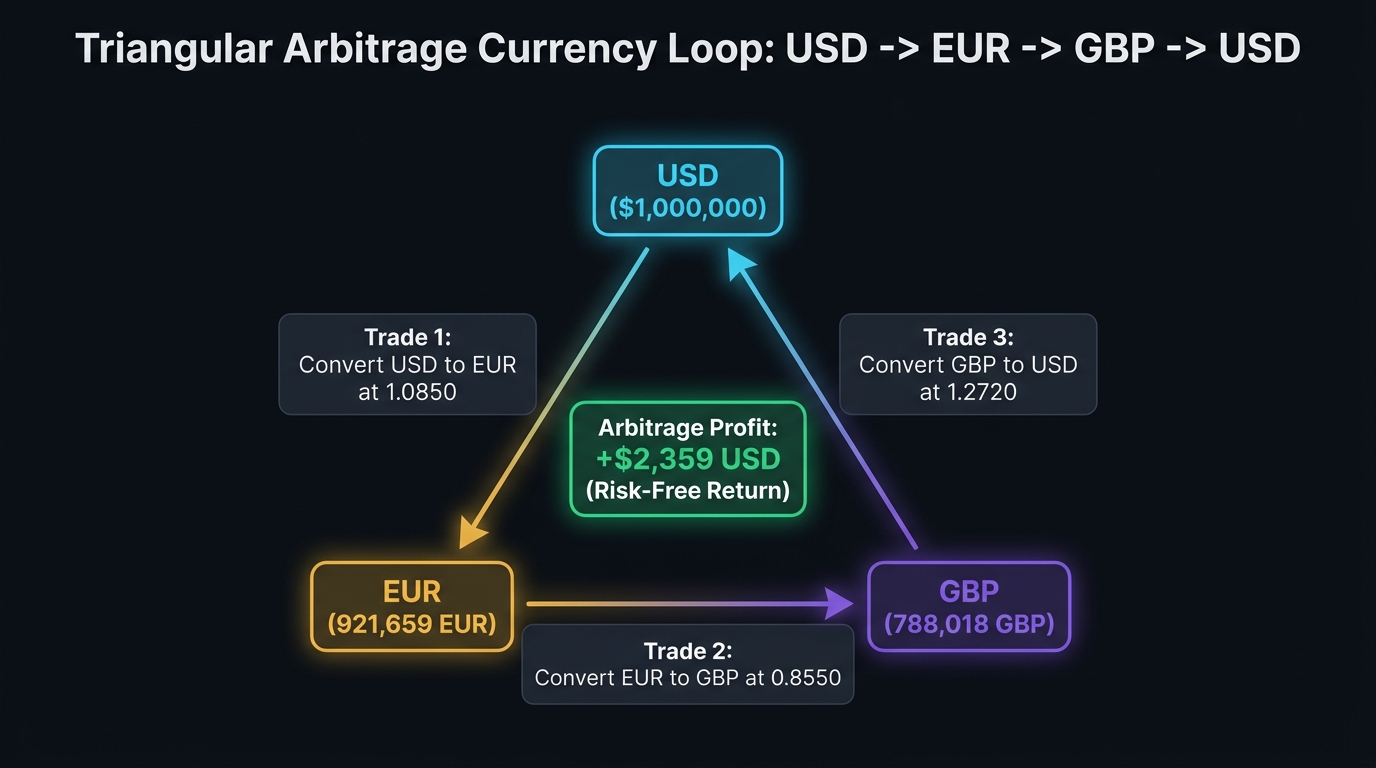
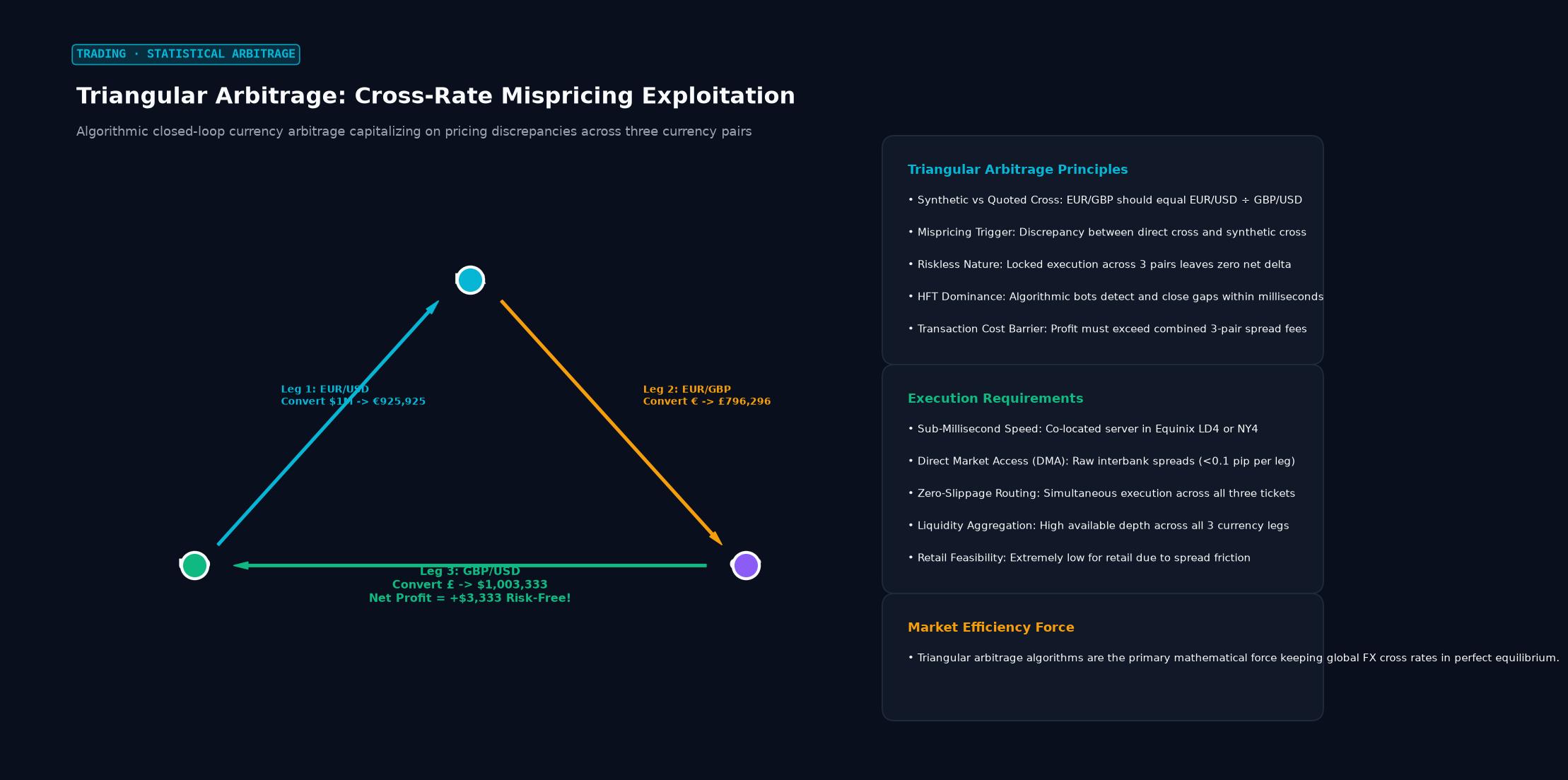 Figure: Algorithmic closed-loop currency arbitrage capitalizing on pricing discrepancies across three currency pairs
Execution Breakdown:
- Trade 1 (USD to EUR): The trader converts $1,000,000 into euros at 1.0850: $$\frac{$1,000,000}{1.0850} = 921,659.91 \text{ EUR}$$
- Trade 2 (EUR to GBP): The trader converts those euros into British pounds at 0.8550: $$921,659.91 \text{ EUR} \times 0.8550 = 788,019.22 \text{ GBP}$$
- Trade 3 (GBP back to USD): The trader converts the pounds back into U.S. dollars at 1.2720: $$788,019.22 \text{ GBP} \times 1.2720 = $1,002,360.45 \text{ USD}$$
Net Cash Result: The trader started with $1,000,000 and ended the 3-step loop with $1,002,360.45, locking in an instantaneous gross profit of $2,360.45 (a 0.236% return) with zero overnight holding risk.
Institutional Realities: High-Frequency Trading and Latency
While the arithmetic of triangular arbitrage appears straightforward, executing it profitably in real-world retail conditions is virtually impossible:
| Trading Hurdle | Retail Trader Environment | Institutional HFT Environment |
|---|---|---|
| Execution Latency | 50 to 200 milliseconds (residential internet) | Sub-millisecond (nanoseconds via fiber optic / microwave links) |
| Server Proximity | Remote personal computers | Co-located servers inside exchange data centers (NY4, LD4, TY3) |
| Transaction Costs | Retail bid-ask spreads (0.8 to 2.0 pips) + commission | Raw interbank spreads (0.0 to 0.2 pips) + wholesale clearing rates |
| Execution Risk | High risk of partial fills and execution slippage | Atomic execution (simultaneous fill-or-kill routing) |
By the time a retail trader manually observes a 2-pip pricing discrepancy across three currency pairs, automated algorithmic engines have already detected the mismatch, deployed hundreds of millions of dollars in capital, and closed the pricing window in less than 50 milliseconds.
Key Takeaways
- Loop Arbitrage: Triangular arbitrage captures pricing discrepancies between three foreign exchange pairs by executing a closed circular sequence of transactions.
- Synthetic Cross Comparison: Mispricings occur when an actual cross rate deviates from the ratio of its underlying USD pairs.
- Market-Neutral: The strategy carries zero market directional risk because all legs are opened and settled simultaneously.
- HFT Dominated: Institutional quantitative firms dominate triangular arbitrage using co-located servers and microsecond execution algorithms.
- Cost Sensitivity: Realized arbitrage profits must exceed the cumulative bid-ask spreads and commissions across all three legs of the trade.
Frequently Asked Questions
Can retail forex traders make money with triangular arbitrage?
Almost never. Retail broker spreads, commissions, and execution latency (the time it takes for an order to reach the broker’s server) devour the tiny fractions of a pip that arbitrage opportunities offer, usually resulting in a net loss.
Does triangular arbitrage help or harm the forex market?
Triangular arbitrage is highly beneficial to the market. Arbitrageurs act as vital efficiency engines: by rapidly buying undervalued currencies and selling overvalued ones, they eliminate mispricings and maintain consistent, synchronized pricing across global financial centers.
What is execution risk in triangular arbitrage?
Execution risk (or “leg risk”) occurs when one or two legs of the three-part transaction are filled, but the third leg experiences slippage or fails to execute due to a rapid price change. This leaves the trader unintentionally exposed to directional market risk on an unhedged position.
Ready to trade forex?
Open a free demo account with a regulated broker. Practice with virtual funds before risking real money.