Ask (Offer) Price
The ask price, also commonly referred to as the offer price, is the lowest price at which a seller, market maker, or broker is willing to sell a specific currency pair or asset. In retail trading, it represents the exact rate at which a buyer can enter a long position immediately using a market order.
Understanding the Ask and Offer Price
Every quotation in the foreign exchange market consists of two separate numbers: a bid price on the left and an ask price on the right. While the terms “ask” and “offer” mean the exact same thing in financial jargon, their usage reflects different trading backgrounds. Interbank desks and institutional floor traders historically preferred the term “offer,” whereas North American equity markets and retail electronic trading terminals popularized the term “ask.”
The fundamental rule of financial execution is straightforward:
- You buy from the market at the ask price.
- You sell to the market at the bid price.
Because dealers and liquidity providers require compensation for taking on inventory risk and facilitating instantaneous transactions, the ask price is always higher than the bid price. The mathematical difference between these two figures is known as the spread. When you place an immediate market order to buy EUR/USD, you pay the ask price. If you were to close that position one second later without any market movement, you would sell at the bid price, incurring a small loss equal to the spread.
How Quotes Appear on Trading Terminals
Currency pair quotes on modern platforms like MetaTrader, cTrader, or TradingView typically appear formatted in a dual-box display:
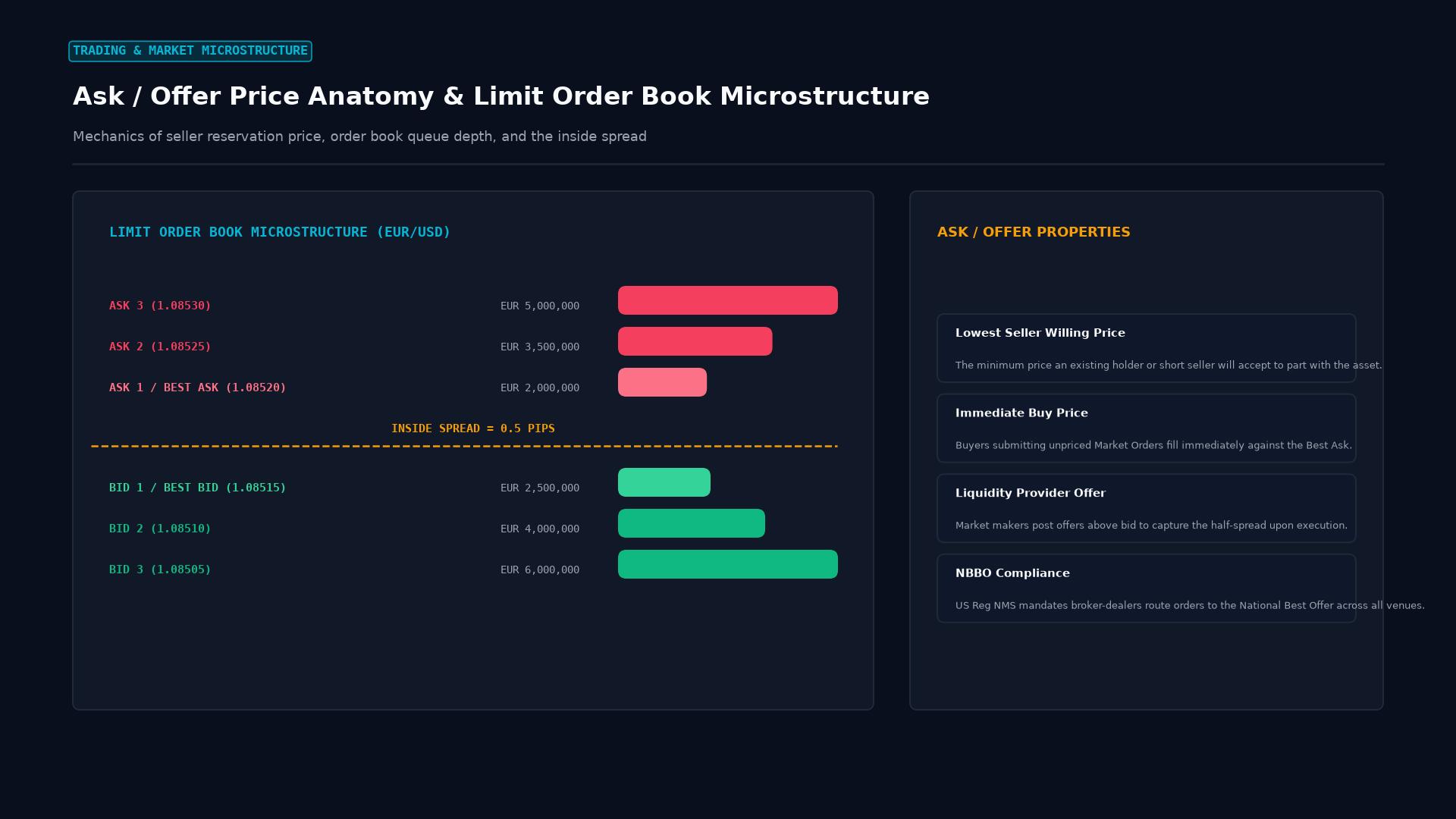 Figure: Limit order book mechanics: seller reservation pricing, ask queue depth distribution, market order matching, and the inside bid-ask spread.
In this quotation:
- Bid Price: 1.08502 (the rate you receive if you sell Euros for US Dollars)
- Ask Price: 1.08514 (the rate you pay if you buy Euros using US Dollars)
- Spread: 1.08514 - 1.08502 = 0.00012, or 1.2 pips
On retail charts, the default candlestick and bar graphs typically plot only the bid price. This creates a frequent source of confusion for new traders. If a trader sets a short position with a buy-to-close stop-loss order at 1.08550, the trade may trigger and close even if the chart’s visible candlestick high reached only 1.08542. The stop-loss was executed because the invisible ask line—floating 1.2 pips above the bid line—reached 1.08554. Most charting platforms allow traders to toggle an explicit “Show Ask Line” option to visualize this pricing dynamic in real time.
Order Types and the Ask Price
Different order types interact with the ask price in distinct ways:
Market Buy Orders
A market buy order instructs the broker to purchase the currency immediately at the best available rate. This order executes instantly against the current top of the liquidity book, filling at the current ask price. If the order size exceeds the volume available at that specific ask level, the order sweeps higher into the order book, filling remaining units at slightly worse prices—an effect known as slippage.
Buy Limit Orders
A buy limit order allows a trader to specify the maximum price they are willing to pay. Buy limit orders must be placed below the current market price. The order remains dormant until the market drops and the ask price touches or breaches the limit price specified by the trader.
Buy Stop Orders
A buy stop order is an instruction to buy only after the market rallies past a designated resistance level. These orders are commonly used by breakout traders or as stop-loss orders for open short positions. When the rising ask price reaches the stop level, the order triggers and transforms into a market order, filling at the next available ask price.
Factors Influencing the Ask Price and Spread
The ask price does not remain static relative to the bid. The gap between them expands and contracts continuously based on market conditions:
- Market Liquidity: Major currency pairs like EUR/USD and USD/JPY have deep order books populated by dozens of global tier-1 banks. As a result, the ask price sits a fraction of a pip above the bid during peak London and New York hours. Exotic pairs, such as USD/TRY or USD/ZAR, have fewer active participants, resulting in significantly higher ask prices relative to bid quotes.
- Economic News Releases: High-impact macroeconomic releases, such as the US Nonfarm Payrolls (NFP) report or Federal Reserve interest rate announcements, prompt market makers to pull liquidity from the order book to avoid adverse selection. As market depth thins, the ask price spikes outward, widening spreads by 5 to 20 pips in a matter of seconds.
- Session Rollover: At 5:00 PM Eastern Standard Time (EST), global interbank clearing shifts to the next value date. During this rollover window, liquidity drops sharply for 15 to 30 minutes. The ask price routinely widens across all pairs, making late-afternoon market execution hazardous.
Practical Trading Example
Imagine a trader analyzing the British Pound against the US Dollar (GBP/USD). The broker quotes:
- Bid: 1.27400
- Ask: 1.27415
The spread is 1.5 pips. The trader believes the Bank of England will deliver a hawkish monetary statement and enters a market buy order for 1 Standard Lot (100,000 units of GBP).
- The order fills instantly at the ask price of 1.27415.
- The initial trade value in US Dollars is: $$ 100,000 \times 1.27415 = $127,415 $$
- At the exact moment of execution, the position shows an unrealized floating loss of -$15.00. This occurs because liquidating the position immediately requires selling at the bid price of 1.27400: $$ (1.27400 - 1.27415) \times 100,000 = -$15.00 $$
- Two hours later, positive news hits the wire. The bid price climbs to 1.27850, and the ask climbs to 1.27865.
- The trader closes the long position by selling at the current bid price of 1.27850.
- The net realized profit is: $$ (1.27850 - 1.27415) \times 100,000 = 0.00435 \times 100,000 = $435.00 $$
Notice that the trader paid the spread once upon entry: the trade needed to travel 1.5 pips just to achieve breakeven before generating net profit.
Key Takeaways
- The ask price (or offer price) is the minimum rate at which sellers are willing to part with an asset.
- Buyers always enter long positions or cover short positions at the ask price.
- The spread is the difference between the ask price and the bid price, representing dealer compensation and transaction cost.
- Chart price candles generally display bid prices by default; enable the “Ask line” to avoid surprise stop-outs on short positions.
- Spreads expand dramatically during economic news releases and daily market rollover periods, temporarily raising the ask price.
FAQ
Why did my short trade get stopped out when the chart line never touched my price? Most trading software displays only the bid price on charts. When you hold a short position, your stop-loss is a buy order, which triggers at the ask price. If the spread widened or the ask price touched your stop level, the position closed even though the visible bid line remained lower.
Is the ask price the same as the offer price? Yes. In financial terminology, “ask” and “offer” are completely synonymous. Institutional forex desks almost universally use the term “offer,” while retail trading brokers frequently display “ask.”
Can a limit order fill at a better price than the ask? If you place a buy limit order, your trade will fill at your specified price or an even lower ask price if the market gaps down. It will never fill at a price higher than your specified limit.
Ready to trade forex?
Open a free demo account with a regulated broker. Practice with virtual funds before risking real money.