World Bank
The World Bank is an international financial institution established at Bretton Woods that provides low-interest loans, zero-interest credits, and policy grants to middle- and low-income countries to fund infrastructure and economic development.
What Is the World Bank?
The World Bank is a multilateral international financial institution headquartered in Washington, D.C., established alongside the International Monetary Fund (IMF) at the 1944 Bretton Woods Conference. Its foundational mandate was to finance the post-World War II reconstruction of European infrastructure, which subsequently evolved into reducing extreme poverty and fostering sustainable economic development in middle- and low-income nations.
The World Bank is not a conventional commercial bank. It functions as a global partnership comprising 189 member countries. Rather than accepting consumer deposits, the World Bank issues sovereign-backed benchmark bonds in international capital markets to raise wholesale capital, which it then relends to sovereign governments at favorable interest rates and long maturities.
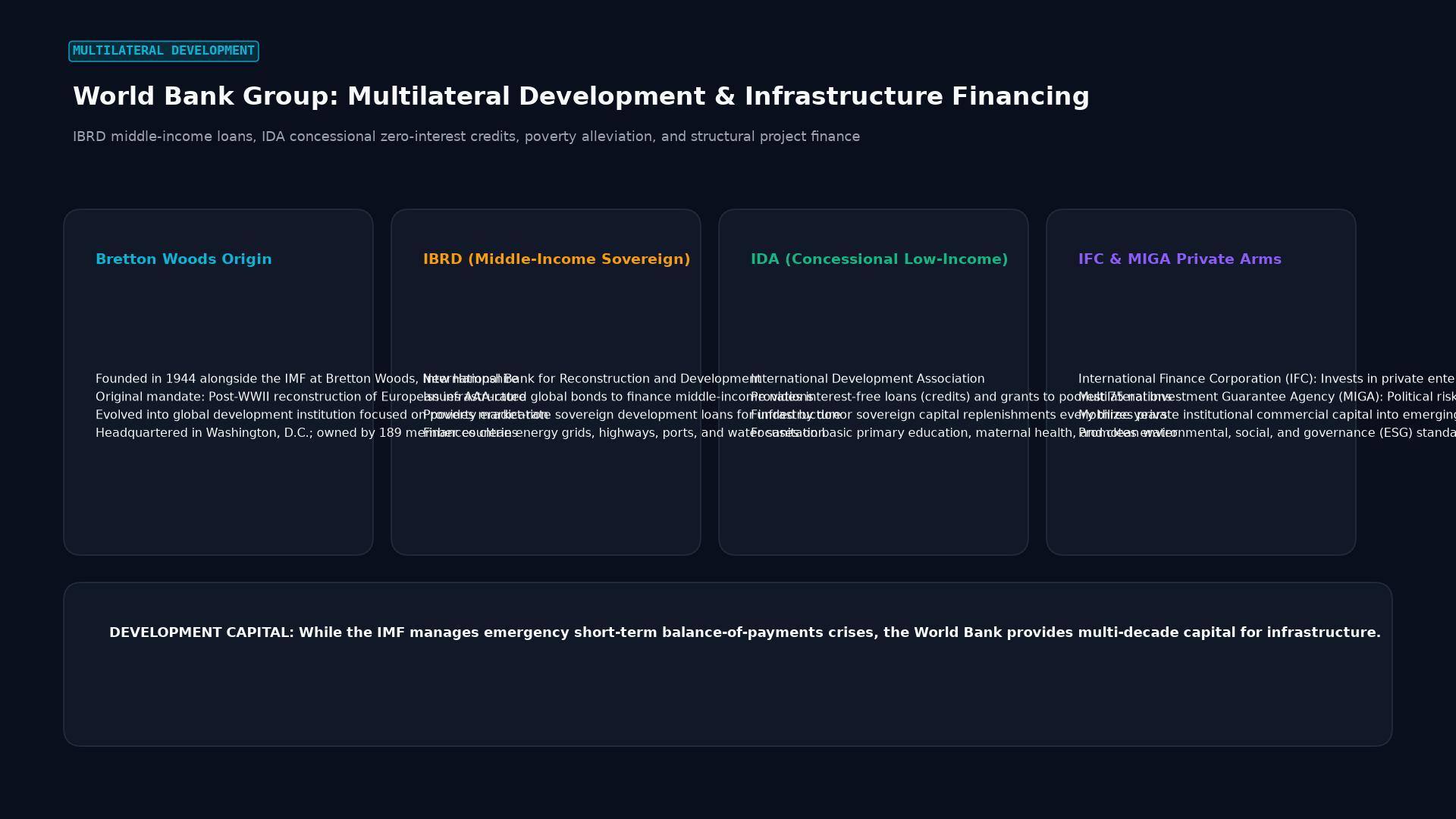 Figure: IBRD middle-income loans, IDA concessional zero-interest credits, poverty alleviation, and structural project finance
Technical Mechanics & Capital Financing
The two primary arms of the World Bank proper—the International Bank for Reconstruction and Development (IBRD) and the International Development Association (IDA)—operate distinct funding models:
1. IBRD Capital Raising & Pricing
The IBRD maintains a Triple-A (AAA) credit rating backed by the callable capital guarantees of its sovereign member nations. It issues billions of dollars in global benchmark bonds annually:
$$\text{Loan Lending Rate} = \text{Reference Benchmark (SOFR)} + \text{Contractual Lending Spread} + \text{Maturity Premium}$$
Because the IBRD borrows at the lowest wholesale rates available in international capital markets, it can pass those low rates on to emerging market sovereigns that would otherwise face punitive 8% to 15% yields in private bond markets.
2. Capital Adequacy Metric: Equity-to-Loans Ratio
To safeguard its AAA rating, the IBRD operates under strict statutory leverage constraints:
$$\text{Equity-to-Loans (E/L) Ratio} = \frac{\text{Usable Equity}}{\text{Total Outstanding Loans and Guarantees}} \ge 19%$$
If loan defaults increase or emerging-market currencies face structural stress, the World Bank preserves its balance sheet by adjusting commitment fees or calling upon member nations for capital replenishment.
Comparative Structure: The Bretton Woods Institutions
| Dimension | The World Bank (IBRD / IDA) | International Monetary Fund (IMF) | World Trade Organization (WTO) |
|---|---|---|---|
| Core Mission | Long-term economic development & infrastructure | Short-term macroeconomic stability & balance-of-payments | International trade rule enforcement & dispute resolution |
| Typical Horizon | 15 to 35-year long-term project loans | 1 to 4-year emergency rescue packages | Continuous multilateral oversight |
| Funding Source | Global bond issuances + member equity | Member quota subscriptions (SDRs) | Member state budgetary dues |
| Intervention Trigger | Development projects (roads, energy, health) | Sovereign currency or balance-of-payments crisis | Trade tariff disputes and dumping conflicts |
Real-World Case Study: Post-War Reconstruction to Modern Crisis Finance (1947–2023)
The First IBRD Loan: France (1947)
The World Bank’s inaugural operational transaction occurred on May 9, 1947, when it approved a $250 million reconstruction loan to France (equivalent to over $3 billion in modern purchasing power). The loan financed essential industrial raw materials, steel imports, locomotives, and port machinery necessary to rebuild France’s war-torn economy after private commercial banks refused to extend long-term credit.
The Pandemic & Green Transition Financing (2020–2023)
Between April 2020 and June 2023, the World Bank deployed more than $150 billion across 100+ developing countries to combat the economic fallout of COVID-19 and finance green energy infrastructure. By issuing innovative “Green Bonds” and debt-for-climate swaps, the World Bank absorbed project risk in high-beta frontier economies, enabling private institutional capital to co-invest alongside official development funds.
Frequently Asked Questions (FAQ)
What is the fundamental difference between the World Bank and the IMF?
While both were established at Bretton Woods, their functional roles are distinct. The IMF acts like an international emergency liquidity facility; it provides short- to medium-term loans to countries facing balance-of-payments deficits, foreign exchange reserve depletion, or sovereign currency collapse. The World Bank, by contrast, is a long-term development lender; it finances specific capital infrastructure projects (schools, bridges, power grids) over multi-decade time horizons to foster sustainable economic growth.
How does the World Bank maintain a AAA credit rating despite lending to developing nations?
The World Bank maintains a pristine AAA rating through three institutional mechanisms: preferred creditor status (sovereign borrowers legally prioritize repaying the World Bank before all private commercial bondholders), massive callable capital guarantees pledged by wealthy shareholder nations (like the US, Japan, and Germany), and ultra-conservative balance sheet management with an equity-to-loans ratio maintained above 19%.
How do World Bank loan disbursements impact emerging-market currency exchange rates?
When the World Bank disburses large development loans, substantial hard currency (typically US dollars or euros) flows into the recipient nation’s central bank reserves. As these funds are converted into local currency to pay domestic contractors and purchase domestic materials, the transaction creates sustained spot demand for the local currency. Over the long term, successful infrastructure upgrades increase national productivity, lower domestic inflation, and strengthen the sovereign currency’s equilibrium real exchange rate.
Ready to trade forex?
Open a free demo account with a regulated broker. Practice with virtual funds before risking real money.