World Trade Organization (WTO)
The World Trade Organization (WTO) is the primary intergovernmental organization that establishes, monitors, and enforces the legal rules of international trade between member nations, providing a forum for tariff negotiations and trade dispute resolution.
What Is the World Trade Organization (WTO)?
The World Trade Organization (WTO) is an international intergovernmental body headquartered in Geneva, Switzerland, responsible for regulating, liberalizing, and arbitrating cross-border commerce among sovereign states. Formally established on January 1, 1995, pursuant to the Marrakesh Agreement, the WTO superseded the 1947 General Agreement on Tariffs and Trade (GATT).
Representing over 98% of global commerce across 164+ member states, the WTO provides the legal and institutional framework through which international trade agreements are negotiated, implemented, and enforced. Unlike informal economic forums (such as the G7 or G20), the WTO possesses a formal, binding Dispute Settlement Mechanism (DSM) empowered to authorize retaliatory trade sanctions against member states that violate multilateral trade agreements.
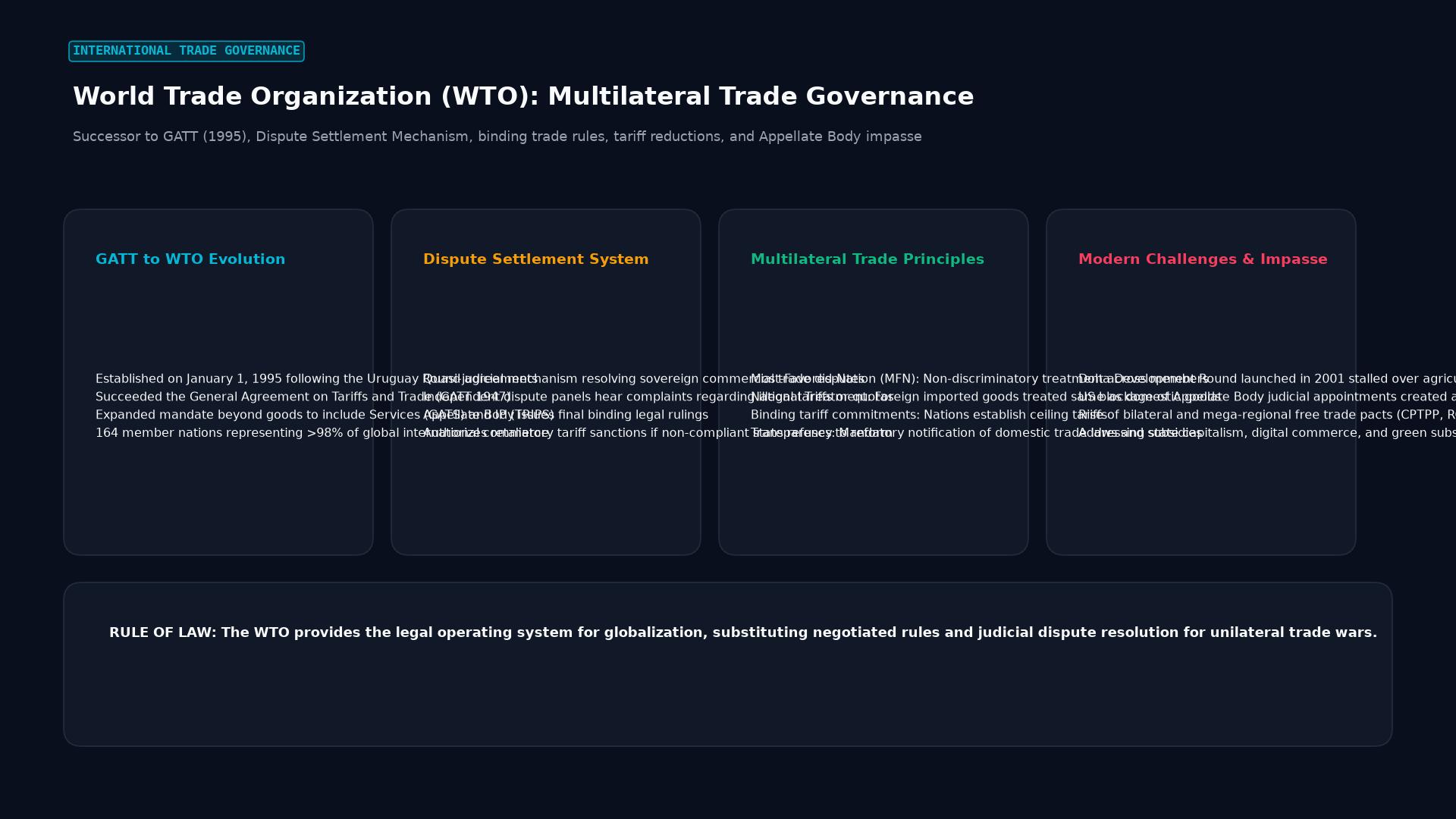 Figure: Successor to GATT (1995), Dispute Settlement Mechanism, binding trade rules, tariff reductions, and Appellate Body impasse
Technical Mechanics & Core Legal Principles
WTO jurisprudence is anchored by several foundational legal principles designed to minimize trade distortion and prevent economic nationalism:
1. Most-Favored-Nation (MFN) Rule
Under Article I of GATT, an advantage, favor, or tariff reduction granted by a WTO member to any single country must immediately and unconditionally be extended to all other WTO members:
$$\text{Tariff}{i,j} = \min{k} \left(\text{Tariff}_{i,k}\right) \quad \forall j, k \in \text{WTO Members}$$
Exceptions are permitted only for formalized regional free trade agreements (FTAs) under Article XXIV (such as NAFTA/USMCA or the European Single Market) or preferential trade access granted to developing economies.
2. National Treatment Principle
Under Article III of GATT, imported goods, once they have cleared domestic customs and paid statutory import duties, must not receive less favorable regulatory, excise, or domestic tax treatment than identical domestically produced goods.
3. Gravity Model of Bilateral Trade
Econometric models evaluate the volume of international trade ($F_{ij}$) influenced by WTO membership and trade friction using the structural gravity equation:
$$F_{ij} = G \frac{M_i M_j}{D_{ij}} \times \left(1 - \tau_{ij}\right)$$
Where $M_i, M_j$ represent the economic output (GDP) of trading partners, $D_{ij}$ is geographical distance, and $\tau_{ij}$ represents trade barriers (tariffs and non-tariff quotas). WTO tariff reduction rounds mechanically compress $\tau_{ij}$, expanding global export velocity.
Comparative Matrix: WTO vs. GATT vs. Regional Free Trade Agreements
| Dimension | World Trade Organization (WTO) | General Agreement on Tariffs and Trade (GATT 1947) | Regional Trade Agreements (e.g., USMCA, CPTPP) |
|---|---|---|---|
| Institutional Status | Permanent international organization | Provisional legal treaty | Plurilateral treaty among specific regional allies |
| Scope of Coverage | Goods, Services (GATS), and Intellectual Property (TRIPS) | Tangible merchandise goods only | Deep integration (labor, environmental rules, digital trade) |
| Dispute Settlement | Binding rulings; cannot be vetoed by defendant | Voluntary; losing party could veto consensus | Investor-State Dispute Settlement (ISDS) panels |
| Tariff Commitments | Multilateral bound tariff caps | Gradual round-by-round reductions | Preferential zero-tariff schedules among signatories |
Real-World Case Study: The 17-Year Boeing-Airbus Subsidies Dispute (2004–2021)
The longest and most expensive dispute in WTO history centered on alleged illegal government subsidies granted to commercial aircraft manufacturers Boeing (United States) and Airbus (European Union).
Timeline of the Transatlantic Trade War:
- 2004: US filed a formal complaint alleging Airbus received billions in illegal below-market European government "launch aid" loans.
- 2005: EU countersued, alleging Boeing received illegal US federal tax breaks, NASA research grants, and DoD military procurement subsidies.
- WTO Rulings (2011-2018): The WTO ruled that both parties had violated multilateral subsidy rules.
- Retaliatory Sanctions (2019-2020):
  * October 2019: WTO authorized the US to impose 10% to 25% tariffs on $7.5 billion of European exports (wine, cheese, aircraft).
  * October 2020: WTO authorized the EU to hit $4.0 billion of US exports (tractors, spirits, planes) with counter-tariffs.
- June 2021: Both sides reached an agreement to suspend tariffs for 5 years to coordinate on clean aerospace development.
The multi-billion dollar tariff authorizations caused sharp localized volatility in EUR/USD spot rates as multinational exporters repriced cross-border supply chains.
Frequently Asked Questions (FAQ)
What is the Most-Favored-Nation (MFN) principle?
The Most-Favored-Nation (MFN) principle mandates non-discrimination among trading partners. If a WTO member country lowers a tariff rate on an imported good to 2% for one partner, it must immediately extend that exact same 2% tariff rate to all 164 WTO member nations. It ensures that small and developing nations enjoy the same commercial tariff access as major economic superpowers without having to negotiate separate bilateral treaties.
Why has the WTO Appellate Body been paralyzed since December 2019?
The WTO Appellate Body—the ultimate supreme court of international trade—normally consists of seven judges. To hear an appeal, a minimum quorum of three judges is required. Beginning in 2017, the United States exercised its veto power to block all new judicial appointments, citing judicial overreach and procedural rule violations. In December 2019, the term of the penultimate judge expired, leaving the body with only one member and preventing it from issuing legally binding appeal rulings.
How do WTO tariff disputes impact foreign exchange markets?
Tariff disputes and WTO rulings influence currency exchange rates by altering terms of trade and corporate capital expenditures. When the WTO authorizes retaliatory tariffs against an export-heavy nation, foreign demand for that nation’s goods contracts, reducing commercial demand for its domestic currency. Furthermore, escalating trade disputes generate global risk-off sentiment, prompting capital to exit emerging-market currencies in favor of traditional safe havens like the US Dollar and Swiss Franc.
Ready to trade forex?
Open a free demo account with a regulated broker. Practice with virtual funds before risking real money.