XPF
The ISO 4217 currency code for the CFP Franc (Franc Pacifique), the official legal tender used in the French Pacific overseas collectivities of French Polynesia, New Caledonia, and Wallis and Futuna, issued by the Institut d'Émission d'Outre-Mer (IEOM) and pegged to the euro.
XPF (CFP Franc - Franc Pacifique)
The CFP Franc (ISO code: XPF, commonly abbreviated as FCFP or simply F), officially termed the Franc Pacifique, is the common currency of three French overseas territories in the South Pacific Ocean:
- New Caledonia (a French special sui generis collectivity)
- French Polynesia (including Tahiti, Bora Bora, and the Marquesas Islands)
- Wallis and Futuna (a French overseas collectivity)
Subdivided into 100 centimes (though fractional coins are no longer in practical circulation), the currency is issued, administered, and defended by a specialized French public central bank, the Overseas Issuing Institute (Institut d’Émission d’Outre-Mer, or IEOM), headquartered in Paris with operational branches in Nouméa (New Caledonia), Papeete (French Polynesia), and Mata-Utu (Wallis and Futuna).
In international monetary economics, the CFP franc represents an offshore currency board arrangement embedded within the French Republic. The defining monetary feature of the XPF is its fixed parity with the euro, backed by an unlimited convertibility guarantee from the French Treasury. With New Caledonia possessing roughly 10% of the world’s nickel reserves and French Polynesia operating a high-end luxury tourism and pearl export economy, the XPF provides macroeconomic insulation, stable purchasing power, and zero exchange rate risk for commercial flows with the European Union.
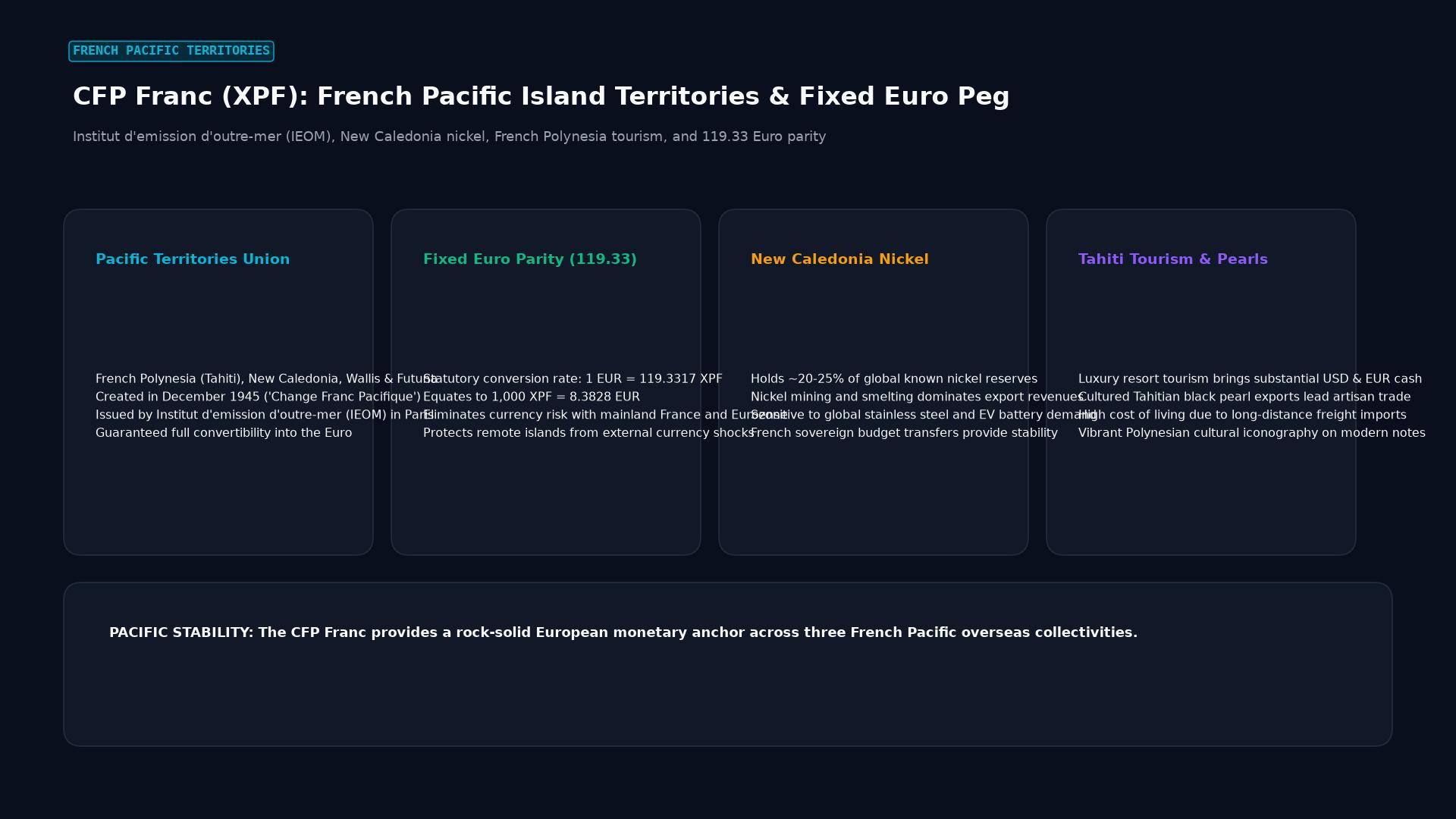 Figure: Institut d’emission d’outre-mer (IEOM), New Caledonia nickel, French Polynesia tourism, and 119.33 Euro parity
Historical Genesis: From Bretton Woods to the Euro Peg
The CFP franc was created on December 26, 1945, simultaneously with the African CFA franc, as part of France’s ratification of the Bretton Woods Agreements:
- Origins of the Acronym: Originally, CFP stood for Colonies Françaises du Pacifique (French Colonies of the Pacific). Following post-war administrative reorganizations, the acronym was officially redefined as Change Franc Pacifique (Pacific Franc Exchange).
- Severance from the War-Torn French Franc (1945): During World War II, the French Pacific territories had been cut off from Vichy France, relying on economic ties with the United States, Australia, and New Zealand. When France devalued the mainland French franc (FRF) in December 1945, the Pacific territories were granted an independent, stronger exchange parity to prevent destabilizing local prices:
- 1945: 1 CFP = 2.40 French francs (FRF).
- 1949: Reset to 1 CFP = 5.50 FRF.
- The 1960 New Franc Conversion: When France introduced the “new franc” (worth 100 old francs) on January 1, 1960, the conversion ratio became: $$1 \text{ CFP Franc (XPF)} = 0.055 \text{ French Francs (FRF)}$$ $$\text{Or equivalently: } 1 \text{ FRF} \approx 18.1818 \text{ XPF}$$
- Transition to the Euro (January 1, 1999): When France adopted the euro at the irrevocably fixed conversion rate of 1 EUR = 6.55957 FRF, the parity of the CFP franc transferred automatically: $$1 \text{ EUR} = \frac{6.55957}{0.055} \approx 119.3317424… \text{ XPF}$$ To simplify commercial calculations, the official legal decree established the conversion standard as 1,000 XPF = 8.38 EUR (yielding the exact same reciprocal value).
The Institutional Architecture of the IEOM
The monetary stability of the CFP franc is maintained under French national monetary law via the Institut d’Émission d’Outre-Mer (IEOM):
1. Supranational-Style Central Banking within the Republic
The IEOM is a public state institution operating under the supervisory oversight of the Banque de France and the French Ministry of the Economy and Finance. The Governor of the Banque de France serves as the Chairman of the Supervisory Board of the IEOM.
2. French Treasury Convertibility Guarantee
The French Treasury provides an unconditional convertibility guarantee for the CFP franc. If trade imbalances or external commodity shocks drain the foreign reserve accounts of the IEOM, the French Treasury provides statutory liquidity to honor all conversion requests into euros.
3. Banking Supervision and Prudential Regulation
Commercial banks operating in New Caledonia, French Polynesia, and Wallis and Futuna (including subsidiaries of major French banking groups such as BNP Paribas, Société Générale, and BRED Banque Populaire) fall under the prudential supervision of the French Prudential Supervision and Resolution Authority (Autorité de Contrôle Prudentiel et de Résolution, or ACPR) and the European Central Bank (ECB), ensuring high institutional depositor safety.
+------------------------------------------------------------------------+
|          Comparison of French Sovereign Currency Arrangements          |
+------------------------------------------------------------------------+
| Territory / Union        | Legal Currency | Issuing Authority | Peg Parity |
| Metropolitan France & DOM| Euro (EUR)     | ECB / BdF         | Floating   |
| French Pacific (XPF)     | CFP Franc      | IEOM (Paris)      | 119.332/EUR|
| West Africa (UEMOA)      | CFA Franc (XOF)| BCEAO (Dakar)     | 655.957/EUR|
| Central Africa (CEMAC)   | CFA Franc (XAF)| BEAC (Yaoundé)    | 655.957/EUR|
+------------------------------------------------------------------------+
Macroeconomic Drivers of the Pacific Territories
1. New Caledonia: The Nickel Titan
New Caledonia’s macroeconomic output is dominated by the extraction and metallurgical processing of nickel:
- The island holds an estimated 10% of the world’s proven nickel reserves, centered around major open-pit operations run by Société Le Nickel (SLN, an Eramet subsidiary), Koniambo Nickel, and Prony Resources.
- Nickel ore and refined ferronickel account for over 90% of New Caledonia’s total merchandise export revenues, predominantly shipped to battery and stainless-steel manufacturing hubs in China, Japan, and South Korea.
- Global nickel price volatility on the London Metal Exchange (LME) directly drives corporate tax revenues, mining employment, and domestic credit demand in Nouméa.
2. French Polynesia: Luxury Tourism and Black Pearls
French Polynesia’s economy is anchored by high-value international tourism and specialized marine aquaculture:
- Luxury Leisure Tourism: Overwater bungalows in Bora Bora, Moorea, and Tahiti attract affluent leisure travelers from the United States, Japan, and Europe.
- Tahitian Black Pearls (Pinctada margaritifera): Cultured pearls harvested from coral atoll lagoons represent French Polynesia’s second-largest commercial export receipt.
3. Sovereign Fiscal Transfers from Paris
A fundamental macroeconomic stabilizer across all three territories is the continuous injection of sovereign budgetary transfers from mainland France:
- France funds public sector salaries (civil servants receive geographical cost-of-living premiums), healthcare infrastructure, education systems, police, and defense forces.
- These direct public transfers represent roughly 15% to 25% of territorial GDP, ensuring consistent inflows of euro-denominated liquidity that offset structural trade deficits in imported food, fuel, and manufactured equipment.
       Pacific Island Territory Balance of Payments Model:

       Net Current Inflows = (Exports_Nickel + Exports_Pearls + Tourism)
                           + French_State_Transfers
                           - (Imports_Petroleum + Imports_Consumer_Goods)

       Because French State Transfers are permanent and guaranteed:
       Territorial current accounts avoid structural sovereign default risks.
Practical Trading and Commercial Mechanics
For multinational corporations, mining conglomerates, and international tourists:
- Absence of International Derivatives: There is no exchange-traded futures or options market for the XPF on global derivative exchanges. Companies hedging exposure to New Caledonian nickel mining or Polynesian resorts execute cross-currency hedges in Euros (EUR), utilizing the mathematical peg of 119.332 XPF per EUR.
- Commercial Currency Conversion: When exchanging money in Nouméa or Papeete:
- Conversion between the Euro and the XPF is legally executed at the fixed parity (1,000 XPF = 8.38 EUR). Commercial banks typically apply only a modest administrative transaction fee.
- Transactions involving US dollars or Australian dollars are converted via the prevailing EUR/USD or EUR/AUD market cross rates.
- Modern Banknote Architecture: In 2014 and 2021, the IEOM modernized the physical currency, replacing historical large-format paper notes with compact, highly secure banknotes celebrating indigenous Kanak, Polynesian, and Wallisian biodiversity (turtles, rays, bird of paradise, coral reefs, and traditional architecture).
Frequently Asked Questions
Can CFP Francs (XPF) be spent directly in mainland France?
No. CFP franc banknotes and coins are legal tender strictly within New Caledonia, French Polynesia, and Wallis and Futuna. They cannot be used to pay for goods or services in mainland France (which uses the euro). Travelers returning to France from the Pacific must exchange their unspent XPF back into euros at commercial banks or airport exchange counters.
What is the relationship between the CFP Franc and New Caledonia’s political status?
Under the Nouméa Accord of 1998, New Caledonia held three self-determination referendums between 2018 and 2021 regarding full political independence from France. In all three votes, the electorate chose to remain part of the French Republic. Had independence been approved, New Caledonia would have faced the decision of whether to establish an independent sovereign national currency or negotiate a bilateral monetary union agreement with France to retain the CFP franc or euro.
Why do New Caledonia and French Polynesia share the same currency despite being thousands of miles apart?
Both territories are integral parts of the French Republic in the Pacific Ocean. Sharing a common currency issued by the IEOM provides economies of scale in monetary administration, prevents competitive devaluations between the island groups, simplifies public budget transfers from Paris, and grants both economies the financial backing of the French Treasury and the Eurozone.
Ready to trade forex?
Open a free demo account with a regulated broker. Practice with virtual funds before risking real money.