Yard
A 'yard' is interbank financial slang for one billion ($1,000,000,000) units of a currency, universally utilized on institutional foreign exchange dealing desks to avoid costly phonetic confusion with 'million'.
What Is a Yard?
In institutional foreign exchange dealing rooms, investment banks, and interbank money markets, a yard is financial slang representing one billion ($1,000,000,000) units of a base currency. If a currency dealer announces that an institutional client wants to “buy two yards of Cable,” it signifies an order to purchase 2 billion British Pounds (GBP) against the US Dollar.
The adoption of the term “yard” is not mere trading floor trivia—it is a critical risk-management convention born out of market microstructure. In open-outcry pits, noisy dealing desks, and crackling telephone squawk boxes, the words “million” and “billion” sound dangerously similar. A misheard order could lead to a catastrophic 1,000-fold position sizing error. To eliminate this lethal phonetic risk, interbank traders universally standardized the term “yard.”
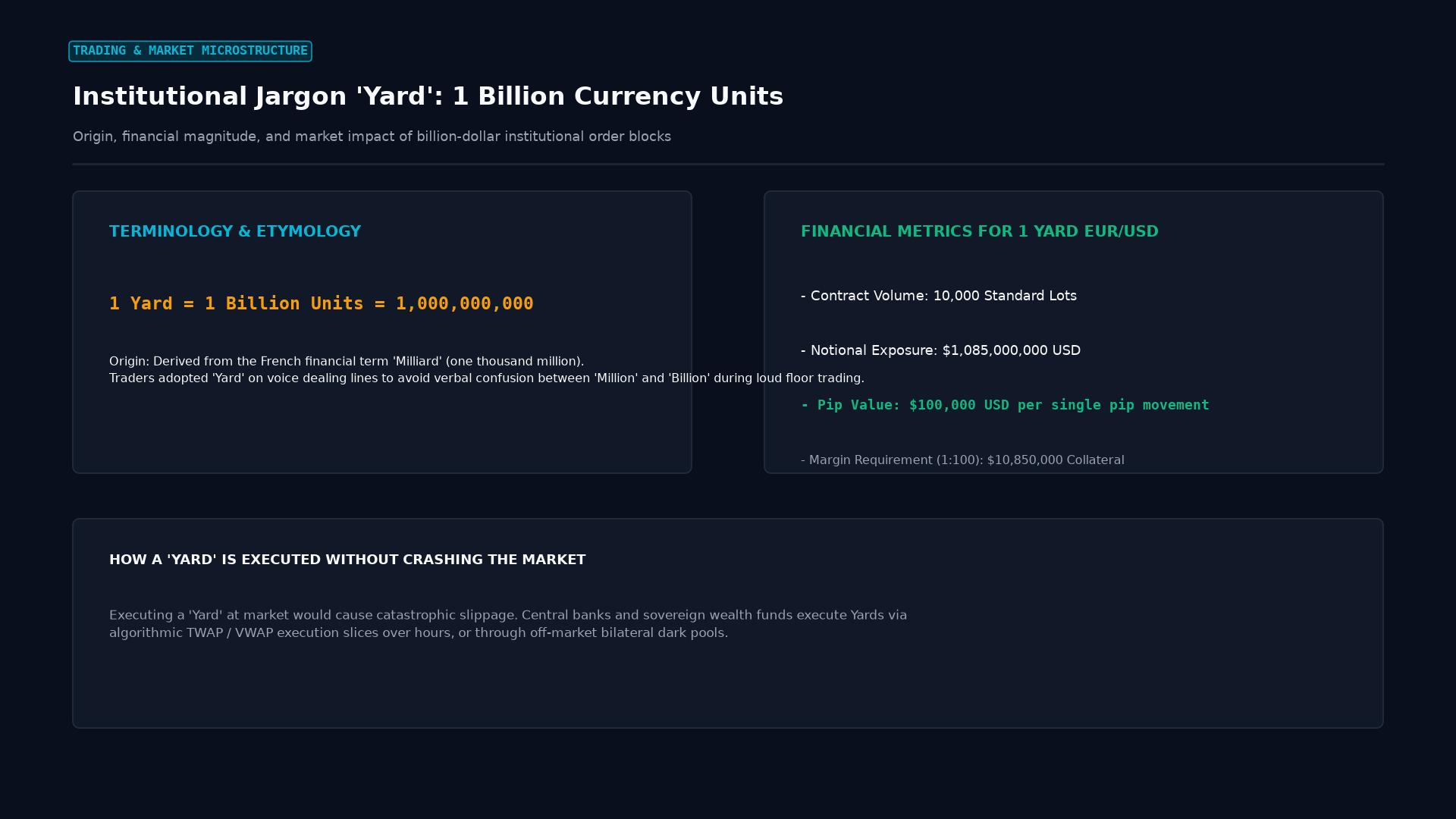 Figure: Institutional currency scale: 1 Yard ($1,000,000,000 notional / 10,000 lots), $100k pip values, and algorithmic TWAP/VWAP execution.
Technical Etymology & Quantitative Market Impact
The term “yard” originates from the French word “milliard,” which represents one thousand million ($10^9$) in the traditional long scale numbering system widely used across European banking centers. British and European money brokers shortened “milliard” to “yard” during the expansion of the London Eurodollar and foreign exchange markets in the 1960s and 1970s.
The Market Impact of Executing a “Yard”
Because $1 billion represents a massive liquidity slug—even in deep G10 currency pairs like EUR/USD or USD/JPY—dumping a yard into the electronic interbank market as a single market order would trigger violent slippage and consume all available top-of-book liquidity.
Quantitative execution desks model the expected price impact ($I$) of a large block order using the square-root law of market impact:
$$I = Y \cdot \sigma \cdot \sqrt{\frac{Q}{V}}$$
Where:
- $Y$: Dimensionless constant characteristic of the market (typically near $0.5$ to $0.7$).
- $\sigma$: Daily asset volatility.
- $Q$: Order quantity ($10^9$ units / 1 yard).
- $V$: Total average daily market turnover.
To minimize this market impact, algorithmic execution algorithms (such as TWAP, VWAP, or Iceberg algorithms) slice a 1-yard parent order into thousands of micro-child orders executed over several hours across multiple primary electronic communication networks (ECNs) such as EBS, Refinitiv Matching, and Currenex.
Comparative Matrix: Interbank Dealing Terminology
| Dealing Slang Term | Numeric Amount | Asset / Context | Typical Usage Example |
|---|---|---|---|
| Yard | 1,000,000,000 (One Billion) | G10 Currencies / Government Bonds | “Central bank just sold half a yard of Dollar/Yen.” |
| Buck | 1,000,000 (One Million) | US Dollars / Cash Commodities | “I can make you a two-way price in five bucks.” |
| Cable | Currency pair GBP/USD | British Pound vs. US Dollar | “Cable is breaking through support at 1.2500.” |
| Fiber | Currency pair EUR/USD | Euro vs. US Dollar | “Bids in Fiber are holding strong at the figure.” |
| Figure | Round number (.00 level) | Price quotes (e.g., 1.3000) | “EUR/USD is trading at the figure.” |
| Handle | Whole integer portion of quote | Price quotes (e.g., 1.08 in 1.0845) | “The pair just entered a new handle.” |
Real-World Case Study: Soros and Black Wednesday (September 1992)
The most legendary deployment of “yard-scale” capital occurred during the Black Wednesday currency crisis of September 16, 1992.
George Soros & The Bank of England:
1. Thesis: Quantum Fund fund manager George Soros and chief strategist Stanley Druckenmiller determined that the British Pound was artificially overvalued inside the European Exchange Rate Mechanism (ERM).
2. Sizing the Position: Soros instructed his execution desks not to trade modest clips, famously telling Druckenmiller to "go for the jugular."
3. The Squeeze: Over several days, Quantum Fund aggressively sold over 10 yards (£10,000,000,000) of British Pounds short.
4. Central Bank Defense: The Bank of England attempted to defend the ERM floor, spending billions of foreign exchange reserves buying pounds.
5. The Capitulation: The Bank of England was overwhelmed by the multi-yard selling pressure, suspended its ERM membership, and let the Pound float freely. The Pound collapsed 15%, generating over $1 billion in net profit for Soros.
Modern central bank interventions routinely match this scale: when the Ministry of Finance of Japan (MOF) and Bank of Japan intervene to support the Yen, they frequently deploy 5 to 10 yards of US dollar reserves in coordinated multi-hour market sweeps.
Frequently Asked Questions (FAQ)
Why do institutional traders say ‘yard’ instead of ‘billion’?
The primary reason is operational risk mitigation. Over telephone squawk lines, dealer voice brokers, and chaotic trading pits, the word “billion” sounds remarkably similar to “million.” A misunderstanding could turn a $1 million position into a $1 billion position, causing catastrophic unauthorized leverage and financial ruin. Saying “yard” (derived from the French milliard) is phonetically distinct and completely eliminates ambiguity.
Can a retail forex trader place a trade measured in yards?
No retail margin broker allows retail traders to trade in yards under standard retail margin accounts. A 1-yard trade represents $1,000,000,000 in notional currency. Even with 100:1 leverage, opening a 1-yard position requires $10,000,000 in upfront margin collateral. Trades of this magnitude are strictly executed by tier-1 global investment banks, central banks, sovereign wealth funds, and multi-billion-dollar macro hedge funds.
What is an “iceberg order” and how is it used to execute a yard?
An iceberg order is an algorithmic execution strategy that hides the true size of a massive trade. When executing an order for a yard, the algorithm displays only a tiny fraction (e.g., $5 million or “5 bucks”) on the public order book at any given time. Once that visible portion is filled, the algorithm automatically replenishes it with another small clip until the entire 1-yard order is completely executed, preventing the broader market from front-running the position.
Ready to trade forex?
Open a free demo account with a regulated broker. Practice with virtual funds before risking real money.