Z-Certificate
A Z-Certificate is an uncertificated or non-negotiable depository instrument historically issued by the Bank of England to authorized discount houses to expedite wholesale secondary market trading in government securities without requiring physical certificate transfer.
What Is a Z-Certificate?
A Z-Certificate is a specialized, non-negotiable depository voucher historically issued by the Bank of England to authorized financial institutions (primarily traditional London discount houses and gilt-edged market makers). Its primary purpose was to facilitate rapid secondary market trading and collateralized overnight borrowing in British government bonds (gilts) without the friction of physically transporting paper stock certificates across the City of London.
In 20th-century financial markets, physical share and bond transfers required manual endorsements, physical courier delivery, and multi-day ledger updates at the central bank’s registrar. The Z-Certificate served as an early institutional bridge toward modern paperless finance. The Bank of England retained the registered stock in its secure vaults and issued a Z-Certificate confirming legal title, allowing financial houses to pledge sovereign debt as collateral for short-term liquidity instantly.
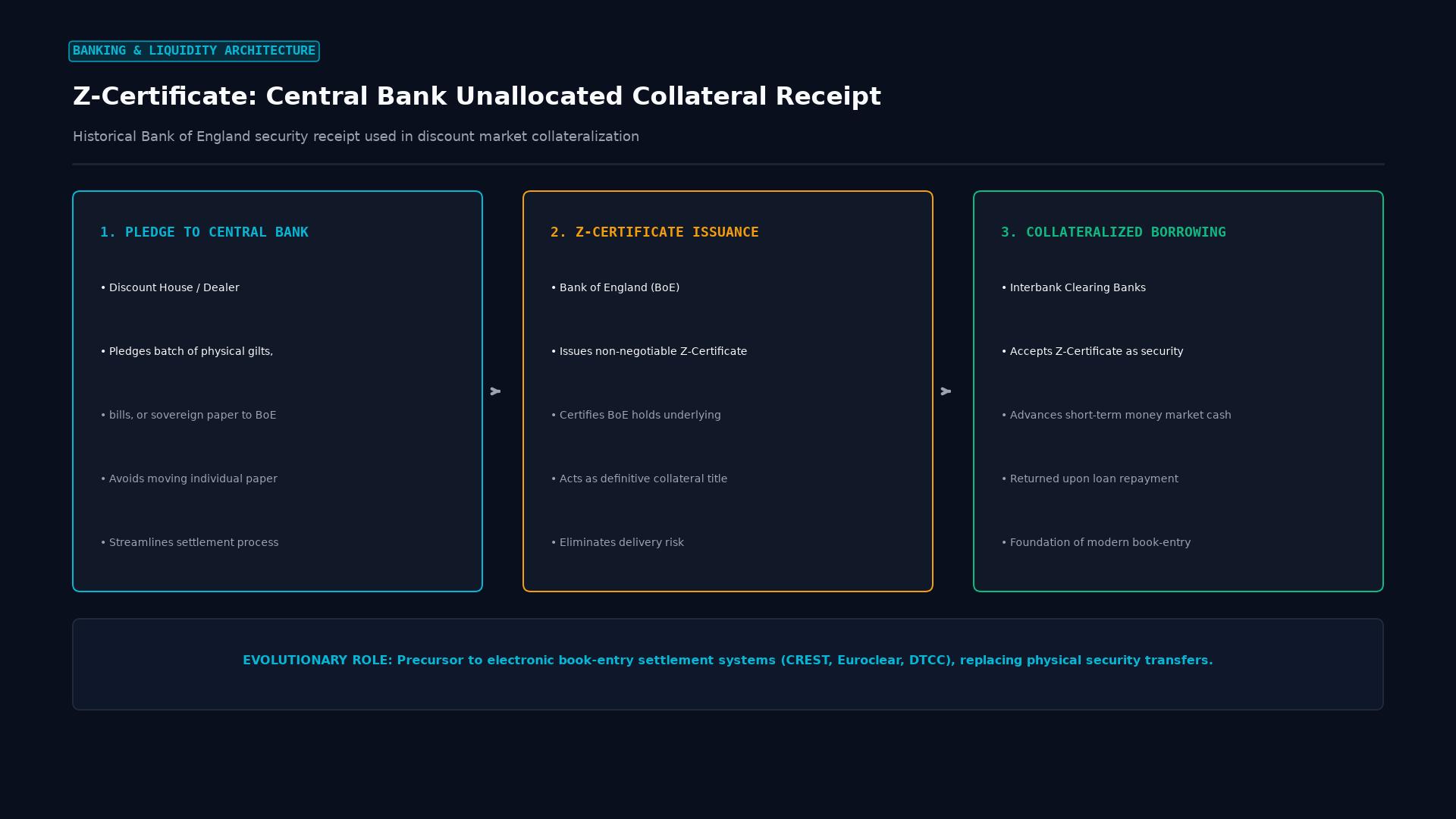 Figure: Historical central bank discount mechanism: Bank of England unallocated collateral receipts securing interbank borrowing prior to electronic book-entry.
Technical Mechanics & Settlement Modernization
Before electronic Central Securities Depositories (CSDs), the settlement of sovereign debt suffered from severe liquidity bottlenecks. Discount houses needed to pledge gilts as collateral to secure overnight loans from commercial clearing banks or the Bank of England’s discount window.
The Z-Certificate Protocol
- Deposit of Registered Stock: The market maker deposited British Government Stock (gilts) into the Bank of England’s chief registrar.
- Issuance of Z-Receipt: The Bank issued a non-negotiable Z-Certificate representing the designated par value of the bonds.
- Pledging Collateral: The discount house delivered the Z-Certificate to a lending bank. Because the certificate was certified by the Bank of England, the lender extended overnight wholesale money immediately without waiting for registrar re-registration.
- Redemption: Upon loan repayment, the Z-Certificate was returned and cancelled, or rolled into new financing.
The Delivery-versus-Payment (DvP) Standard
Modern settlement eliminated paper vouchers entirely by establishing electronic Delivery-versus-Payment (DvP):
$$\text{DvP Settlement Finality} \iff \Delta \text{Securities Ledger}{\text{Seller} \to \text{Buyer}} \equiv \Delta \text{Central Bank Reserves}{\text{Buyer} \to \text{Seller}}$$
Under DvP Model 1, securities transfer and funds transfer occur simultaneously in real time, completely eliminating principal counterparty risk.
Comparative Matrix: Securities Settlement Paradigms
| Feature | Physical Stock Certificate | Bank of England Z-Certificate | Modern Electronic Book-Entry (CREST) |
|---|---|---|---|
| Medium | Physical paper document | Standardized non-negotiable receipt | Dematerialized electronic record |
| Settlement Horizon | T+5 to T+14 business days | Same-day collateral pledge | T+1 / T+2 rolling business days |
| Physical Movement | Required physical messenger transport | Transferred between City banks | Zero physical movement (electronic ledger) |
| Counterparty Risk | Extreme (forgery, loss, courier theft) | Low (backed by central bank vault) | Negligible (simultaneous RTGS DvP) |
| Primary Era | 18th Century to 1980s | Mid-20th Century to 1996 | 1996 to Present |
Real-World Case Study: The TAURUS Disaster & The Birth of CREST (1993–1996)
The transition away from physical instruments and interim devices like Z-Certificates was accelerated by the collapse of the London Stock Exchange’s TAURUS project.
The Dematerialization Crisis (1990-1996):
- The Bottleneck: In the late 1980s, trading volumes overwhelmed London's paper-based settlement machinery, threatening the City's status as a global financial hub.
- The Project: The LSE initiated TAURUS (Transfer and Automated Registration of Uncertificated Stock) to eliminate all paper certificates.
- The Catastrophe: Over-engineered architecture and conflicting institutional demands caused costs to balloon past £80 million with severe software instability.
- Termination (March 1993): The Bank of England cancelled TAURUS, prompting the immediate resignation of the London Stock Exchange Chief Executive.
- The Solution: The Bank of England took direct control, designing CREST, which launched successfully in July 1996. CREST fully dematerialized UK equities and gilts, rendering Z-Certificates and physical stock warrants obsolete.
Today, CREST (operated by Euroclear UK & International) settles hundreds of billions of pounds daily in dematerialized securities.
Frequently Asked Questions (FAQ)
What was the specific advantage of a Z-Certificate over an ordinary share certificate?
An ordinary physical share or gilt certificate required a formal deed of transfer, signature verification, and physical presentation to the registrar before legal ownership changed hands—a process that took days or weeks. A Z-Certificate was pre-certified by the Bank of England as proof of deposit. This allowed discount houses to instantly pledge sovereign collateral to clearing banks for overnight liquidity without executing cumbersome formal transfer deeds.
What is “dematerialization” in modern financial markets?
Dematerialization is the process of converting physical paper securities certificates (stocks, bonds, and warrants) into electronic, digital book-entry form within a Central Securities Depository (CSD). Once dematerialized, ownership is tracked entirely through computer ledgers, eliminating printing costs, physical vault storage, courier transit risks, and paperwork bottlenecks.
Are Z-Certificates still used in financial markets today?
No. Z-Certificates have been entirely superseded by electronic book-entry settlement platforms like CREST in the United Kingdom, DTC (Depository Trust Company) in the United States, and Clearstream/Euroclear across Continental Europe. All modern sovereign debt and wholesale money market repo operations settle electronically through real-time gross settlement systems linked directly to central bank balance sheets.
Ready to trade forex?
Open a free demo account with a regulated broker. Practice with virtual funds before risking real money.