After-Hours Trading
After-hours trading refers to buying and selling financial instruments outside the primary operating hours of formal exchanges, facilitated through Electronic Communication Networks (ECNs). While equities have rigid daily closing times, the 24/5 foreign exchange market encounters analogous dynamics during off-peak sessions, daily rollover windows, and weekend closures.
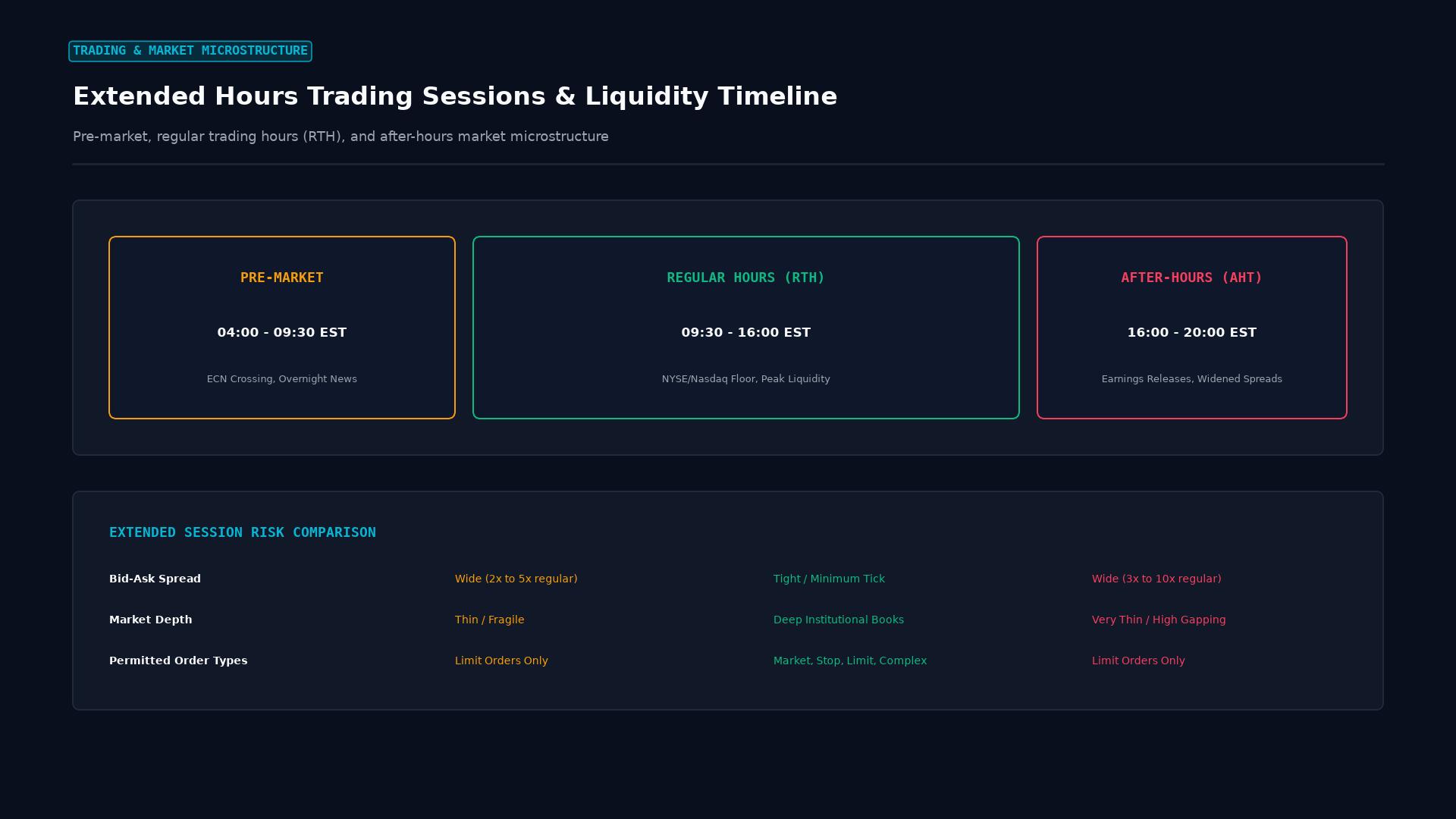 Figure: Market session breakdown across the trading day: pre-market ECN crossing, regular trading hours (RTH) peak liquidity, and post-market after-hours earnings volatility.
Understanding After-Hours Trading
In traditional stock exchanges, such as the New York Stock Exchange (NYSE) or NASDAQ, regular trading takes place during a fixed six-and-a-half-hour window—from 9:30 AM to 4:00 PM Eastern Standard Time (EST). Historically, once the closing bell rang at 4:00 PM, market activity ceased completely until the following morning.
The advent of computerized Electronic Communication Networks (ECNs) in the late 1990s fundamentally reshaped this structure, introducing after-hours trading (typically 4:00 PM to 8:00 PM EST) and pre-market trading (typically 4:00 AM to 9:30 AM EST). During these extended sessions, retail and institutional participants match orders electronically outside normal exchange operations, primarily to react immediately to corporate earnings reports, unexpected regulatory announcements, or breaking geopolitical headlines.
After-Hours Trading vs. The 24/5 Forex Market
To understand after-hours trading in the context of foreign exchange, one must first recognize the fundamental structural difference between centralized stock exchanges and the global currency market:
The Continuous Forex Cycle
The foreign exchange market is not housed in any single building and has no physical closing bell. It is an over-the-counter (OTC) interbank network operating continuously 24 hours a day, 5 days a week. As trading desks in New York close on a Monday afternoon, banks and dealers in Wellington and Sydney are already opening for Tuesday morning, followed seamlessly by Tokyo, Singapore, Frankfurt, London, and back to New York.
Consequently, foreign exchange does not have a daily “after-hours” session in the traditional equity sense from Monday morning through Friday evening.
The True “After-Hours” Windows in Forex
Despite its continuous weekday schedule, currency traders experience distinct periods that mirror the exact risks and characteristics of equity after-hours trading:
- The 5:00 PM EST Rollover Twilight Zone: The official “New York Close” occurs at 5:00 PM EST. At this hour, trading desks mark daily accounts and compute overnight interest (rollover swaps). For roughly 30 to 45 minutes between the New York close and the full activation of Asian banking centers, liquidity drops to the thinnest levels of the 24-hour cycle. Spreads on major currency pairs often blow out from 1 pip to 8 or 15 pips, creating hazardous conditions for market orders and tight stop-losses.
- The Weekend Market Freeze (Friday 5:00 PM to Sunday 5:00 PM EST): From Friday afternoon until Sunday afternoon New York time, global retail platforms and interbank spot matching engines shut down. Any geopolitical development, emergency central bank press conference, or national election result occurring over the weekend cannot be hedged or liquidated by retail traders. When trading resumes on Sunday afternoon, prices frequently “gap” dozens or even hundreds of pips above or below Friday’s closing price.
- Off-Peak Session Divergence: For European and North American currency pairs (such as EUR/USD or GBP/USD), the Asian session (00:00 to 07:00 GMT) acts functionally as an extended after-hours session. Trading volume is low, price action is predominantly range-bound, and sudden large orders can spark outsized price slippage.
Key Risks of After-Hours and Off-Peak Trading
Whether trading equities on an ECN after 4:00 PM or executing currency positions during illiquid market twilight zones, market participants face severe structural vulnerabilities:
1. Severe Illiquidity
During regular operating hours, thousands of market makers, hedge funds, and retail participants contribute deep bids and offers to the order book. After hours, participation plummets. A transaction volume that would barely budge the price during peak London hours can trigger a dramatic price dislocation when liquidity books are thin.
2. Aggressive Spread Widening
Because liquidity providers take on significantly higher inventory risk when the market lacks depth, they widen the bid-ask spread to protect themselves against adverse selection. A wider spread means entering a trade incurs an immediate, substantial transaction penalty.
3. Asymmetric Execution Slippage
In illiquid extended hours, stop-loss orders frequently suffer extreme slippage. If a trader sets a stop-loss at 1.0820 on a short position and unexpected news breaks when order books are empty, the first available buyer may be willing to sell only at 1.0850. The stop-loss fills at the higher price, inflicting far greater losses than anticipated.
4. False Breakouts and “Whipsaws”
Price spikes occurring in thin after-hours environments frequently lack institutional follow-through. When major market participants return to their desks the next morning, they frequently push prices back toward previous value zones, trapping retail traders who chased illiquid momentum.
Practical Trading Example: The Sunday Open Gap
Consider a forex swing trader holding a long position in EUR/USD heading into a Friday close:
- Friday 4:45 PM EST: EUR/USD trades steadily at 1.0900. The trader sets a stop-loss at 1.0860 (40 pips risk, risking $400 on a standard lot).
- Over the weekend, a surprise geopolitical escalation breaks in the Middle East, sparking emergency safe-haven demand for the US Dollar.
- Sunday 5:00 PM EST: The global forex market reopens in New Zealand. Due to overwhelming weekend selling, EUR/USD opens with an immediate gap down to 1.0810—a 90-pip collapse from Friday’s close.
- Even though the trader’s stop-loss was set at 1.0860, no liquidity existed between 1.0900 and 1.0810. The broker’s execution engine fills the stop at the first available market price: 1.0810.
- Instead of losing 40 pips ($400), the trader suffers a 90-pip loss ($900), more than double their planned risk budget.
This scenario illustrates why prudent risk management dictates closing speculative short-term positions prior to weekend closures.
Key Takeaways
- After-hours trading allows market participants to trade outside primary exchange hours via electronic communication networks (ECNs).
- While equities observe rigid daily trading boundaries, spot forex trades continuously 24/5 across shifting global time zones.
- The primary “after-hours” hazards in forex occur during the 5:00 PM EST daily rollover window and over the weekend closure.
- Extended hours trading features reduced liquidity, widened spreads, higher volatility, and substantial execution slippage.
- Holding positions across market closures exposes traders to weekend gap risk, which can bypass stop-loss levels and cause severe account drawdowns.
FAQ
Can retail traders access after-hours equity trading? Yes. Most modern retail brokerages allow clients to trade US equities during pre-market (from 4:00 AM or 7:00 AM EST) and after-hours (until 8:00 PM EST) by routing limit orders directly through ECNs.
Why does the forex market close on weekends? While currency exchange is technically possible between any two parties at any time, the global interbank clearing networks, central banks, and major financial institutions close their commercial settlement operations from Friday afternoon until Sunday afternoon, removing the liquidity necessary for open-market pricing.
Can I use market orders in after-hours trading? Most equity brokers strictly prohibit market orders during after-hours sessions, requiring clients to submit limit orders to protect them from paying astronomical prices due to wide bid-ask spreads. In forex, market orders are permitted 24 hours a day, but submitting them during illiquid session transitions often results in steep spread costs.
Ready to trade forex?
Open a free demo account with a regulated broker. Practice with virtual funds before risking real money.