Economic Calendar
An economic calendar is a schedule of upcoming economic data releases, central bank decisions, government reports, and major speeches that have the potential to move financial markets. For fundamental traders, it is an indispensable planning tool — the equivalent of a trader's daily briefing on what market-moving events to expect and when.
Why Every Forex Trader Needs an Economic Calendar
Without an economic calendar, you’re trading blind. You might have a technically perfect setup — clean entry at support, tight stop, excellent risk-reward ratio — and then a data release erases your setup in 30 seconds because the market moved 150 pips in one direction before you knew what happened.
The economic calendar doesn’t eliminate this risk, but it lets you plan around it. You can choose not to trade during high-impact events, widen stops to accommodate expected volatility, or specifically build a strategy around news reactions. What you shouldn’t do is trade in ignorance of what’s scheduled.
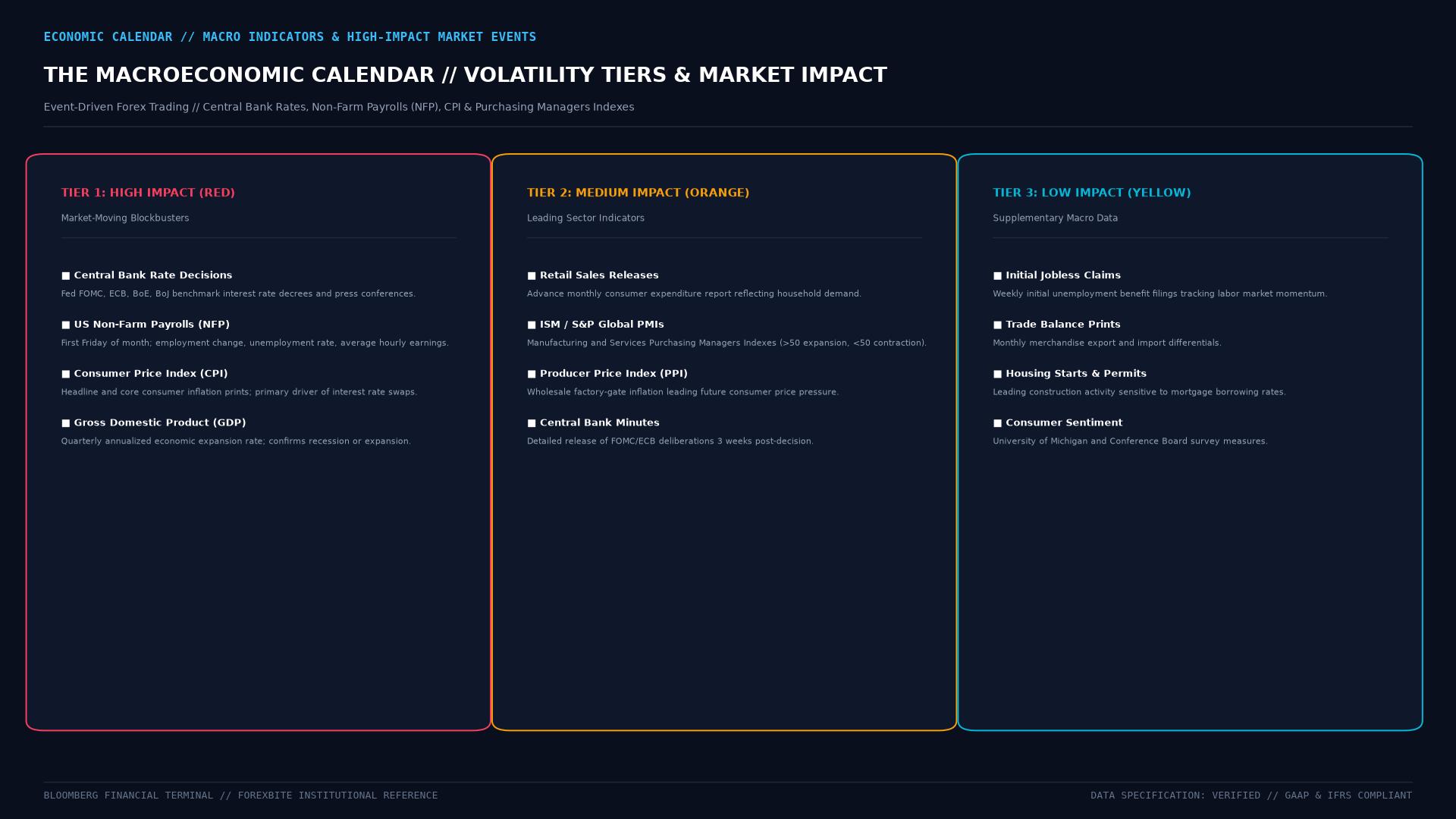 Figure: High-frequency Macroeconomic Calendar architecture categorizing Tier-1 (NFP, CPI, Central Bank rates), Tier-2, and Tier-3 events by volatility impact, consensus expectation deviation, and FX trading reaction windows.
How Economic Calendar Events Are Categorized
Most calendar providers (Forex Factory, Investing.com, Trading Economics, Bloomberg) use an impact rating system:
High impact (red/3 bull): Events likely to cause significant market movement. Examples: US Non-Farm Payrolls, CPI, Fed/ECB rate decisions, GDP releases, central bank press conferences. These can move major pairs 50-200 pips instantly.
Medium impact (orange/2 bull): Events with moderate market-moving potential. Examples: Retail Sales, Trade Balance, Manufacturing PMI, jobless claims. Typically cause 10-40 pip moves.
Low impact (yellow/1 bull): Routine data releases unlikely to significantly move markets unless the reading is dramatically outside expectations. Examples: minor housing data, second-tier confidence surveys.
Understanding this hierarchy helps prioritize which events require active monitoring and which can be observed passively.
The Most Market-Moving Events by Currency
USD pairs (EUR/USD, GBP/USD, USD/JPY, etc.):
- Non-Farm Payrolls (first Friday each month, 08:30 EST)
- CPI (mid-month, 08:30 EST)
- Federal Reserve FOMC rate decision (8 times/year, 14:00 EST)
- Fed Chair press conference (follows rate decision)
- GDP (advance estimate, 08:30 EST)
- Retail Sales
EUR pairs:
- ECB rate decision and press conference
- Eurozone CPI (HICP)
- German CPI, GDP, ZEW survey
- Eurozone PMI (Manufacturing and Services)
GBP pairs:
- Bank of England MPC rate decision
- UK CPI
- UK employment report (unemployment + average earnings)
- UK GDP and Retail Sales
JPY pairs:
- Bank of Japan policy decision
- BOJ Governor press conferences
- Japan CPI and GDP
- Tankan survey (quarterly)
Reading a Calendar Entry
A complete calendar entry shows:
- Date and time (always check the time zone — most calendars default to UTC or Eastern US time)
- Country/currency affected
- Event name
- Previous reading: Last month’s or last quarter’s actual data
- Forecast/consensus: The market’s expected reading (aggregated from economist surveys)
- Actual: Populated when the data releases
The critical number is the deviation from consensus. Markets have already priced in the forecast. A reading that matches consensus produces minimal movement. A reading that beats or misses consensus produces the reaction. The larger the deviation, the larger the move.
Building a Trading Schedule Around the Calendar
Professional traders look at the weekly calendar every Sunday evening before the week begins. They identify:
- Blackout periods: Windows around high-impact events (typically 15 minutes before to 30 minutes after) where they either avoid trading entirely or dramatically widen stop distances
- Priority events: The 1-2 events that week with highest potential market impact on the pairs they trade
- Session planning: Whether to focus on pre-event setup vs. post-event directional trades
For position traders holding multi-day swing trades, checking the calendar before entering is essential — a 50-pip trade target with a CPI release scheduled the next morning is a very different risk than the same trade with no events scheduled.
Free Economic Calendar Resources
Several free, high-quality economic calendars are available:
- Forex Factory (forexfactory.com): Most popular among retail forex traders. Color-coded impact ratings, filterable by currency and impact level
- Investing.com/economic-calendar: Broad coverage, clear formatting, available as a mobile app
- Trading Economics: Deeper historical data context, useful for comparing current readings to historical ranges
- Bloomberg and Reuters: Institutional-grade with more granular data, but subscription-based
Key Takeaways
- An economic calendar tracks scheduled events that can move forex markets — essential for both fundamental and technical traders
- Events are rated by expected impact: high (red), medium (orange), low (yellow)
- The deviation from consensus — not the absolute reading — determines market reaction magnitude
- Review the weekly calendar before trading each session; identify blackout periods around high-impact events
- NFP, CPI, and central bank rate decisions are the consistently highest-impact events
FAQ
What should I do if I’m holding a trade when a high-impact event releases? Options: close the trade beforehand, widen your stop to accommodate expected volatility, or hedge. Closing is the most conservative approach. Widening the stop is appropriate if the event is unlikely to change the underlying thesis. What you should never do is ignore the event and hope for the best — that’s how large unexpected losses happen.
Do low-impact events ever cause big moves? Yes, occasionally. If a low-impact data point is dramatically outside expectations, or if it comes at a time when the market is positioned one-directionally and looking for any reason to reverse, a “minor” event can trigger a significant move. The calendar’s impact ratings are probabilistic guides, not guarantees.
Ready to trade forex?
Open a free demo account with a regulated broker. Practice with virtual funds before risking real money.