Aggregate Demand
Aggregate Demand (AD) is a macroeconomic measure of the total quantity of all final goods and services demanded across an economy at a specific overall price level and time period. It comprises consumer spending, private investment, government expenditures, and net exports.
What Is Aggregate Demand?
In macroeconomic analysis, Aggregate Demand (AD) represents the total spending across an entire national economy on domestically produced final goods and services. It reflects the cumulative purchasing desire of households, private businesses, government entities, and foreign buyers at varying overall price levels.
While closely related to Gross Domestic Product (GDP), a subtle distinction exists: GDP measures the total value of what an economy actually produces, whereas Aggregate Demand measures the total spending power that economic agents are willing and able to deploy. In economic equilibrium, Aggregate Demand equals Gross Domestic Product.
Understanding aggregate demand is essential for currency traders because modern central banks—such as the Federal Reserve, the European Central Bank, and the Bank of England—adjust monetary policy primarily to steer aggregate demand into alignment with the economy’s sustainable productive capacity.
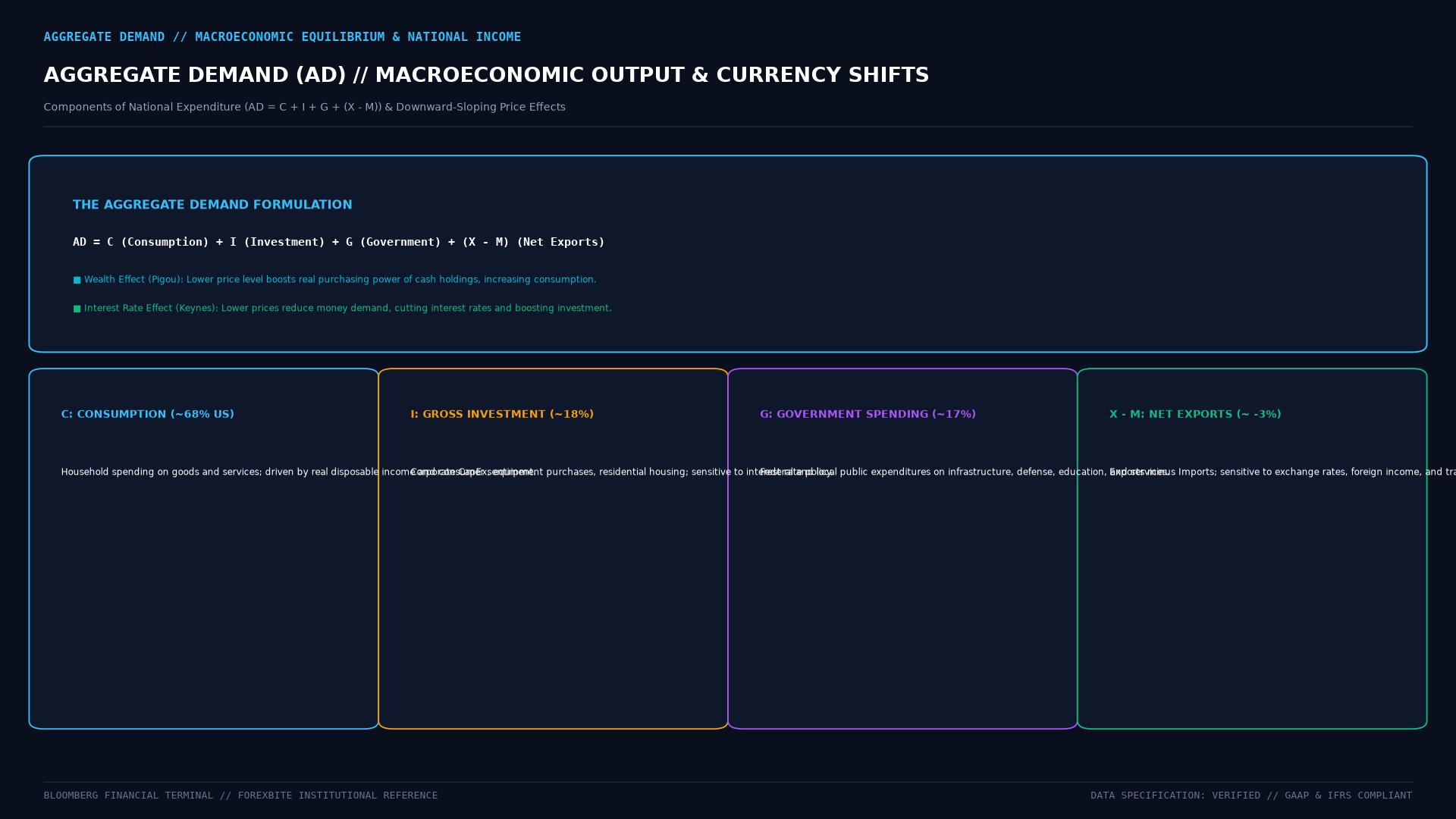 Figure: Aggregate Demand curve ($AD = C + I + G + (X - M)$) and the AD-AS macroeconomic equilibrium illustrating downward-sloping wealth, interest-rate, and exchange-rate effects alongside expansionary demand shocks.
The Mathematical Components of Aggregate Demand
The standard Keynesian formulation decomposes Aggregate Demand into four distinct operational components:
$$ AD = C + I + G + (X - M) $$
1. Consumer Spending ($C$)
Personal consumption expenditures represent the largest single engine of aggregate demand in developed consumer economies, accounting for approximately 68% to 70% of total demand in the United States and the United Kingdom. It encompasses household purchases of durable goods (cars, appliances), non-durable goods (food, fuel), and services (healthcare, entertainment, financial services). Key drivers of consumption include disposable income, consumer confidence, wage growth, and household debt levels.
2. Private Investment ($I$)
Business capital spending includes corporate investments in manufacturing facilities, technology hardware, software systems, commercial real estate, and changes in business inventory levels, alongside residential home construction. Business investment is highly sensitive to prevailing interest rates and future profit expectations: when borrowing costs rise, corporations postpone capital-intensive expansion projects.
3. Government Spending ($G$)
Direct government consumption and gross investment across federal, state, and municipal levels. This includes public infrastructure projects, defense procurement, public school operations, and civil servant payrolls. Crucially, transfer payments—such as state pensions, unemployment insurance, and welfare checks—are excluded from this figure because they do not represent direct purchases of goods or services (they only enter aggregate demand when recipients spend those funds under consumer spending).
4. Net Exports ($X - M$)
Gross exports ($X$) minus gross imports ($M$). When a country exports more goods and services to foreign consumers than it purchases from abroad, net exports are positive, adding directly to aggregate demand. Conversely, running a trade deficit acts as a net drag on total domestic expenditure.
The Aggregate Demand Curve
When plotted on a graph with the overall price level on the vertical axis and real output (Real GDP) on the horizontal axis, the Aggregate Demand curve slopes downward from left to right. Three distinct economic transmission mechanisms explain why total output demanded increases as general prices fall:
- The Wealth Effect (Pigou Effect): As price levels decline, the real purchasing power of accumulated money balances increases. Consumers feel wealthier in real terms and expand discretionary spending.
- The Interest Rate Effect (Keynes Effect): When price levels drop, households need less cash to settle everyday transactions, allowing them to purchase government bonds and bank deposits. This influx of loanable funds drives interest rates lower, stimulating commercial borrowing and residential mortgage activity.
- The Exchange Rate Effect (Mundell-Fleming Effect): Lower domestic price levels encourage domestic interest rates to fall. International investors shift capital toward higher-yielding foreign economies, causing the domestic currency to depreciate. A weaker currency makes domestic exports cheaper for foreign buyers and imports more expensive for local consumers, boosting net exports ($X - M$) and shifting aggregate demand higher.
How Aggregate Demand Drives Currency Markets
Forex traders monitor leading indicators of aggregate demand to forecast central bank interest rate decisions:
The Inflationary Gap (Hawkish Catalyst)
When aggregate demand expands faster than the economy’s physical capacity to produce goods and services (potential GDP), an “inflationary gap” emerges. Factories operate at maximum capacity, labor shortages drive up wages, and businesses raise prices to ration supply. In response, the central bank enacts hawkish monetary policy—hiking interest rates to dampen aggregate demand. Rising interest rates attract international yield-seeking capital, sparking sharp appreciation in the domestic currency.
The Recessionary Gap (Dovish Catalyst)
When aggregate demand contracts—triggered by falling consumer confidence, tighter credit conditions, or fiscal austerity—economic output drops below potential capacity. Unemployment climbs and deflationary pressures build. To avert prolonged stagnation, the central bank cuts interest rates and deploys quantitative easing to stimulate borrowing and consumption. The flood of monetary liquidity and declining yields typically causes the national currency to depreciate against peers.
Practical Forex Example: Post-Pandemic Macro Divergence
Consider the sharp divergence in aggregate demand between the United States and the Eurozone during the 2021–2022 recovery:
- United States: Unprecedented multi-trillion-dollar federal fiscal stimulus directly distributed cash to households ($G$), while household savings surged. As lockdowns lifted, American consumer spending ($C$) erupted, driving aggregate demand far beyond pre-pandemic trends. US inflation surged to 9.1%. To suppress runaway aggregate demand, the Federal Reserve hiked interest rates by 525 basis points in 16 months.
- Eurozone: The European recovery was severely dampened by a historic natural gas crisis following the conflict in Ukraine. Soaring energy import bills acted as an enormous tax on European consumers, crushing disposable income ($C$) and corporate investment ($I$). Aggregate demand stagnated.
- Forex Reaction: Because US aggregate demand remained resilient while European aggregate demand faltered, the Fed was able to hike rates far more aggressively than the European Central Bank. The EUR/USD exchange rate collapsed from 1.2250 in early 2021 to below parity at 0.9535 in September 2022, demonstrating how macroeconomic demand disparities shape multi-thousand-pip foreign exchange trends.
Key Takeaways
- Aggregate Demand measures the total spending across an economy at a given price level over a defined time period.
- Its four components are Consumer Spending ($C$), Investment ($I$), Government Spending ($G$), and Net Exports ($X - M$).
- The AD curve slopes downward due to the wealth effect, the interest rate effect, and the exchange rate effect.
- When aggregate demand outstrips productive capacity, central banks hike interest rates to cool inflation, boosting the currency.
- Disparities in aggregate demand growth between nations create long-term interest rate divergences that drive major forex trends.
FAQ
How does an increase in interest rates reduce aggregate demand? Higher interest rates make consumer borrowing (car loans, credit cards, mortgages) and corporate capital financing more expensive, discouraging spending and investment. At the same time, higher yields incentivize households and businesses to save cash rather than spend it, pulling liquidity out of the economy.
What is the difference between aggregate demand and GDP? Aggregate demand reflects the total intended expenditure on goods and services at various price levels, whereas GDP is the actual measured value of all finished goods and services produced within an economy during a quarter or year. In macroeconomic equilibrium, realized aggregate demand equals actual GDP.
Can a depreciating currency stimulate aggregate demand? Yes. When a nation’s currency weakens, its manufactured products and agricultural commodities become cheaper and more competitive in international markets, increasing exports. Concurrently, foreign imported goods become more expensive, encouraging domestic buyers to substitute domestic products, thereby improving Net Exports ($X - M$).
Ready to trade forex?
Open a free demo account with a regulated broker. Practice with virtual funds before risking real money.