Aggregate Supply
Aggregate Supply (AS) is the total quantity of all final goods and services that businesses across an entire economy are willing and able to produce and sell at a given overall price level over a specific period. It is analyzed across short-run (upward-sloping) and long-run (vertical) horizons.
What Is Aggregate Supply?
In macroeconomic theory, Aggregate Supply (AS) reflects the productive capacity and willingness of a nation’s businesses to supply goods and services to the market at varying general price levels. While aggregate demand illustrates the total purchasing desire across the economy, aggregate supply defines the physical output that firms actually deliver.
The interaction between aggregate supply and aggregate demand establishes the overall equilibrium price level (inflation) and total national output (Real Gross Domestic Product). For foreign exchange traders, shifts in aggregate supply are among the most critical fundamental market forces because they directly determine whether an economy experiences healthy, non-inflationary growth or enters the destructive trap of stagflation—rising inflation combined with economic contraction.
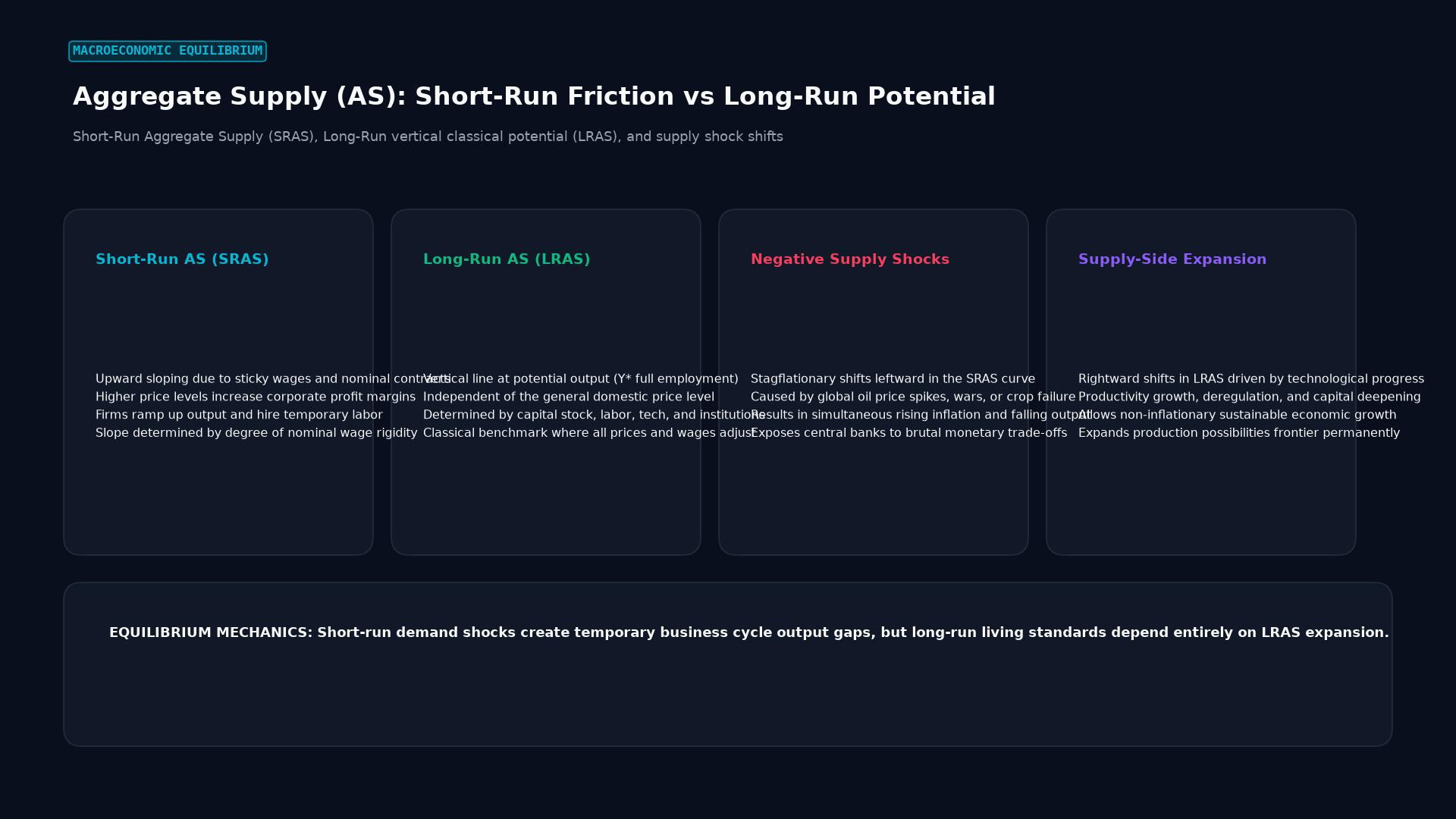 Figure: Short-Run Aggregate Supply (SRAS), Long-Run vertical classical potential (LRAS), and supply shock shifts
Short-Run vs. Long-Run Aggregate Supply
Economists divide aggregate supply into two distinct time horizons based on the flexibility of input costs and wages:
1. Short-Run Aggregate Supply (SRAS)
In the short run, the aggregate supply curve slopes upward from left to right. This upward slope exists because many business production costs—particularly nominal employee wages, commercial leases, and raw material contracts—are “sticky” (fixed in the near term by binding contracts or institutional inertia).
When consumer price levels rise across the broader economy while input costs remain fixed, a firm’s profit margins expand. Businesses respond by increasing output: they schedule overtime shifts, add temporary workers, and run machinery at maximum capacity. Conversely, if price levels fall while wages remain rigid, profit margins shrink, compelling businesses to cut production and lay off staff.
2. Long-Run Aggregate Supply (LRAS)
In the long run, all contractual stickiness evaporates. Workers renegotiate wages to match higher living costs, suppliers raise component prices, and commercial leases reset to current market rates. Because input costs fully adjust to price changes, overall price levels no longer influence business profitability or total real output.
Consequently, the Long-Run Aggregate Supply (LRAS) curve is completely vertical at the point known as Potential GDP (or full-employment output). Long-run capacity is governed entirely by structural economic fundamentals:
- Labor Force Demographics: The size, education level, and participation rate of the workforce.
- Capital Stock: The volume and quality of physical infrastructure, factories, robotics, and logistics networks.
- Natural Resource Availability: Domestic access to mineral deposits, arable land, and energy reserves.
- Technology and Total Factor Productivity (TFP): Innovations in artificial intelligence, software, and industrial automation that allow workers to produce more output per hour.
The Impact of Supply Shocks
External events frequently displace the aggregate supply curve, generating profound market shocks:
Positive Supply Shocks (Disinflationary Expansion)
A positive supply shock occurs when sudden technological breakthroughs, tax reductions, or cheap energy discoveries lower the cost of doing business across the entire economy. The SRAS curve shifts to the right: industrial output expands while consumer price inflation falls. This represents the gold standard of economic environments. Central banks can maintain supportive monetary policy without igniting inflation, creating a stable, confident backdrop for domestic equities and the national currency.
Negative Supply Shocks (The Stagflation Nightmare)
A negative supply shock occurs when sudden supply chain disruptions, geopolitical embargoes, or natural disasters dramatically raise input costs. The classic historical catalyst is an unexpected spike in global crude oil or natural gas prices.
A negative supply shock shifts the SRAS curve to the left:
- Output contracts: Skyrocketing energy and transportation costs force factories to curb production and lay off workers, triggering an economic slowdown.
- Prices surge: Businesses pass escalating input costs onto consumers, driving headline inflation upward.
This lethal combination of falling GDP and surging inflation is known as stagflation.
The Central Bank Dilemma and Currency Ramifications
Negative supply shocks create an almost impossible policy dilemma for central banks, which directly impacts currency valuation:
- If the central bank hikes interest rates: Raising borrowing costs cools demand and curbs inflation, but it accelerates the recession, deepening corporate bankruptcies and driving unemployment higher.
- If the central bank cuts interest rates: Slashing rates supports businesses and preserves employment, but it pours fuel on the inflationary fire, debasing the currency’s purchasing power.
In foreign exchange, how a currency performs during a supply shock depends entirely on the nation’s trade balance and energy independence:
- Net Energy Exporters (e.g., USD, CAD, NOK): When a global energy supply shock strikes, oil-exporting nations benefit from surging terms of trade. Their current accounts improve, domestic energy revenues soar, and their currencies appreciate.
- Net Energy Importers (e.g., EUR, JPY, GBP): Nations dependent on foreign fuel imports experience a devastating economic drain. They must sell domestic currency to purchase foreign-denominated energy, creating severe structural depreciation pressure.
Practical Forex Example: The 2022 European Energy Shock
The real-world manifestation of an aggregate supply shock unfolded across Europe in 2022 following the conflict in Ukraine:
- Russia drastically curtailed pipeline natural gas flows to Western Europe. European benchmark natural gas prices skyrocketed from €30 per megawatt-hour to over €300/MWh—a ten-fold increase in core industrial energy costs.
- The sudden energy cutoff triggered a violent leftward shift in European Short-Run Aggregate Supply (SRAS). Energy-intensive chemical, steel, and fertilizer plants in Germany and Italy shuttered operations, halting manufacturing output.
- Concurrently, Eurozone Harmonised Index of Consumer Prices (HICP) inflation surged past 10.6%, driven by utility bills and transport costs.
- The European Central Bank faced a classic stagflationary trap: raising rates threatened to crush an already reeling industrial sector, while doing nothing promised to entrench double-digit inflation expectations.
- Foreign exchange markets reacted decisively: global capital fled European assets. The Euro collapsed from 1.1400 against the US Dollar in early 2022 down to a two-decade low of 0.9535 in September 2022. Because the US was a net energy exporter while Europe was an energy importer, the asymmetric supply shock dictated the dominant forex trend of the year.
Key Takeaways
- Aggregate Supply measures the total volume of goods and services that a nation’s businesses produce and sell at varying price levels.
- Short-Run Aggregate Supply (SRAS) slopes upward due to sticky nominal wages and contractual production costs.
- Long-Run Aggregate Supply (LRAS) is vertical at Potential GDP, determined exclusively by capital, labor, technology, and productivity.
- Positive supply shocks foster economic growth alongside falling inflation.
- Negative supply shocks generate stagflation, confronting central banks with painful trade-offs and triggering severe depreciation in energy-importing currencies.
FAQ
Why is Long-Run Aggregate Supply vertical? In the long run, all wages, prices, and contractual inputs fully adjust to inflation. Because money is neutral in the long run, general price increases no longer provide any artificial profit incentive for firms to produce above their sustainable physical capacity.
What factors can shift the LRAS curve to the right? The LRAS curve shifts permanently to the right through capital investment, workforce growth, higher educational attainment, infrastructure improvements, and technological innovation that permanently boosts worker productivity.
How do supply chain bottlenecks affect aggregate supply? Supply chain bottlenecks act as a temporary negative supply shock. By restricting access to vital components (such as semiconductor microchips or shipping containers), factories cannot fulfill demand, causing production to fall while the scarce finished goods command higher market prices.
Ready to trade forex?
Open a free demo account with a regulated broker. Practice with virtual funds before risking real money.