Monetary Policy Committee (MPC)
The Monetary Policy Committee (MPC) is the rate-setting body of the Bank of England, responsible for setting the Bank Rate (the UK's benchmark interest rate) and other monetary policy tools. Its nine members vote at eight scheduled meetings per year. The MPC's decisions directly drive GBP exchange rates — its meeting outcomes, voting splits, and quarterly forecasts are among the highest-impact scheduled events on the GBP forex calendar.
What the MPC Does
The Monetary Policy Committee is responsible for one of the most consequential decisions in UK financial markets: setting the Bank Rate — the interest rate at which the Bank of England lends to commercial banks, and the benchmark rate that propagates through all UK borrowing costs from mortgages to business loans.
The MPC’s primary mandate is maintaining price stability — defined as 2% CPI inflation. Secondary to this is supporting the government’s wider economic objectives. When inflation is significantly above 2%, the MPC raises rates to cool demand. When inflation is below target or the economy is in recession, it cuts rates or deploys unconventional tools like quantitative easing.
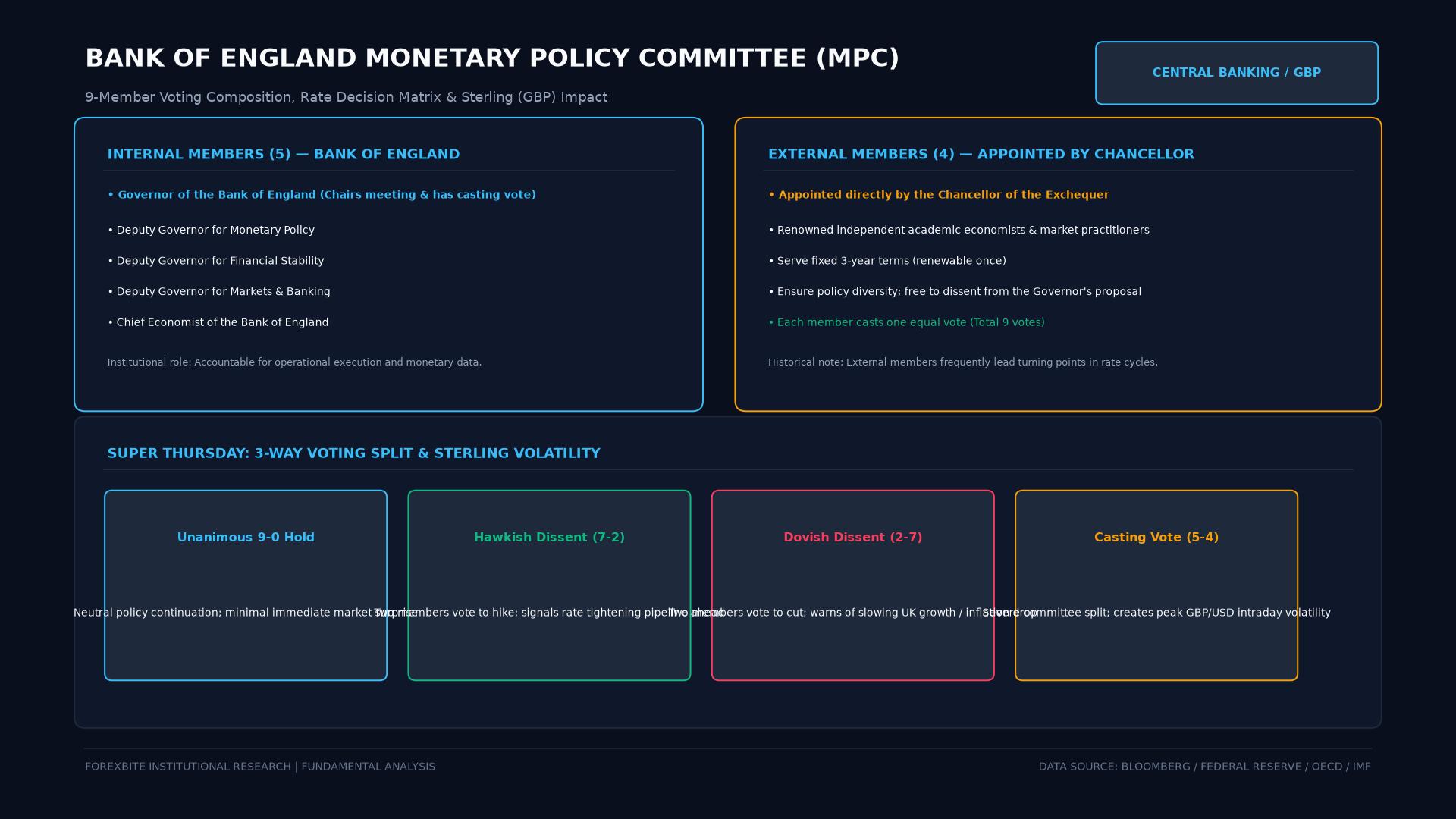 Figure: Governance structure of the Bank of England MPC, showing the 5 internal Bank members and 4 external Chancellor-appointed members, voting split dynamics, and Sterling foreign exchange market impact.
The Nine-Member Structure
The MPC is deliberately structured to balance internal Bank expertise with external perspectives:
Internal members (5):
- Governor of the Bank of England (chairs the meeting)
- Three Deputy Governors
- Chief Economist
External members (4): Appointed by the Chancellor of the Exchequer for three-year renewable terms. They are independent academic economists, former central bankers, or financial practitioners. Their external status is designed to prevent groupthink and allow dissenting views to influence deliberations.
External members have historically driven some of the most notable dissents: voting for cuts when internal members vote to hold, or voting for larger moves than the majority. These dissents signal potential future policy direction.
The Meeting and Decision Process
Eight times per year: MPC meetings are scheduled on a fixed calendar, roughly every six weeks. This schedule is published at the start of the year.
Two-day meeting: Members deliberate over two days, reviewing economic data, staff projections, and alternative policy scenarios.
Vote: Each member casts a single vote. The majority determines the decision. The Governor has a casting vote in the event of a tie (extremely rare).
Published simultaneously: On decision day (typically the Thursday of the meeting week at 12:00 noon GMT), the Bank releases: the rate decision, the voting record (showing how each member voted), and a summary statement.
Quarterly Monetary Policy Report (MPR): Four times per year (February, May, August, November), the decision is accompanied by the full MPR — containing the Bank’s economic projections, the “fan chart” showing inflation forecast scenarios, and extended forward guidance on the rate path.
Why the Vote Split Moves Markets
The rate decision itself is often fully priced by the time it’s released — markets spend the weeks between meetings analyzing data and adjusting their expectations. What frequently surprises is the vote split.
Examples of how the split moves GBP:
- 8-1 decision to hold (one hawk voting to hike): Mildly hawkish — the hawk is outnumbered but the dissent signals active debate about hiking
- 6-3 decision to hold (three doves voting to cut): Dovish — three members think policy is already too tight, signaling cuts are coming sooner
- 7-2 decision to cut 25bp (two voting for 50bp): More aggressive easing than consensus — GBP sells off sharply
- Unanimous decision to hold: Signals committee cohesion; impact depends on language in the statement
Key MPC Events for GBP Traders
| Event | Frequency | Market Impact |
|---|---|---|
| MPC Rate Decision + Vote | 8x/year | Very High |
| Monetary Policy Report | 4x/year | Very High |
| Governor’s Press Conference | 4x/year (post-MPR) | Very High |
| MPC Minutes | Released with decision | High |
| MPC member speeches (external) | Ad hoc | Medium |
Key Takeaways
- MPC: 9 members (5 internal BoE, 4 external independent) voting on Bank Rate 8x/year
- Primary mandate: 2% CPI inflation; secondary: economic growth support
- Voting split is often as market-moving as the rate decision itself
- Quarterly Monetary Policy Reports contain projections and fan charts — very high GBP impact
- Hawkish MPC (vote to hike) = GBP bullish; Dovish MPC (vote to cut) = GBP bearish
FAQ
Who is the current MPC Governor? As of 2026, Andrew Bailey serves as Governor of the Bank of England and chairs the MPC. Governor speeches outside of MPC meetings are also closely watched for signals about the committee’s direction.
Does the Chancellor control MPC decisions? No. The MPC is operationally independent — the Chancellor sets the 2% CPI inflation target and appoints external members, but cannot direct individual rate decisions. This independence was formally granted in 1997 and is considered foundational to UK monetary credibility.
Ready to trade forex?
Open a free demo account with a regulated broker. Practice with virtual funds before risking real money.