Breakaway Gap
A breakaway gap is a high-momentum technical chart pattern where an asset's price jumps violently past a major support or resistance boundary, leaving an unfilled void on the price chart. It signals the decisive end of a consolidation phase and the birth of a powerful new trend.
What Is a Breakaway Gap?
In technical analysis, a price gap appears on a chart whenever an instrument opens at a price noticeably higher than the previous bar’s high (a gap up) or noticeably lower than the previous bar’s low (a gap down), leaving an empty space where no transactions took place.
Among the various gap formations recognized by technical analysts, the breakaway gap is the most significant. It occurs at the decisive completion of an extended trading range, consolidation pattern, or multi-week base (such as a rectangle, symmetrical triangle, or head and shoulders neckline). Rather than grinding slowly through the established technical boundary, price bursts across the barrier in a single leap, driven by an overwhelming imbalance between buyers and sellers.
A true breakaway gap marks a profound psychological and structural transition in the market: it signifies that smart money and institutional liquidity providers have completely liquidated or accumulated inventory, initiating an aggressive directional trend.
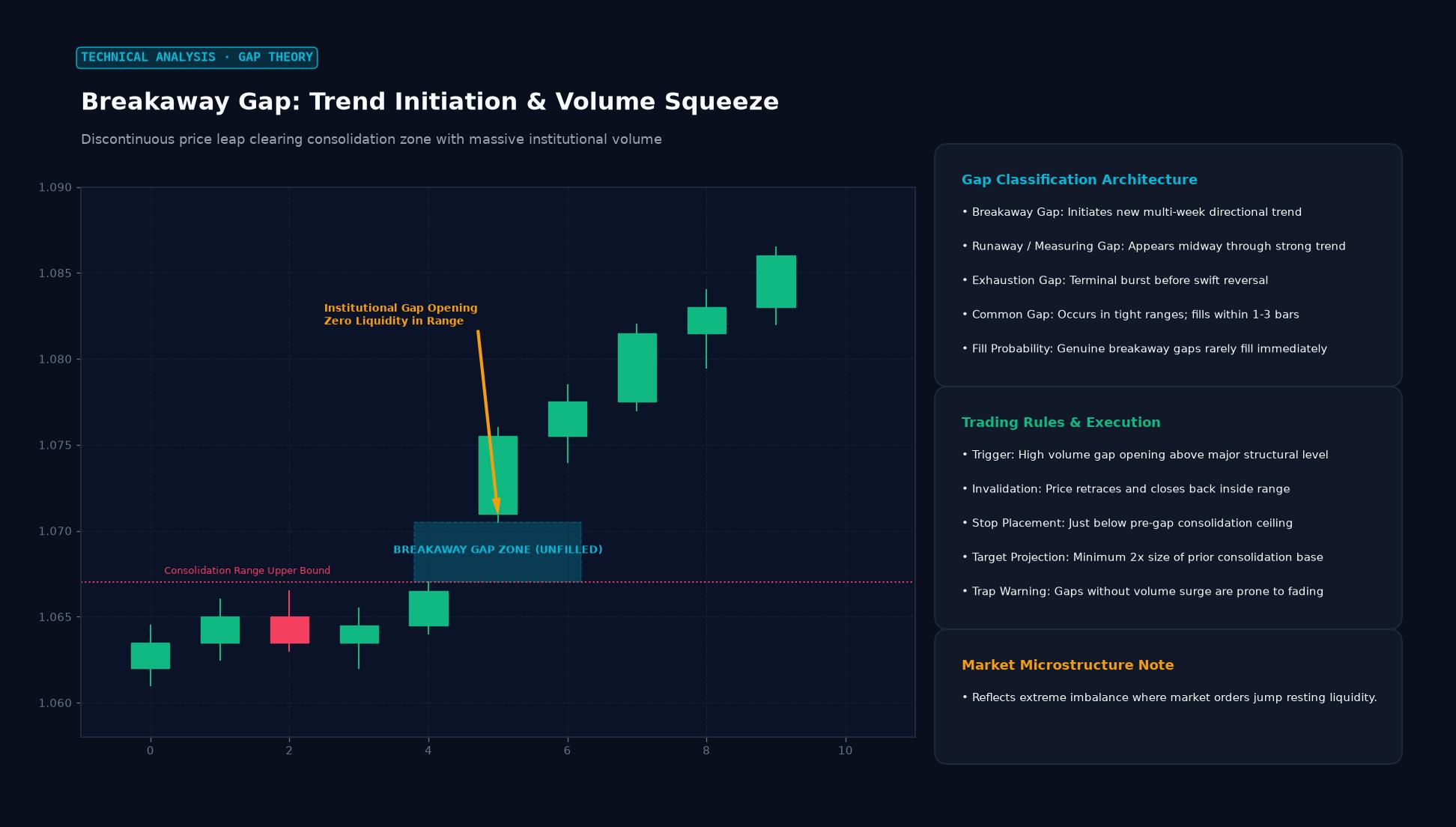 Figure: Discontinuous price leap clearing consolidation zone with massive institutional volume
The Four Major Types of Price Gaps
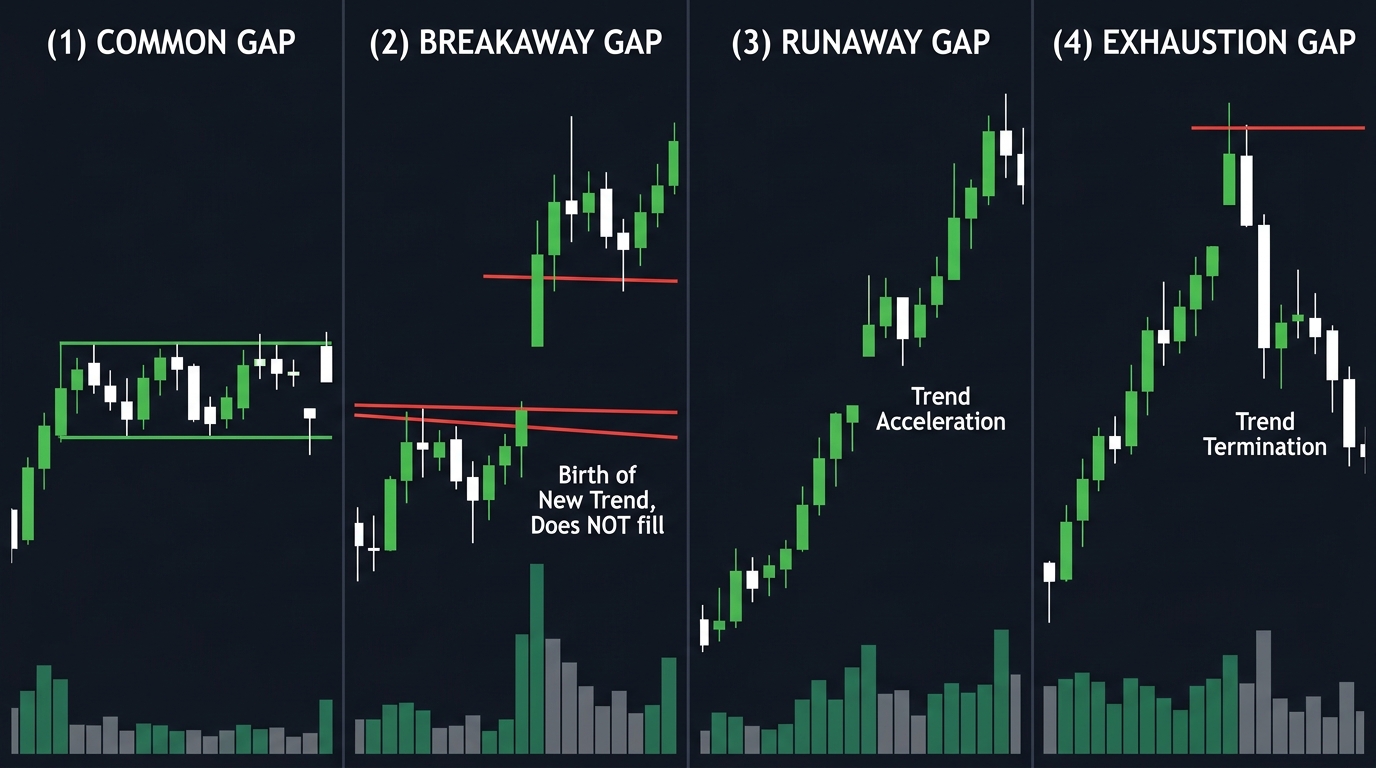
To trade gaps effectively, a market participant must accurately classify the gap within the broader market structure. Technical analysts categorize gaps into four distinct classifications:
1. Common Gaps (Trading Noise)
Common gaps occur randomly inside quiet trading ranges. They are characterized by low trading volume, lack fundamental catalysts, and are routinely “filled” (price returns to trade through the empty price zone) within a few sessions. They offer minimal predictive value.
2. Breakaway Gaps (Trend Origin)
Breakaway gaps form at the exact perimeter of a prolonged congestion zone. They are accompanied by a massive surge in trading volume and institutional participation. Unlike common gaps, true breakaway gaps rarely fill in the near term. The empty zone left behind becomes a formidable barrier of dynamic support (for upside gaps) or resistance (for downside gaps).
3. Runaway Gaps (Continuation / Measuring Gaps)
Runaway gaps appear roughly midway through an established, powerful trend. They reflect intense panic among sidelined traders rushing to enter the market. Technical analysts use runaway gaps as “measuring gaps”: the distance from the initial breakout to the runaway gap frequently equals the projected distance from the runaway gap to the eventual trend peak.
4. Exhaustion Gaps (Trend Termination)
Exhaustion gaps occur near the climax of a mature, extended trend. They represent final, frantic capitulation by retail traders chasing a move. Within one to three trading bars, price stalls, reverses violently, and fills the gap, confirming that the prevailing trend has run out of momentum.
Gaps in Equity Markets vs. The 24/5 Forex Market
The physical mechanics of gap formation differ substantially across asset classes:
Stock Exchanges
In equity markets, breakaway gaps occur frequently. Because centralized exchanges close for 17.5 hours each day, quarterly earnings reports, regulatory decisions, and macroeconomic headlines announced overnight cause market makers to open stocks dollars away from the previous day’s closing price.
Spot Foreign Exchange
Because the interbank foreign exchange market operates continuously 24 hours a day from Monday morning in Sydney through Friday afternoon in New York, intraday price gaps on daily charts are exceedingly rare during the normal trading week. When intraday gaps do occur, they are typically sparked by catastrophic geopolitical events or sudden central bank interventions (such as the Swiss National Bank abandoning the 1.2000 EUR/CHF floor in January 2015).
However, foreign exchange traders routinely encounter breakaway gaps during the Sunday Market Open. Between Friday’s New York close (5:00 PM EST) and Sunday’s Asian open (5:00 PM EST), international news unfolds while retail platforms are closed. Major election outcomes, emergency weekend summits, or military escalations can cause major currency pairs to open Sunday evening 50 to 150 pips above or below Friday’s close, producing classic breakaway gaps across global charts.
The Fatal “Gap Fill” Trap
A widespread and dangerous myth among novice traders is the belief that “all gaps must be filled.” While common gaps do fill regularly due to range-bound mean reversion, attempting to “fade” (trade against) a breakaway gap is one of the quickest routes to catastrophic account drawdowns.
When a genuine breakaway gap forms, aggressive institutional order flow has driven price out of equilibrium. Traders who attempt to short a bullish breakaway gap expecting it to “fill” find themselves trapped on the wrong side of a runaway institutional trend, suffering severe margin calls as the market powers forward without looking back.
Practical Trading Strategy: Trading the Breakaway Setup
Professional traders treat a breakaway gap not as an opportunity to fade, but as high-conviction confirmation to enter in the direction of the gap:
- Identify the Base: Observe an asset consolidating inside a well-defined horizontal trading range for at least three to six weeks.
- Confirm the Gap: Price gaps cleanly outside the range boundary. The open, high, and low of the session remain entirely beyond the previous support or resistance level.
- Volume Confirmation: Ensure that tick volume (in forex) or exchange volume (in futures/equities) expands substantially—ideally 150% to 200% above the 20-day moving average.
- Execution Options:
- Aggressive Entry: Enter on the market open immediately following the gap confirmation.
- Conservative Entry: Wait for an intraday pullback toward the outer edge of the broken consolidation boundary. The former resistance level now functions as support. If price prints a bullish reversal candle (such as a pin bar) at the boundary, enter long.
- Stop-Loss Placement: Place the stop-loss order just inside the broken consolidation zone (typically 15 to 30 pips below the former resistance level). If price drops back into the center of the old range, the breakaway thesis is invalidated.
- Profit Target: Project a measured move equal to the height of the original consolidation pattern added to the breakout level.
Key Takeaways
- A breakaway gap forms when an asset’s price leaps decisively past a major technical boundary from an established consolidation base.
- It is characterized by high volume, strong directional momentum, and a shift in institutional consensus.
- Unlike common gaps, true breakaway gaps rarely fill quickly and establish strong dynamic support or resistance.
- In spot forex, breakaway gaps occur predominantly over the weekend, opening on Sunday afternoon following major economic or geopolitical news.
- Novice traders often blow up accounts trying to fade breakaway gaps; professional strategy dictates trading in the direction of the break.
FAQ
How can I distinguish a breakaway gap from an exhaustion gap? Context and volume are paramount. A breakaway gap occurs after an extended period of sideways consolidation with price breaking out of a base. An exhaustion gap occurs after a rapid, multi-week trend that is already visually overextended, and the exhaustion gap is quickly filled within a few bars.
What happens if a breakaway gap fills completely? If price falls back and completely fills the gap within a few sessions, re-entering the previous trading range, the move is classified as a “false breakout” or “bear trap.” Traders should immediately exit positions, as failed breakouts frequently trigger violent moves in the opposite direction.
Should I enter immediately when the gap appears? Aggressive traders enter immediately on the open of the gap bar to avoid missing the trend. More conservative traders wait for a minor pullback to test the broken support or resistance level, using a confirming candlestick pattern to enter with tighter risk parameters.
Ready to trade forex?
Open a free demo account with a regulated broker. Practice with virtual funds before risking real money.