Breakeven
Breakeven in forex trading refers to the point at which a trade neither gains nor loses money — the exit price equals the entry price plus spread costs. In position management, 'moving to breakeven' means adjusting the stop-loss to the entry price once a trade has moved sufficiently in your favor, eliminating the risk of a monetary loss on the position while leaving the possibility of further profit.
Breakeven: Two Meanings in Trading
The word “breakeven” appears in two distinct contexts in forex trading, and confusing them leads to poor decisions.
1. Breakeven price of a trade: The exact price at which your trade exits with zero profit or loss. For a long position, this is your entry price plus the spread you paid. Example: buy EUR/USD at 1.0852 (ask price), spread was 1 pip. Breakeven is approximately 1.0853 — price needs to reach that level before you’re in net profit. The spread is an immediate loss at entry that must be overcome before actual profit begins.
2. Moving stop-loss to breakeven: A position management technique where, after a trade has moved meaningfully in your favor, you adjust the stop-loss from its initial protection level to your entry price. If the trade subsequently reverses, it exits at your entry price — with zero monetary loss (the spread cost is a minor exception).
This second meaning is far more commonly what traders refer to when they say “I moved my stop to breakeven” or “running a breakeven trade.”
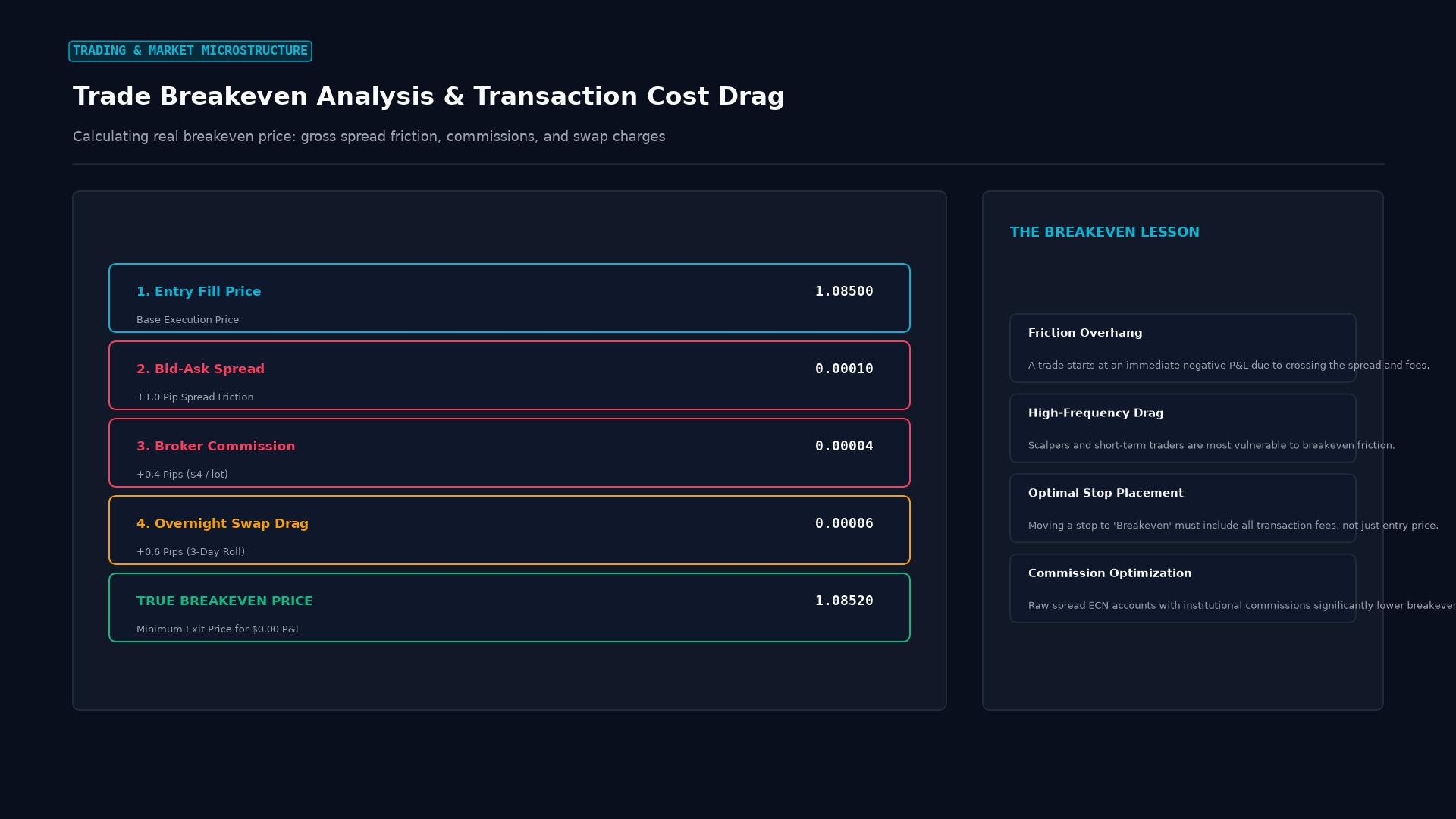 Figure: Calculating true trading breakeven: adding bid-ask spread friction, round-turn commissions, and overnight financing swap drag to initial entry price.
The Logic of Moving to Breakeven
The core purpose: eliminate the fear and psychological pressure of a losing position while maintaining the possibility of further profit.
Before moving to breakeven:
- Entry: 1.0850
- Stop: 1.0820 (-30 pips risk)
- Open P&L: +25 pips (trade moving in your favor)
- Worst case: -$300 per lot if stopped out
After moving stop to breakeven at 1.0850:
- Entry: 1.0850
- Stop: 1.0850 (moved to entry)
- Open P&L: +25 pips
- Worst case: $0 loss (breakeven exit, minus a pip or two for spread)
The trade is now “free” — you can hold it without fear of a loss, allowing the remainder to aim for the full target.
When to Move to Breakeven
The timing matters. Move too soon, and the normal market noise stops you out at breakeven before the trade has space to develop — you get stopped at breakeven repeatedly, and miss many of the profitable moves that would have followed.
Common frameworks:
Rule of 1R: Move to breakeven when the trade reaches 1× your initial risk in profit. If your stop was 30 pips (-$300/lot), move to breakeven when you’re up 30 pips (+$300/lot). You’ve now secured the equivalent of a risk-free trade on the remaining position.
First structural target: Move to breakeven when price reaches the first significant resistance level (for long trades) or support level (for short trades). This level is likely to cause at least a temporary pause or pullback — having the stop at breakeven protects against a pullback that takes out the position entirely.
Time-based: Some traders move to breakeven after a trade has been open for a specified time (e.g., if the market hasn’t moved significantly in 24 hours, move to breakeven to avoid slow, grinding losses).
Limitations of the Breakeven Move
Moving to breakeven is not a guarantee of a good outcome — it’s a risk management choice with trade-offs:
Premature breakeven causes missed profits: If you move to breakeven at +20 pips and normal market noise immediately triggers the stop, you miss the 150-pip move that follows. Moving stops too tight too early is one of the most common causes of underperforming win/loss ratios.
False security: A breakeven stop doesn’t eliminate all risk. If price gaps through your stop level overnight, your fill may be several pips worse than breakeven.
Strategy coherence: Not all strategies benefit from breakeven management. Trend-following strategies designed to hold for extended moves may see more damage from premature breakeven stops than from letting the trade breathe.
Key Takeaways
- Breakeven price = entry price + spread cost (the minimum to exit with no loss)
- “Moving to breakeven” = adjusting stop-loss to entry price to eliminate monetary loss risk
- Move at 1R profit (when up the same amount as you risked) or at first key structural level
- Too-early breakeven moves cause being stopped out in normal market noise
- Breakeven management is a psychological tool as much as a risk tool — eliminates fear, enables holding
FAQ
Does a breakeven stop eliminate all loss? Almost — a breakeven stop eliminates monetary loss from the trade itself, but the spread cost paid on entry is a sunk cost (typically 0.5-2 pips on a major pair). So a true zero-loss exit requires hitting the stop level and getting a fill within a pip or two of breakeven, accounting for spread. In practice, “breakeven” usually means within $5-20 of zero.
Should I always move to breakeven? No — it depends on your strategy. If you’re trading a high-probability, low-reward-to-risk system with many trades, premature breakeven moves destroy profitability. If you’re trading a low-frequency, high-reward-to-risk trend system, breakeven moves protect against turning a profitable setup into a loss. Match the technique to the strategy.
Ready to trade forex?
Open a free demo account with a regulated broker. Practice with virtual funds before risking real money.