Bundesbank (Buba)
The Deutsche Bundesbank, universally known in financial markets by its colloquial abbreviation 'Buba,' is the central bank of the Federal Republic of Germany. Headquartered in Frankfurt, it is historically the most influential national central bank in Europe and serves as the operational anchor and institutional blueprint for the European Central Bank (ECB).
What Is the Deutsche Bundesbank?
The Deutsche Bundesbank is the independent central bank of the Federal Republic of Germany. Established in its modern form in 1957 and headquartered in Frankfurt am Main, the institution is universally known on interbank trading desks and across global financial media by its familiar German abbreviation, Buba.
Historically, the Bundesbank was the most powerful and widely respected central bank on the European continent. Before the introduction of the Euro in 1999, the Bundesbank’s domestic currency—the Deutsche Mark (DEM)—served as the undisputed anchor currency of Europe and the second most important reserve currency in the world after the US Dollar.
Today, Germany represents the largest national economy in the European Union, contributing nearly 28% of total Eurozone Gross Domestic Product. As a result, the Bundesbank constitutes the largest and most influential National Central Bank (NCB) within the Eurosystem and the European System of Central Banks (ESCB).
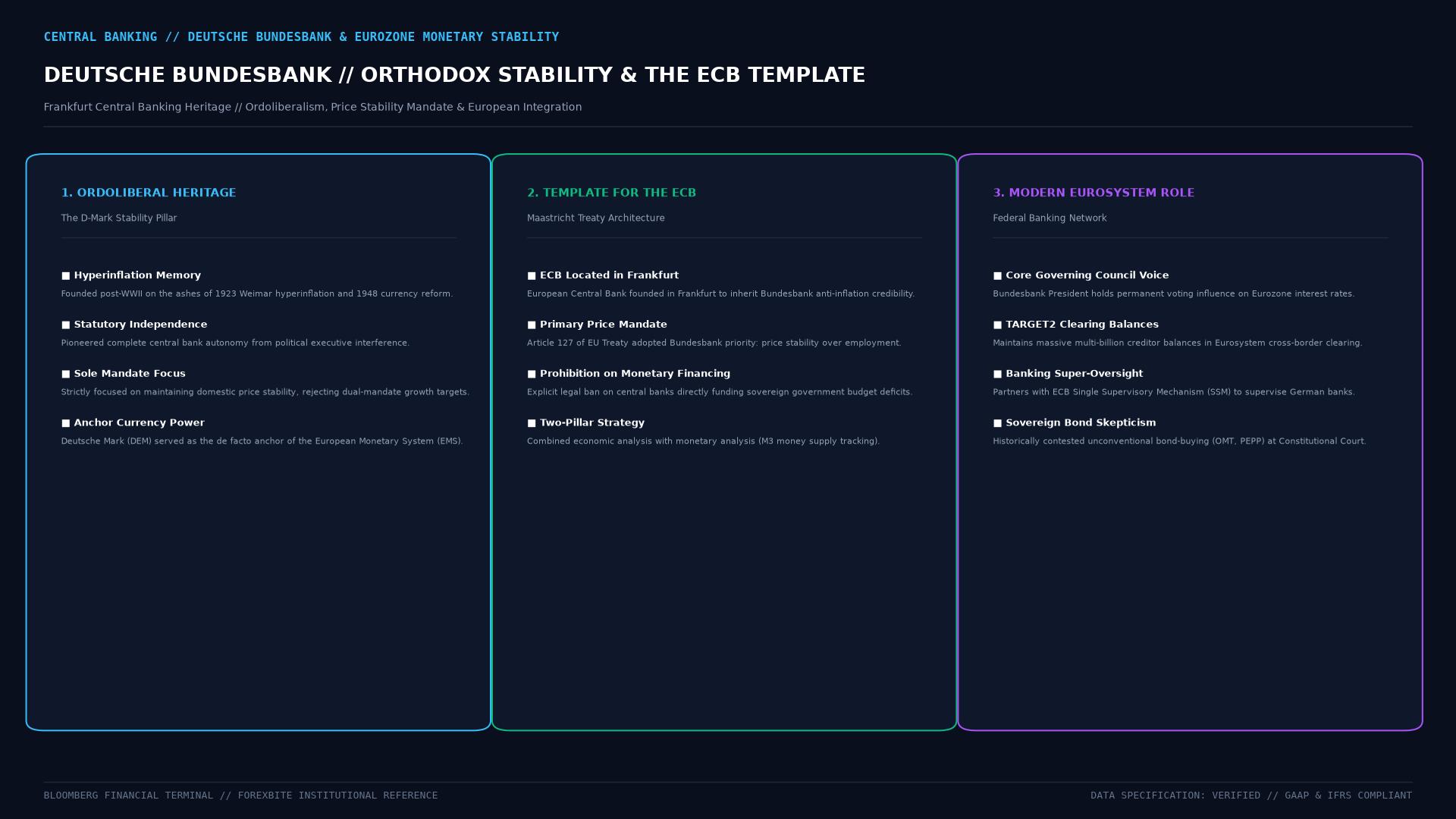 Figure: Institutional framework of the Deutsche Bundesbank, showcasing its historical anti-inflation mandate, its central role within the Eurosystem/ECB Governing Council, and TARGET2 balance surveillance.
The Stability Culture: The Trauma of Hyperinflation
To understand the Bundesbank’s uncompromising monetary philosophy, one must understand German economic history.
Following World War I, the Weimar Republic suffered one of the most catastrophic episodes of hyperinflation in modern history. By late 1923, consumer prices doubled every few days, paper Marks became worthless, and the middle class was financially devastated. A second monetary collapse occurred in the immediate aftermath of World War II before the introduction of the Deutsche Mark in 1948.
These historical traumas forged a deep-seated, cross-generational German consensus: price stability is a sacred democratic prerequisite.
When the West German parliament chartered the Bundesbank in 1957, it granted the institution total legal independence from the federal government—a revolutionary concept at a time when most global central banks (including the Bank of England and Banque de France) operated under the direct political control of finance ministries. The Bundesbank’s statutory mandate was simple and unbending: preserve the purchasing power of the currency at all costs, regardless of political pressure or short-term electoral cycles.
The European Monetary Hegemon (1970s–1990s)
During the decades of the European Monetary System (EMS) and the Exchange Rate Mechanism (ERM), European nations attempted to link their currencies within fluctuating bands to facilitate cross-border trade.
Because the Deutsche Mark was the undisputed gold standard of fiscal discipline and low inflation, the Bundesbank became the de facto monetary hegemon of Europe. Whenever the Bundesbank raised its discount rate to combat German domestic inflation, central banks in London, Paris, Rome, and Madrid were forced to hike their own interest rates in lockstep to prevent their currencies from crashing against the Mark—even if their domestic economies were in recession.
This dynamic reached a dramatic climax on Black Wednesday (September 16, 1992), when aggressive currency speculation led by George Soros forced the British Pound out of the ERM because the UK could no longer afford to mirror punishingly high Bundesbank interest rates.
The Blueprint for the European Central Bank (ECB)
When European leaders negotiated the 1992 Maastricht Treaty to create the Euro, German political leaders and the German public were deeply reluctant to sacrifice their beloved Deutsche Mark. Germany agreed to join the monetary union only on the strict condition that the new European central bank be modeled directly in the Bundesbank’s image:
- Absolute Political Independence: Like the Bundesbank, the ECB was granted total autonomy from EU institutions and national governments.
- Strict Price Stability Mandate: Unlike the US Federal Reserve, which operates under a “dual mandate” balancing maximum employment with price stability, the ECB’s primary and overriding statutory mandate is price stability.
- Frankfurt Headquarters: The ECB was established in Frankfurt am Main, Germany, just miles from Bundesbank headquarters.
The Bundesbank’s Modern Role Within the Eurosystem
While the European Central Bank’s Governing Council in Frankfurt sets official monetary policy for the entire Euro area, the Bundesbank remains an operational powerhouse:
1. The Chief “Hawk” of the ECB
Within the ECB Governing Council, policymakers traditionally split into two intellectual camps:
- Doves: Favor lower interest rates, quantitative easing, and economic stimulus to support growth and employment (traditionally southern European nations like Italy, Spain, and Greece).
- Hawks: Prioritize strict inflation control, fiscal discipline, and normalized interest rates, warning continuously against asset bubbles and moral hazard.
The Bundesbank serves as the intellectual and institutional leader of the hawkish faction. When Eurozone inflation rises, the President of the Bundesbank is typically the first and most vocal official advocating for aggressive interest rate hikes and quantitative tightening (QT).
2. Largest Capital Shareholder
The Bundesbank holds the largest individual share of the ECB’s subscribed capital key (approximately 26% of the Eurosystem total), reflecting Germany’s outsized population and economic output.
3. The TARGET2 Creditor
The Bundesbank holds massive net claims—routinely exceeding €1 trillion—in the Eurosystem’s real-time gross settlement system, known as TARGET2. These balances represent structural capital and trade flows from southern Eurozone banking sectors into safe-haven German commercial bank accounts, highlighting the Bundesbank’s role as Europe’s ultimate financial safe deposit box.
Why Forex Traders Monitor the Bundesbank
Currency traders analyze speeches and publications from the Bundesbank for direct hints regarding upcoming European Central Bank decisions:
- The President’s Voice: The President of the Bundesbank holds a permanent voting seat on the ECB Governing Council. Public remarks by the Buba President outlining inflation concerns frequently front-run official ECB policy pivots.
- The Monthly Report (Monatsbericht): The Bundesbank’s monthly economic report provides the most exhaustive, granular analysis of German industrial production, wage growth, export orders, and business sentiment available.
- Market Impact on EUR/USD: When the Bundesbank warns that German wage growth is running too hot, algorithmic trading engines often bid up the Euro, anticipating that the ECB will be pressured into raising interest rates or delaying planned cuts.
Key Takeaways
- The Deutsche Bundesbank (Buba) is the central bank of Germany, founded in 1957 in Frankfurt.
- Its uncompromising culture of price stability was forged by the traumatic memory of 1923 Weimar hyperinflation.
- The Bundesbank served as the European monetary anchor throughout the post-war era and provided the direct institutional template for the European Central Bank.
- Inside the modern Eurosystem, the Bundesbank acts as the primary leader of the hawkish monetary policy bloc.
- Forex traders scrutinize Bundesbank economic reports and presidential speeches to forecast upcoming shifts in ECB interest rate policy.
FAQ
Does the Bundesbank still issue currency? Yes. While the European Central Bank authorizes the volume of banknotes issued, national central banks physically print and distribute Euro banknotes. Euro banknotes issued by the Bundesbank carry the country-identifier letter “X” on their serial numbers.
Who is the head of the Bundesbank? The Bundesbank is led by its President (currently Joachim Nagel, who succeeded Jens Weidmann in January 2022), appointed by the President of Germany upon nomination by the federal government for an eight-year term.
Can the Bundesbank set its own interest rates today? No. Since January 1, 1999, official monetary policy and benchmark interest rates for Germany and all other Eurozone nations are set exclusively by the Governing Council of the European Central Bank. However, the Bundesbank President exercises significant influence as a key voting member of that council.
Ready to trade forex?
Open a free demo account with a regulated broker. Practice with virtual funds before risking real money.