Dow Theory
Dow Theory is a foundational technical analysis framework developed by Charles Dow, positing that market prices reflect all available information, trends exist across three distinct timeframes, and primary movements unfold through accumulation, public participation, and distribution phases.
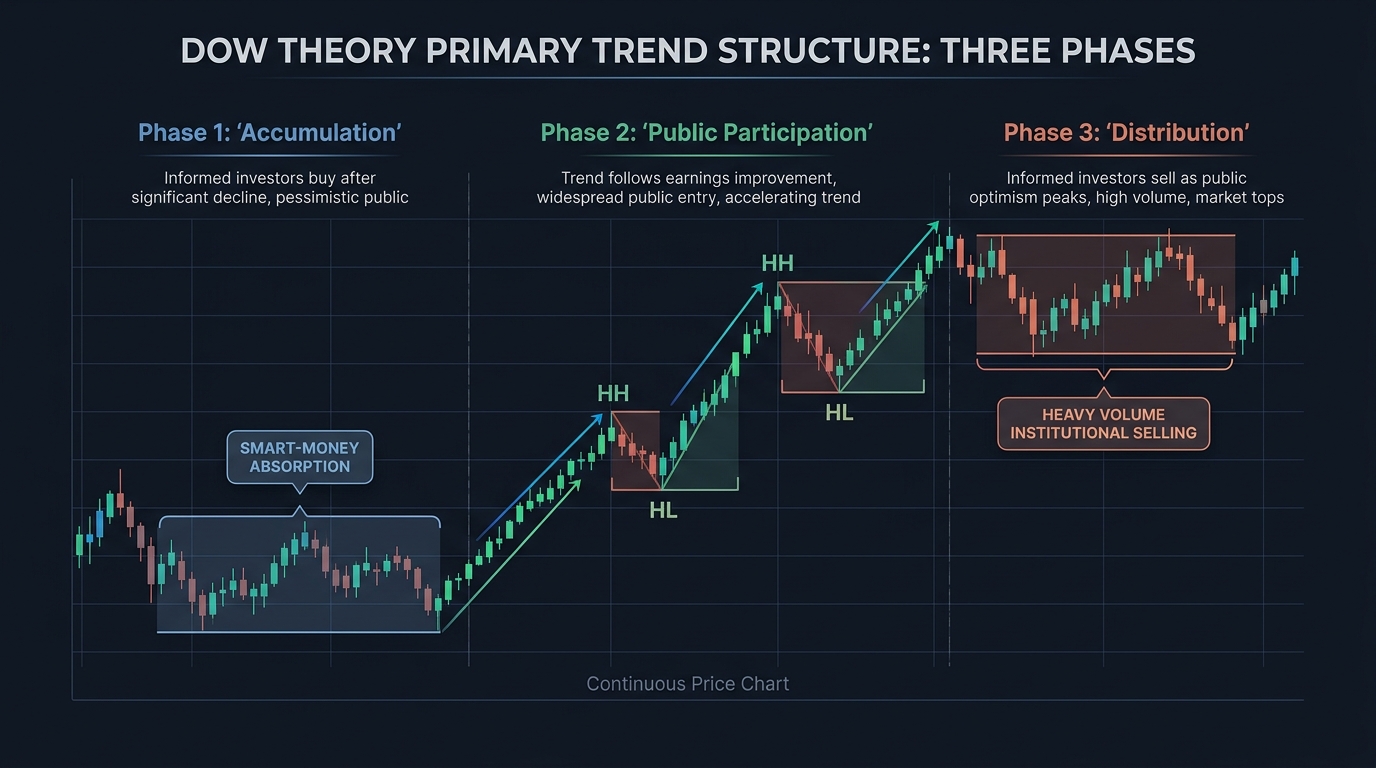
What Is Dow Theory?
Dow Theory is the intellectual cornerstone of modern technical analysis. Formulated from a series of editorial essays published in The Wall Street Journal by Charles H. Dow between 1900 and 1902, the theory was later codified into a coherent trading framework by William Peter Hamilton, Robert Rhea, and E. George Schaefer.
While Charles Dow originally designed his principles to analyze US equity averages (specifically the Dow Jones Industrial Average and the Dow Jones Rail, now Transportation, Average), the underlying tenets describe human herd behavior, supply and demand equilibrium, and price discovery. As a result, Dow Theory remains directly applicable to modern foreign exchange trading, where institutional capital flows dictate multi-month macro trends.
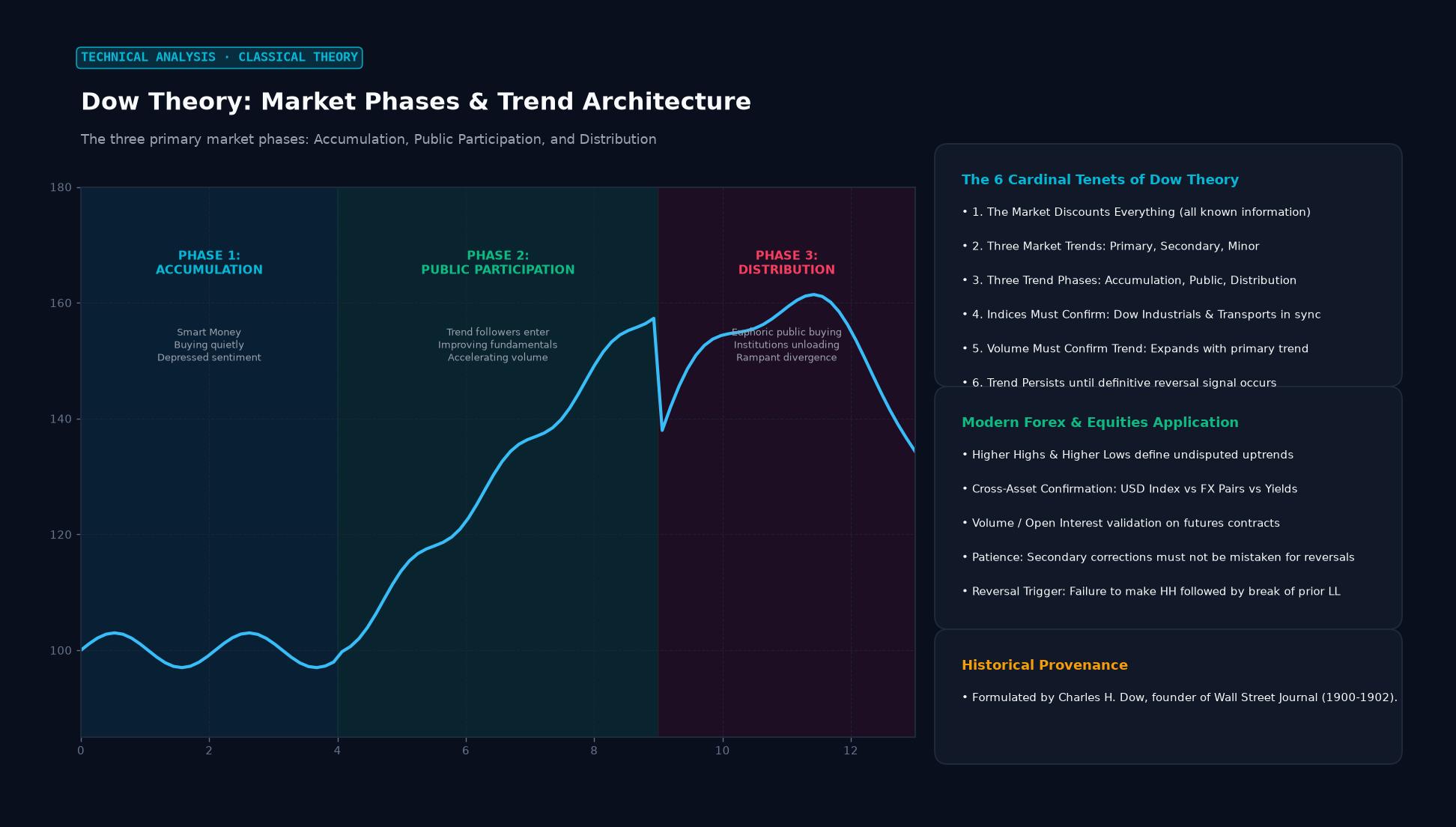 Figure: The three primary market phases: Accumulation, Public Participation, and Distribution
The Six Core Tenets of Dow Theory
Dow Theory is organized around six foundational axioms that govern how financial market trends form, persist, and reverse.
1. The Market Discounts Everything
Dow’s first tenet mirrors the efficient market hypothesis: current asset prices immediately incorporate all past, present, and anticipated information. In foreign exchange, this means interest rate decisions, geopolitical conflicts, GDP prints, inflation figures, and trader sentiment are already reflected in the prevailing spot exchange rate before an individual trader executes an order.
2. The Market Has Three Trends
Dow categorized price action into three distinct temporal tiers:
- Primary Trend: The broad macro direction lasting from one year to several years. In forex, primary trends are typically driven by central bank monetary divergence cycles.
- Secondary Trend: Counter-trend pullbacks or corrections that retrace one-third to two-thirds of the previous primary move, typically persisting from three weeks to three months.
- Minor Trend: Day-to-day market noise lasting from hours to less than three weeks. Dow cautioned traders against placing excessive weight on minor fluctuations due to their vulnerability to short-term manipulation and randomness.
3. Primary Trends Possess Three Distinct Phases
A bull or bear cycle does not advance in a straight line. It evolves through three structural phases:
- Accumulation Phase: Informed institutional participants enter positions at depressed price levels when public sentiment is overwhelmingly pessimistic.
- Public Participation Phase: As economic data stabilizes and price action breaks out into clear higher highs, trend followers, algorithmic models, and retail traders aggressively join the move, producing strong momentum.
- Distribution Phase: Financial media coverage peaks and late buyers flood the market. The early institutional investors quietly unwind their long positions, selling into incoming retail liquidity.
4. Averages Must Confirm Each Other
In equities, Dow asserted that a rally in the Industrial Average was not sustainable unless confirmed by a simultaneous high in the Transportation Average. In currency markets, cross-asset confirmation takes the form of correlated pairs:
- If EUR/USD breaks out to fresh highs, a healthy US dollar bear trend should be confirmed by GBP/USD and AUD/USD advancing as well, alongside a downward breakdown in the US Dollar Index (DXY).
- If EUR/USD rallies while GBP/USD and the Swiss Franc fail to follow, an intermarket divergence warning emerges, signaling potential exhaustion.
5. Volume Must Confirm the Trend
In classic Dow Theory, volume expands in the direction of the primary trend and contracts during secondary corrections. In an uptrend, trading volume should spike on advancing swings and dry up on pullbacks. In decentralized forex where global consolidated exchange volume is unavailable, traders utilize tick volume or CME Currency Futures volume to confirm institutional participation.
6. A Trend Remains in Effect Until Definite Reversal Signals
A trend is assumed to persist until price action demonstrates an objective structural failure. An uptrend is defined by a succession of higher highs (HH) and higher lows (HL). The trend is only violated when price fails to print a higher high and subsequently breaks below the preceding swing low (lower low).
Practical Forex Application: Identifying Market Structure
Modern price action concepts such as Market Structure Shift (MSS) and Break of Structure (BOS) trace their lineage directly to Dow’s sixth tenet.
       Higher High (HH)
             /\
            /  \     Lower High (LH)
           /    \         /\
   HL     /      \  HL   /  \
   /\    /        \ /\  /    \
  /  \  /          V  \/      \
 /    \/                       V
Higher Low BREAK OF STRUCTURE (Reversal Confirmed)- Trend Definition: When a currency pair such as GBP/JPY establishes consecutive higher highs and higher lows on the daily chart, retail traders should seek buy entries exclusively during secondary pullbacks.
- Structural Invalidation: The primary bull trend is not broken when price merely pulls back sharply. The trend is officially terminated only when price prints a lower high followed by a decisive close below the most recent higher low.
Key Takeaways
- Dow Theory establishes that asset prices discount all fundamental news, rumors, and sentiment.
- Price moves in three timeframes: primary trends (macro), secondary trends (corrective), and minor fluctuations (daily noise).
- Sustainable market trends move through three psychological stages: accumulation, public absorption, and distribution.
- Trends require confirmation: individual currency moves should be validated by correlated pairs, the US Dollar Index, and volume data.
- An established trend remains intact until an unambiguous structural reversal (lower low in an uptrend, higher high in a downtrend) is completed.
Frequently Asked Questions
Is Dow Theory still relevant in modern algorithmic forex trading?
Yes. Despite the prevalence of high-frequency algorithms, institutional capital allocations still adhere to multi-timeframe trend structures, liquidity accumulation, and distribution cycles described by Charles Dow over a century ago.
How do forex traders measure volume for Dow Theory confirmation?
Because spot forex is an over-the-counter market without a centralized clearinghouse, traders use broker tick volume (which correlates over 90% with real traded volume) or Chicago Mercantile Exchange (CME) currency futures volume to confirm trend strength.
What is the difference between a secondary trend and a trend reversal?
A secondary trend is a temporary correction that retraces between 33% and 66% of the primary movement without breaking the key structural swing high or swing low. A reversal occurs when the prior swing low is breached in an uptrend, establishing a sequence of lower highs and lower lows.
Ready to trade forex?
Open a free demo account with a regulated broker. Practice with virtual funds before risking real money.