European Central Bank (ECB)
The European Central Bank (ECB) is the official central bank of the Eurozone, responsible for monetary policy for the 20 European Union member nations that utilize the Euro. Headquartered in Frankfurt, its primary statutory mandate is maintaining price stability, targeted at 2% over the medium term.
What Is the European Central Bank (ECB)?
The European Central Bank (ECB) is the institutional monetary authority presiding over the Eurozone—the monetary union comprising the 20 European Union member states that have adopted the single European currency, the Euro (€).
Established on June 1, 1998, under the Treaty of Amsterdam and headquartered in Frankfurt am Main, Germany, the ECB serves as the operational core of the Eurosystem (which includes the ECB and the National Central Banks of all Eurozone member nations) and the broader European System of Central Banks (ESCB).
The ECB governs the monetary policy of the world’s second-largest economic currency bloc, directly impacting over 350 million European citizens. In global foreign exchange markets, policy announcements, interest rate decisions, and press conferences conducted by the ECB serve as the single most critical fundamental catalyst dictating the valuation and multi-month trends of the EUR/USD currency pair and all Euro crosses.
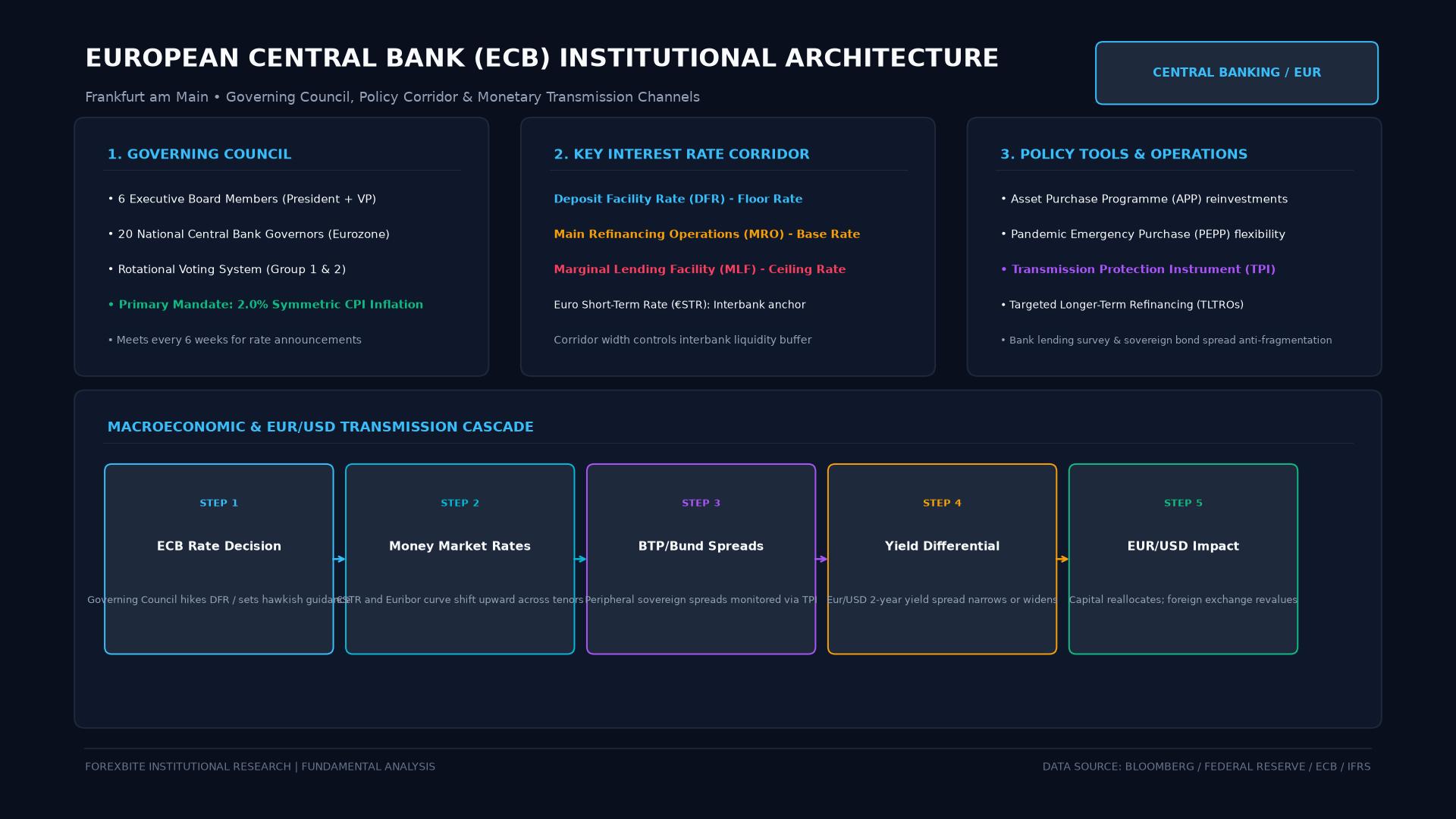 Figure: Institutional architecture of the European Central Bank (ECB), showcasing the Governing Council structure, the three key interest rates (DFR, MRO, MLF), and the macroeconomic transmission channels to Eurozone sovereign bond spreads and EUR exchange rates.
Mandate and Governance Structure
Unlike the US Federal Reserve, which operates under a statutory “dual mandate” (balancing maximum employment with price stability), the ECB was founded upon the strict, conservative German Bundesbank model:
The Primary Mandate: Price Stability
Under Article 127 of the Treaty on the Functioning of the European Union, the primary, overriding objective of the ECB is to maintain price stability. In July 2021, the ECB finalized a strategic review defining price stability as an unambiguous, symmetric 2.0% inflation target over the medium term, measured by the Harmonised Index of Consumer Prices (HICP).
The Three Decision-Making Bodies
- The Governing Council (The Monetary Policy Engine): Comprises the six members of the ECB Executive Board and the governors of the 20 Eurozone National Central Banks (such as the Deutsche Bundesbank, Banque de France, and Banca d’Italia). It meets every six weeks in Frankfurt to evaluate macroeconomic data, adjust official interest rates, and guide monetary stimulus programs.
- The Executive Board: Comprises the ECB President (currently Christine Lagarde), the Vice-President, and four appointed executive members responsible for day-to-day administrative management and the physical implementation of Governing Council policies.
- The General Council: A transitional advisory body including the ECB President, Vice-President, and the governors of all 27 EU member states, coordinating convergence for countries preparing to adopt the Euro.
The ECB’s Three Key Policy Interest Rates
When financial news reports on “ECB interest rate decisions,” the Governing Council actually adjusts three distinct policy rates:
1. The Deposit Facility Rate (The De Facto Anchor)
The interest rate commercial banks receive for depositing surplus overnight funds with the Eurosystem. In the modern era of abundant banking liquidity, the Deposit Facility Rate has become the primary operational anchor dictating Eurozone interbank money market rates and the benchmark yield curve.
2. The Main Refinancing Operations (MRO) Rate
The benchmark fixed rate or minimum bid rate at which commercial banks can borrow one-week liquidity from the ECB against eligible collateral.
3. The Marginal Lending Facility Rate
The higher penalty interest rate commercial banks pay to borrow overnight emergency liquidity from the Eurosystem when open interbank lending markets freeze.
Unconventional Monetary Policy Tools
In response to the European sovereign debt crisis (2010–2012), prolonged deflationary stagnation, and the COVID-19 pandemic, the ECB pioneered powerful non-standard monetary mechanisms:
- Negative Interest Rate Policy (NIRP): From 2014 to 2022, the ECB set its Deposit Facility Rate below zero (bottoming at -0.50%), effectively penalizing commercial banks for hoarding cash reserves in an aggressive effort to force them to lend to European businesses.
- Asset Purchase Programmes (Quantitative Easing): The Public Sector Purchase Programme (PSPP) and the Pandemic Emergency Purchase Programme (PEPP), under which the ECB purchased trillions of Euros in sovereign and corporate bonds to depress long-term borrowing yields.
- Targeted Longer-Term Refinancing Operations (TLTROs): Specialized multi-year loans offered to commercial banks at deeply subsidized rates, contingent upon banks expanding direct lending to businesses and households.
- Transmission Protection Instrument (TPI): A permanent anti-fragmentation tool designed to purchase sovereign bonds of specific Eurozone countries (such as Italy or Spain) if their borrowing spreads widen unjustifiably relative to German Bunds, preventing speculative bond runs from breaking up the Eurozone.
How ECB Policy Dictates EUR/USD Trends
Foreign exchange traders monitor the ECB’s six-week meeting cycle for decisive trend catalysts:
The Hawkish Scenario (Euro Appreciation)
When Eurozone services inflation or wage growth accelerates, the Governing Council responds with a hawkish stance—raising the deposit rate or signaling that rates will remain “higher for longer.” European sovereign bond yields rise, attracting international yield-seeking capital. Global asset managers sell foreign currencies to buy Euros, driving EUR/USD and EUR/GBP higher.
The Dovish Scenario (Euro Depreciation)
If European industrial production slows, purchasing managers’ indices (PMI) contract below 50, or inflation falls below the 2% target, the ECB adopts a dovish posture—cutting benchmark rates or expanding asset purchases. Lower yields encourage capital to flee Eurozone assets in favor of higher-yielding alternatives (like US Treasuries), driving EUR/USD lower.
Practical Trading Example: The ECB Press Conference Trade
Consider an intraday forex trader preparing for an ECB monetary policy announcement:
- 12:15 GMT (The Rate Statement): The ECB announces that it is holding the Deposit Facility Rate steady at 3.75%, exactly matching market consensus. EUR/USD experiences a minor 10-pip flicker around 1.0820 because the decision was fully priced in.
- 12:45 GMT (The Press Conference): ECB President Christine Lagarde begins her live press conference. In her opening statement, she explicitly emphasizes that domestic wage growth in Germany and France remains stubbornly high and asserts that “the Governing Council will not hesitate to hike rates again if energy prices reignite inflation.”
- Market Reaction: Algorithms scan the audio transcript and detect the word “hike.” Global bond yields immediately jump as traders price out rate cuts for the remainder of the year.
- Forex Execution: The trader enters a momentum long order on EUR/USD at 1.0835 on a 5-minute candle breakout.
- Outcome: The Euro trends steadily upward over the next two hours, gaining 75 pips to reach daily resistance at 1.0910, delivering a clean, news-driven breakout trade.
Key Takeaways
- The European Central Bank (ECB) manages monetary policy for the 20 nations of the Eurozone from its Frankfurt headquarters.
- Its primary statutory mandate is maintaining medium-term price stability at a symmetric 2.0% target.
- The Governing Council meets every six weeks to set three key interest rates: the Deposit Facility, Main Refinancing Operations, and Marginal Lending rates.
- Unconventional tools include negative interest rates, quantitative easing (PEPP/PSPP), and the Transmission Protection Instrument (TPI).
- Hawkish ECB policy drives Euro appreciation, while dovish rate cuts trigger depreciation against the US Dollar and global peers.
FAQ
Who decides ECB monetary policy? Policy is determined by the Governing Council, consisting of the six Executive Board members and the 20 governors of the National Central Banks of the Eurozone member nations.
Where does the ECB get the money to buy bonds? Like all modern fiat central banks, the ECB creates digital central bank reserves electronically on its balance sheet when executing asset purchases.
How does the ECB differ from the US Federal Reserve? The Federal Reserve has a dual mandate from the US Congress to achieve both maximum employment and stable prices. The ECB has a single hierarchical mandate: price stability is its overriding primary goal, with economic growth and employment strictly secondary.
Ready to trade forex?
Open a free demo account with a regulated broker. Practice with virtual funds before risking real money.