Federal Open Market Committee (FOMC)
The Federal Open Market Committee (FOMC) is the twelve-member monetary policy-making committee of the US Federal Reserve. Meeting eight times annually, it sets national interest rate policy, regulates open market operations, and issues the closely watched Dot Plot economic projections.
What Is the Federal Open Market Committee (FOMC)?
The Federal Open Market Committee (FOMC) is the premier monetary policy-making body of the Federal Reserve System. Operating under federal statutory authority, the committee is charged with managing the nation’s money supply and domestic credit conditions to promote maximum sustainable employment and long-term price stability.
Every financial instrument on Earth—from US Treasury bonds and global stock indices to crude oil futures and emerging market currencies—reacts directly to FOMC policy decisions. Because the FOMC establishes the benchmark borrowing cost for the world’s reserve currency, FOMC meeting days are the most anticipated, heavily traded, and volatile events on the global economic calendar.
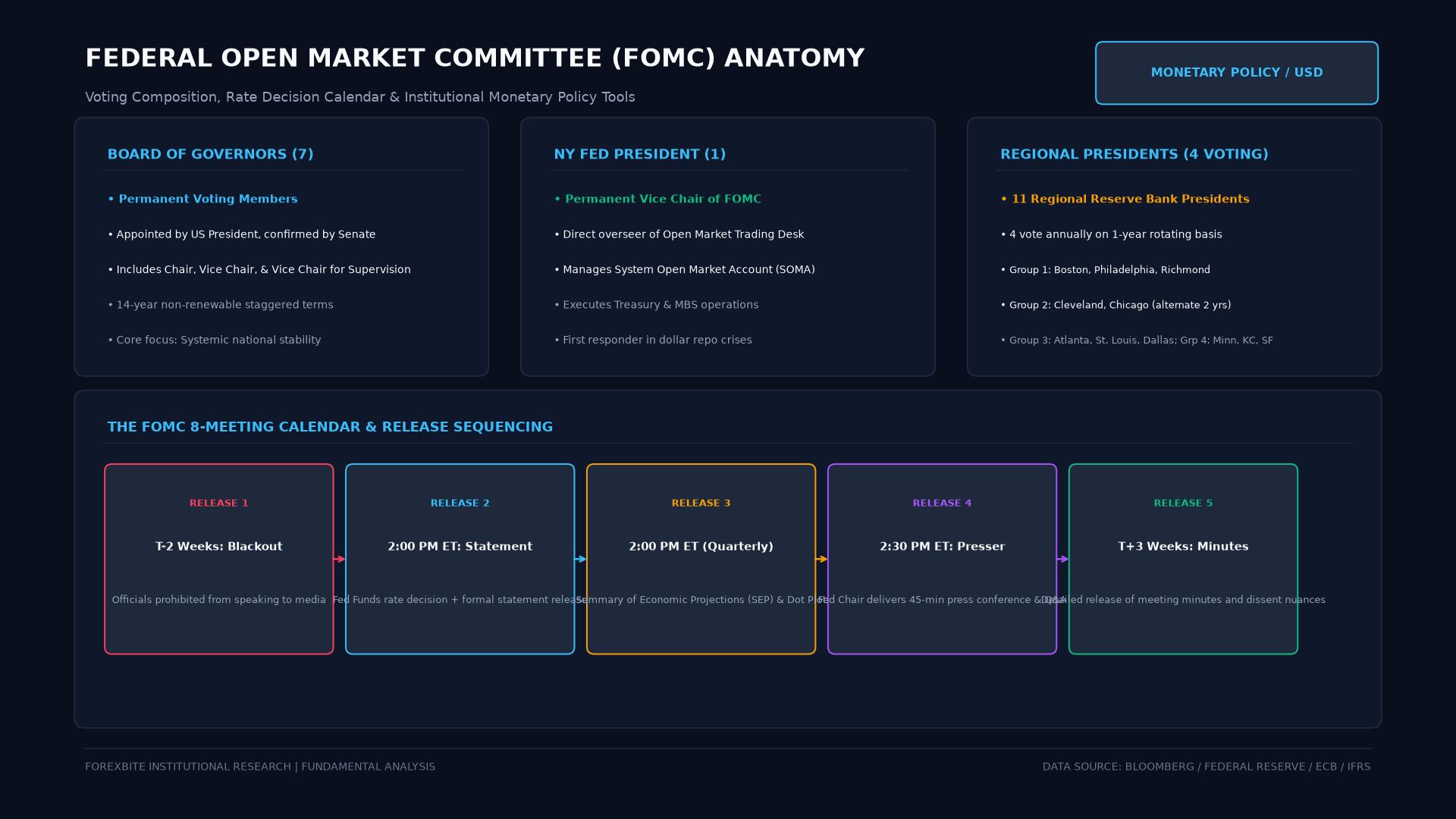 Figure: Structural composition and decision-making pipeline of the FOMC, highlighting the 7 permanent Board Governors, the New York Fed President, the 4 rotating regional reserve bank presidents, and the 8-meeting annual announcement timeline.
Committee Composition and Voting Rights
The FOMC consists of twelve voting members, carefully balanced between Washington presidential appointees and regional banking leaders:
1. The Seven Permanent Board Governors
All seven members of the Federal Reserve Board of Governors in Washington, D.C.—including the Chair and Vice Chair of the Federal Reserve—hold permanent, continuous voting seats on the committee.
2. The President of the Federal Reserve Bank of New York
The New York Fed occupies a permanent voting seat and serves as the Vice Chair of the FOMC. This permanent status reflects the New York Fed’s vital role as the operational execution arm that physically conducts open market transactions and trades currencies on Wall Street.
3. Four Rotating Regional Bank Presidents
The remaining eleven regional Federal Reserve Bank Presidents rotate into four annual voting seats on a structured rotational schedule:
- Group 1: Boston, Philadelphia, and Richmond (one voting member each year)
- Group 2: Cleveland and Chicago (one voting member each year)
- Group 3: Atlanta, St. Louis, and Dallas (one voting member each year)
- Group 4: Minneapolis, Kansas City, and San Francisco (one voting member each year)
Crucially, all 12 regional Bank Presidents attend every FOMC meeting, participate actively in policy deliberations, and submit individual economic forecasts—even during years when they do not hold an official policy vote.
The Eight Scheduled Annual Meetings
The FOMC convenes eight regularly scheduled meetings each year (roughly once every six weeks) in Washington, D.C., with emergency unscheduled meetings called during severe financial panics (such as March 2020).
An FOMC release day follows a rigid, highly choreographed three-stage schedule:
Stage 1: The 14:00 EST Policy Statement
At exactly 2:00 PM Eastern Standard Time, the committee releases its official policy statement detailing its interest rate decision (raising, lowering, or maintaining the Federal Funds Target Range) and summarizing its macroeconomic assessment of employment, consumer spending, and inflation.
Stage 2: The “Dot Plot” (Summary of Economic Projections - SEP)
Four times per year (at the March, June, September, and December meetings), the statement is accompanied by the Summary of Economic Projections (SEP), universally known as the Dot Plot:
- Each dot on the chart represents where one of the 19 FOMC participants (governors and regional presidents) individually forecasts the Federal Funds Rate will sit at the end of the current year, the next two calendar years, and over the “longer run.”
- The median dot provides financial markets with forward guidance on the Fed’s projected interest rate trajectory, often causing violent multi-asset repricing if the dots signal more or fewer rate cuts than previously expected.
Stage 3: The 14:30 EST Press Conference
Thirty minutes following the statement release, the Chair of the Federal Reserve steps to the podium for a live, televised press conference. The Chair reads an explanatory opening statement and then fields spontaneous questions from financial journalists for roughly 45 minutes.
Hawks vs. Doves: Committee Dynamics and Dissents
Traders analyze the individual rhetoric and voting patterns of FOMC members, classifying them along an ideological spectrum:
- Hawks: Policymakers who prioritize inflation control above all else, advocating for higher interest rates, tighter credit conditions, and a smaller central bank balance sheet.
- Doves: Policymakers who prioritize labor market health, economic growth, and low unemployment, advocating for lower interest rates and supportive monetary accommodation.
- Centrists: Pragmatic policymakers who shift between hawkish and dovish stances depending strictly on incoming macroeconomic data.
Most FOMC rate decisions are passed unanimously. When a member casts a formal dissenting vote (voting against the Chair’s consensus), it signals deep intellectual division within the central bank, alerting currency markets that policy may be nearing an inflection point.
Practical Trading Strategy: Navigating FOMC Volatility
FOMC days are characterized by the famous “Two-Phase Reaction”, a dynamic that frequently traps inexperienced traders:
Phase 1: The 14:00 EST Algorithmic Knee-Jerk
At 14:00 EST, automated institutional news-scraping algorithms parse the text of the statement and the Dot Plot within milliseconds. If the Fed cuts rates unexpectedly or lowers its Dot Plot projections:
- Algorithms immediately fire sell orders into US Dollar pairs.
- Spreads widen from 0.5 pips to 8 or 12 pips, and price whipsaws violently.
- The Trap: Novice traders chase the initial spike, only to be caught in a vicious reversal during Phase 2.
Phase 2: The 14:30 EST Press Conference Trend Reversal
At 14:30 EST, the Fed Chair takes the microphone. The Chair’s verbal tone and unscripted answers during the Q&A frequently clarify or completely contradict the market’s initial interpretation of the written statement:
- If the written statement appeared dovish, but the Chair stresses during the press conference that “inflation remains stubborn and rate cuts may be delayed,” the market reverses sharply, erasing the initial 14:00 spike and triggering an aggressive US Dollar rally that sets the true directional trend for the coming weeks.
Professional Rule of Thumb: Prudent traders remain flat (in cash) through the 14:00 statement release, allowing algorithmic whipsaws to subside. They wait until the press conference concludes at 15:15 EST, entering trades only after the true, consolidated market trend establishes itself.
Key Takeaways
- The FOMC is the 12-member monetary policy-making committee of the US Federal Reserve.
- It comprises the 7 Board Governors, the New York Fed President, and 4 rotating regional Reserve Bank Presidents.
- The committee meets eight times annually to set the target range for the benchmark Federal Funds Rate.
- The quarterly “Dot Plot” provides invaluable forward guidance by mapping out each policymaker’s individual interest rate projections.
- FOMC releases feature a two-phase market reaction: the initial 14:00 statement spike often completely reverses during the 14:30 Fed Chair press conference.
FAQ
When are FOMC meeting minutes released? The official minutes of each FOMC meeting are published exactly three weeks after the policy decision. The minutes provide an exhaustive, non-attributed record of the granular debates, economic modeling disagreements, and policy discussions that occurred behind closed doors.
What is an emergency or inter-meeting FOMC rate cut? During extraordinary systemic crises (such as the September 11 terrorist attacks, the 2008 Lehman collapse, or the March 2020 COVID outbreak), the FOMC can convene emergency conference calls between scheduled meetings to slash interest rates or launch emergency liquidity facilities with immediate effect.
Why does the New York Fed have a permanent vote while other regional banks rotate? The Federal Reserve Bank of New York is located at the center of American capital markets. It is the only Reserve Bank tasked with physically executing open market operations, trading government securities, and managing international foreign exchange swap lines with foreign central banks.
Ready to trade forex?
Open a free demo account with a regulated broker. Practice with virtual funds before risking real money.