Resources
In economics and corporate finance, resources are scarce economic inputs, encompassing factors of production, natural commodities, and cost-accounting drivers, utilized to produce goods and services.
What are Economic Resources?
In economic theory, corporate valuation, and managerial accounting, resources are the fundamental, scarce inputs utilized by economic agents to produce goods, provide services, and generate wealth.
Scarcity is the defining premise of economic science: human desires and societal demands are effectively unlimited, whereas the physical and financial resources available to satisfy them are finite. Consequently, how an economy, a corporation, or an individual allocates scarce resources dictates economic growth, productivity, and investment returns.
Depending on the analytical framework, resources are categorized across three major disciplines:
- Classical Macroeconomics: The foundational Factors of Production, Land, Labor, Capital, and Entrepreneurship, that power national gross domestic product (GDP).
- Managerial and Cost Accounting: The measurable operational assets, including personnel hours, raw materials, facility floor space, and machine capacity, consumed during organizational activities to support cost objects under Activity-Based Costing (ABC).
- Strategic Corporate Management: The tangible and intangible capabilities evaluated under the Resource-Based View (RBV) and VRIO framework to determine a firm’s sustainable competitive advantage and economic moat.
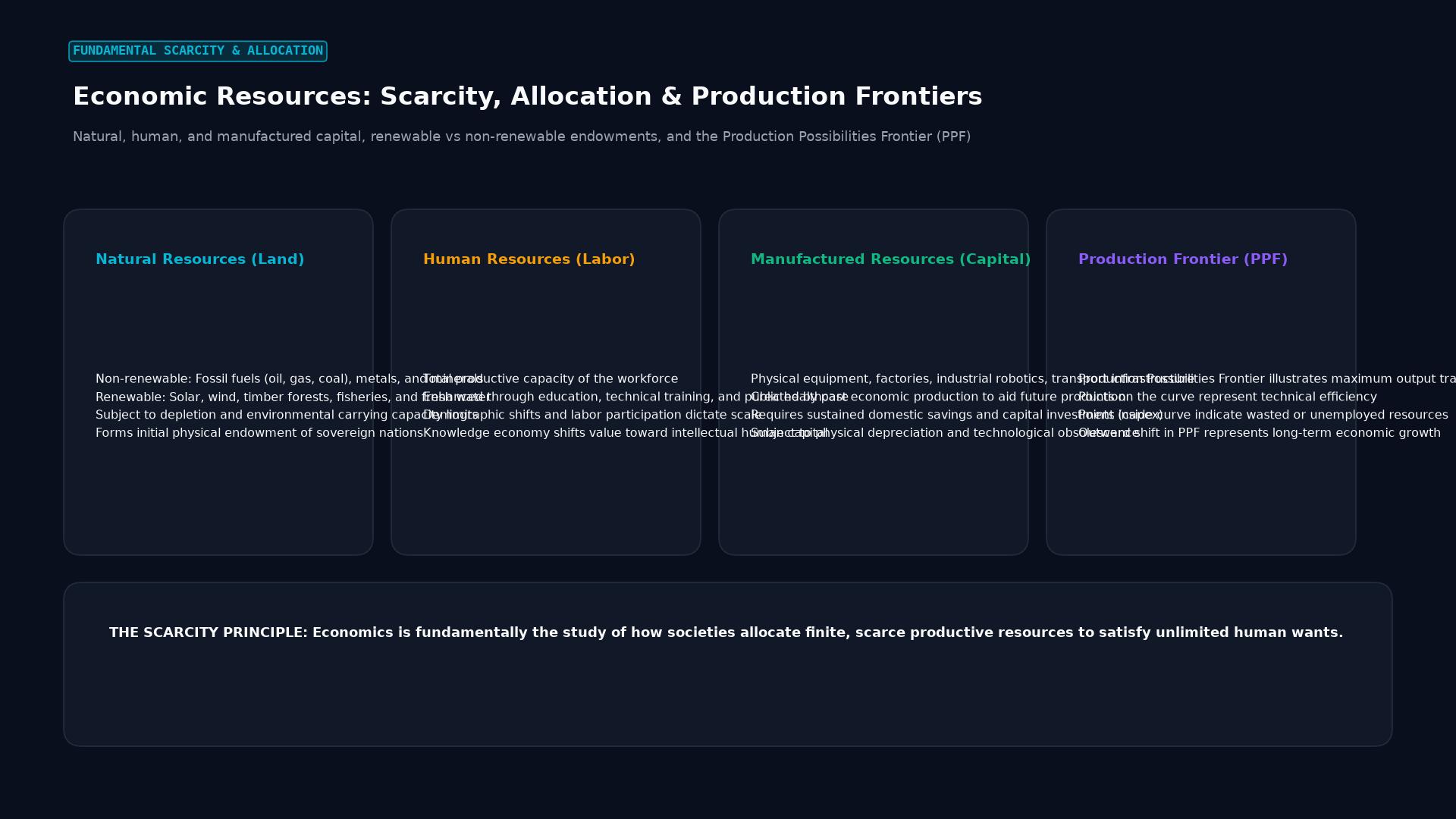 Figure: Natural, human, and manufactured capital, renewable vs non-renewable endowments, and the Production Possibilities Frontier (PPF)
The Classical Factors of Production
Classical economic theory, formulated by Adam Smith, David Ricardo, and Jean-Baptiste Say, and expanded by neoclassical economists, divides all productive resources into four core Factors of Production:
                              THE FOUR FACTORS OF PRODUCTION

       [ LAND / NATURAL ]          [ LABOR / HUMAN ]          [ PHYSICAL CAPITAL ]
       Raw materials, soil,        Physical & cognitive        Machinery, factories,
       minerals, water, fossil     workforce capacity;         tools, technology, &
       fuels, & geography.         demographics & skills.      logistics networks.
               │                           │                           │
               └───────────────────────────┼───────────────────────────┘
                                           │
                                           ▼
                                [ ENTREPRENEURSHIP ]
                                Combines land, labor, & capital;
                                assumes financial & business risk;
                                drives creative destruction & innovation.
1. Land (Natural Resources)
In economics, “land” encompasses all naturally occurring gifts of nature not created through human intervention:
- Renewable Resources: Agricultural farmland, commercial timber forests, clean water fisheries, solar radiation, and wind energy.
- Non-Renewable Resources: Subsurface fossil fuels (crude oil, natural gas, coal), industrial metals (copper, iron ore, aluminum, lithium), and precious metals (gold, silver, platinum).
- Economic Return: The financial return accrued by the owners of natural resources is defined as Rent (or economic rent).
2. Labor (Human Capital)
Labor represents the aggregate physical and intellectual effort exerted by humans in the production process:
- Modern economics distinguishes between raw labor (headcount hours) and Human Capital, the accumulated education, technical training, institutional experience, and health of the workforce.
- Economic Return: The financial compensation earned by labor is Wages and salaries.
3. Capital (Physical and Financial Infrastructure)
Capital represents human-made durable goods used to produce other goods and services:
- Physical Capital: Machine tooling, manufacturing plants, heavy transport trucks, semiconductor fabrication cleanrooms, fiber-optic data networks, and corporate warehouses.
- Distinction from Financial Capital: Financial capital (cash, equity shares, corporate bonds) is not a factor of production itself; rather, it is the paper medium used to purchase physical capital assets.
- Economic Return: The financial return generated by capital investment is Interest and capital yield.
4. Entrepreneurship
The entrepreneurial factor provides the organizing capability that synthesizes land, labor, and capital to create marketable output. The entrepreneur identifies market inefficiencies, allocates venture capital, designs operating workflows, and assumes the financial risk of business failure.
- Economic Return: The residual financial compensation earned by the entrepreneur is Profit.
Macroeconomics: The Resource Curse and Dutch Disease
While possessing vast natural resources seems beneficial, international development economics demonstrates that resource-rich nations frequently suffer from lower economic growth, higher corruption, and severe macroeconomic instability. This paradox is known as the Resource Curse (Paradox of Plenty).
Major Discovery of Hydrocarbon / Mineral Reserves
                       │
                       ▼
Surge in Massive Raw Commodity Export Revenues
                       │
                       ▼
Substantial Inflows of Foreign Currency Appreciate Exchange Rate
                       │
                       ▼
Domestic Currency Becomes Strong & Expensive
                       │
                       ▼
Non-Resource Manufacturing & Agricultural Exports Rendered Uncompetitive
                       │
                       ▼
Industrial Hollow-Out: Economy Becomes Trapped in Petro-State Volatility
The Mechanics of Dutch Disease
The term Dutch Disease originated in 1977 from The Economist, describing the structural decline of the manufacturing sector in the Netherlands following the discovery of the vast Groningen natural gas field in 1959.
The economic transmission mechanism unfolds in stages:
- Resource Inflow Shock: Massive foreign currency revenues from natural resource exports flow into the banking system.
- Currency Overvaluation: Strong demand for the national currency causes it to appreciate significantly against international trading partners.
- De-Industrialization: A stronger currency makes domestic non-resource manufacturing and agricultural products expensive and uncompetitive globally. Domestic factories close, and non-resource exports collapse.
- Factor Siphoning: High wages and capital returns in the extractive sector pull skilled labor, engineering talent, and financial capital away from domestic technology, healthcare, and manufacturing sectors.
Mitigating the Resource Curse: Sovereign Wealth Funds (SWFs)
To break the cycle of Dutch Disease and insulate domestic economies from commodity price volatility, resource-rich governments establish Sovereign Wealth Funds (SWFs):
- Revenue Sterilization: Oil or mineral royalties are immediately invested in offshore foreign assets rather than converted into local currency, preventing domestic currency overvaluation.
- Intergenerational Wealth Creation: Norway’s Government Pension Fund Global (exceeding $1.6 trillion in assets) and the Alaska Permanent Fund channel finite oil revenues into diversified global stock, bond, and real estate portfolios, ensuring future generations benefit long after oil wells run dry.
Managerial Accounting: Resources in Activity-Based Costing (ABC)
In managerial cost accounting and enterprise resource planning (ERP), resources represent the economic elements assigned to operational activities.
       [ RESOURCE ]                 [ ACTIVITY ]               [ COST OBJECT ]

    Engineering Labor  ────────►   Machine Calibration  ─────►  Product Line A
    Electrical Utility ────────►   Injection Molding    ─────►  Product Line B
    Factory Lease Cost ────────►   Quality Inspection   ─────►  Customer Account X
The Cost Assignment Flow
Traditional cost accounting systems often pooled overhead expenses arbitrarily and allocated them based on a single metric, such as direct labor hours, leading to distorted product margins.
Activity-Based Costing (ABC) maps resources accurately:
- Resource Identification: Catalogs all operational costs (such as equipment depreciation, warehouse leases, IT infrastructure, and supervisory salaries).
- First-Stage Allocation (Resource Drivers): Measures the consumption of resources by specific business activities (e.g., floor space consumed by a testing lab determines the portion of building lease allocated to that activity).
- Second-Stage Allocation (Activity Drivers): Assigns the cost of completed activities to specific finished cost objects (products, service contracts, or customer tiers) based on actual consumption, revealing true unit profitability.
Strategic Management: The Resource-Based View (RBV)
In corporate finance and equity research, the Resource-Based View (RBV) of the firm argues that sustainable competitive advantages, and superior equity returns, are not determined primarily by industry structure, but by the firm’s unique internal bundle of resources and capabilities.
+------------------------------------------------------------------------------------+
|                         THE VRIO RESOURCE FRAMEWORK                                |
+-------------------+----------------------------------------------------------------+
| VRIO ATTRIBUTE    | STRATEGIC EVALUATION CRITERIA                                  |
+-------------------+----------------------------------------------------------------+
| Valuable (V)      | Does the resource allow the firm to exploit external market    |
|                   | opportunities or neutralize competitive threats?               |
+-------------------+----------------------------------------------------------------+
| Rare (R)          | Is the resource controlled by only a small number of competing |
|                   | market participants?                                           |
+-------------------+----------------------------------------------------------------+
| Inimitable (I)    | Is the resource costly or impossible for rivals to duplicate   |
|                   | due to patents, unique history, or complex corporate culture?  |
+-------------------+----------------------------------------------------------------+
| Organized (O)     | Is the firm organized with operational processes, management   |
|                   | systems, and capital to fully exploit the resource's value?    |
+-------------------+----------------------------------------------------------------+
Under Jay Barney’s VRIO framework, if a company possesses resources that satisfy all four criteria (such as proprietary artificial intelligence algorithms, specialized mineral claims, or dominant brand loyalty), it creates a durable economic moat. This moat allows the corporation to earn returns on invested capital (ROIC) far exceeding its Weighted Average Cost of Capital (WACC) over decades.
Critical Mineral Resources and the Energy Transition
In global macroeconomics, the transition away from fossil fuels has altered the geopolitical definition of strategic natural resources.
+------------------------------------------------------------------------------------+
|                         CRITICAL ENERGY TRANSITION MINERALS                        |
+---------------------+-------------------------------+------------------------------+
| CRITICAL RESOURCE   | INDUSTRIAL APPLICATION        | SUPPLY CONCENTRATION RISK    |
+---------------------+-------------------------------+------------------------------+
| Copper (Cu)         | Electrical grids, EV wiring,  | Mining concentrated in Chile |
|                     | wind turbines, data centers   | & Peru; smelters in China.   |
+---------------------+-------------------------------+------------------------------+
| Lithium (Li)        | EV lithium-ion battery cells, | Lithium Triangle (Chile,     |
|                     | grid storage systems          | Argentina) and Australia.    |
+---------------------+-------------------------------+------------------------------+
| Cobalt (Co)         | High-energy-density cathodes  | Over 70% of global extraction|
|                     | for electric vehicles         | in Democratic Rep. of Congo. |
+---------------------+-------------------------------+------------------------------+
| Rare Earths (REE)   | Permanent neodymium magnets   | Heavy mining and refining    |
|                     | for EV motors & wind dynamos  | concentration in China.      |
+---------------------+-------------------------------+------------------------------+
The global shift toward electrification has expanded demand for industrial metals. Countries possessing large deposits of these critical transition minerals now wield significant geopolitical leverage, leading to increased export controls and sovereign resource nationalism across developing markets.
Key Takeaways
- Scarcity Principle: In economic theory, resources are finite productive inputs whose allocation under conditions of scarcity determines aggregate wealth creation and corporate value.
- Classical Four Factors: Macroeconomic production relies on Land (natural resources), Labor (human capital), Capital (physical equipment and infrastructure), and Entrepreneurship (risk organization).
- Dutch Disease Vulnerability: Major natural resource discoveries can trigger sharp currency appreciation, hollowing out domestic manufacturing and agricultural export competitiveness.
- Stabilization via SWFs: Sovereign Wealth Funds insulate commodity-exporting economies by investing resource windfalls in offshore assets, preventing domestic currency distortion.
- Cost Allocation Precision: In Activity-Based Costing, resources represent operational costs traced via resource drivers to internal activities, establishing true unit costs.
- The VRIO Competitive Moat: Strategic management evaluates corporate resources through the VRIO lens, identifying proprietary assets that generate sustainable economic moats and superior returns on capital.
Frequently Asked Questions (FAQ)
What is the difference between physical capital and financial capital?
Physical capital consists of tangible, human-made durable goods utilized directly in the physical production of goods and services, such as factories, robotic assembly lines, computers, transport ships, and specialized machinery. Financial capital consists of monetary instruments, liquid cash, bank credit, equity shares, and corporate debt used by corporations to acquire physical capital assets. While financial capital facilitates commerce and resource allocation, only physical capital contributes directly as a factor of production to physical economic output.
How does a country catch “Dutch Disease,” and how can it cure it?
A country experiences Dutch Disease when a massive surge in natural resource exports (such as crude oil or natural gas) leads to large inflows of foreign currency. As domestic banks and the central bank absorb these dollars, the domestic currency appreciates significantly. This overvaluation makes non-resource domestic goods, like manufactured products and agricultural crops, too expensive for foreign buyers, causing traditional industries to close. The standard remedy is the creation of a Sovereign Wealth Fund that redirects export revenues into foreign offshore investments, preventing export cash from flooding the domestic market and distorting the exchange rate.
What is human capital, and why is it considered an economic resource?
Human capital is the collective economic value of an individual’s or workforce’s education, specialized training, technical skills, creativity, institutional knowledge, and physical health. Unlike raw labor, which measures simple hours worked, human capital measures productive capacity and efficiency. Economists treat human capital as a resource because capital investments in education, vocational apprenticeships, and healthcare directly increase worker productivity, driving technological innovation and expanding an economy’s long-term gross domestic product.
Ready to trade forex?
Open a free demo account with a regulated broker. Practice with virtual funds before risking real money.