Round Trip
A complete two-legged trading transaction involving both the initiation and offsetting closure of a financial position, crystallizing net realized profit or loss and triggering full round-turn transaction costs.
What Is a Round Trip?
A round trip (frequently referred to as a round turn) describes the complete lifecycle of a trading operation. It encompasses the initiation of an open position followed by an exact, offsetting transaction that closes that exposure, returning the market participant to a neutral (flat) cash position.
Every round trip consists of two distinct operational legs:
- Long Cycle: Buying an asset (Opening Leg) and subsequently selling the identical quantity (Closing Leg).
- Short Cycle: Selling an asset short (Opening Leg) and subsequently buying it back (Covering Leg).
Until the second leg is executed, an investor holds an open position subject to market fluctuations, margin requirements, and unrealized (mark-to-market) gains or losses. The completion of the round trip eliminates directional market risk, establishes the final realized profit or loss (P&L), and settles all associated exchange fees, broker commissions, and financing charges.
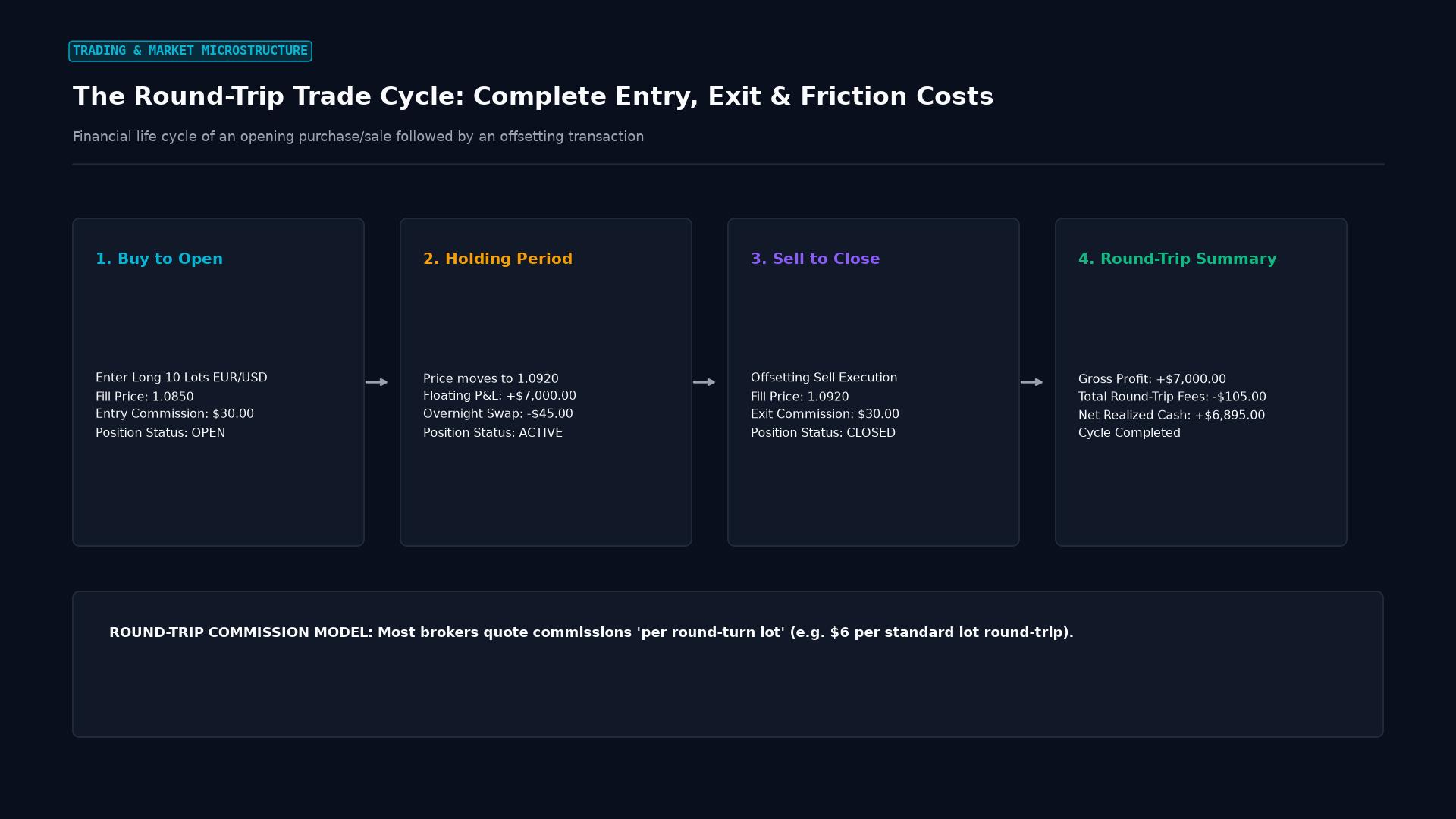 Figure: Complete trade lifecycle: buy to open, active holding period, sell to close, and net realized cash accounting after round-turn commissions.
The Mathematics of Round-Trip Net Profitability
A common error among novice traders is calculating profitability solely based on the price distance between entry and exit. In institutional practice, a round trip must overcome multiple friction points—including bid-ask spreads, dual-leg commissions, overnight financing, and execution slippage—before generating net capital gains.
The comprehensive formula for net round-trip performance is:
$$\text{Net P&L} = \text{Gross Realized P&L} - \left( C_{\text{round-trip}} + S_{\text{entry}} + S_{\text{exit}} + \text{Rollover} + \text{Slippage} \right)$$
Where:
- $\text{Gross P&L} = (\text{Exit Price} - \text{Entry Price}) \times \text{Notional Units} \times \text{Trade Direction}$ ($+1$ for Long, $-1$ for Short).
- $C_{\text{round-trip}}$: Total round-turn brokerage commission.
- $S_{\text{entry}} / S_{\text{exit}}$: Bid-ask spread cost incurred on execution.
- $\text{Rollover}$: Cumulative financing debits or credits accrued during the holding period.
- $\text{Slippage}$: Adverse price execution differences between order placement and fill.
Concrete Example: Scalping Round Trip on EUR/USD
Consider a high-frequency scalper executing a 5-lot ($500,000 notional) round trip:
- Buy Entry: 5 lots at 1.0852 (Raw spread: 0.2 pips)
- Sell Exit: 5 lots at 1.0858 (Gross gain: 0.6 pips = $300.00)
- Broker Commission: $3.50 per lot per side ($7.00 per lot round-trip = $35.00 total)
- Spread & Liquidity Frictions: 0.2 pips entry ($100.00) + 0.1 pip exit slippage ($50.00)
- Total Friction: $$35.00 + $100.00 + $50.00 = $185.00$
- Net Realized Profit: $$300.00 - $185.00 = \mathbf{$115.00}$ (A 61.6% reduction in gross theoretical gain due to round-trip transaction costs).
Commission Pricing: Round-Turn vs. Half-Turn Quoting
When opening an account with an Electronic Communication Network (ECN) or Direct Market Access (DMA) broker, commission schedules are quoted in one of two standardized formats:
| Pricing Model | Quoted Structure | When Fees Are Deducted | Practical Example ($100k Lot) |
|---|---|---|---|
| Half-Turn (Per Side) | Fee specified per individual execution leg | Deducted once upon entry, and again upon exit | “$3.50 per side” = $3.50 deducted at entry, $3.50 deducted at exit ($7.00 total) |
| Round-Turn (Round Trip) | Full two-legged commission quoted as a single figure | Often charged upfront in its entirety upon order entry | “$7.00 round trip” = $7.00 deducted immediately when the trade opens |
| Spread-Only (No Commission) | Zero explicit commissions; fees embedded directly into widened spreads | Continuous cost absorbed through the bid-ask differential | EUR/USD raw spread of 0.2 pips marked up to 1.0 pip (0.8 pip hidden round-trip cost) |
Round Trip vs. Turn-and-Hold vs. Rollover
| Parameter | Round Trip | Turn-and-Hold (Swing) | Rollover Execution |
|---|---|---|---|
| Objective | Complete entry and exit cycle to capture directional spread | Extended duration holding across market cycles | Synthetic technical swap extending value date overnight |
| Execution Legs | Two distinct matching orders (Buy + Sell) | Two distinct matching orders separated by days or weeks | Back-to-back spot and forward transaction without changing market risk |
| P&L State | Flat / Closed; zero active market risk remains | Variable unrealized mark-to-market exposure | Cash adjustment reflecting daily interest differentials |
| Tax Event | Immediate capital gain or loss realization | Unrealized until final closing leg is executed | Immediate taxable financing credit or deductible expense |
Real-World Institutional Case Study: High-Frequency Market Making and Round-Trip Latency
In modern electronic markets, institutional proprietary trading desks and market makers (such as Citadel Securities and Virtu Financial) survive entirely on executing hundreds of thousands of automated round trips each day.
          INSTITUTIONAL HIGH-FREQUENCY ROUND TRIP CYCLE

 Microsecond 000: Algorithm quotes Bid @ 1.08500 / Ask @ 1.08504 (0.4 pip spread)
 Microsecond 012: Retail flow hits Ask ──► Desks sells 10 lots short @ 1.08504
 Microsecond 028: Algorithm immediately routes passive limit order to bid book
 Microsecond 045: Market fills Bid ─────► Desk buys 10 lots to cover @ 1.08500
 ─────────────────────────────────────────────────────────────────────────────
 Total Duration:  45 Microseconds
 Gross Capture:   0.4 pips ($40.00 profit)
 Net Exchange Fee: $4.50 round-turn rebate
 Total Net Gain:  $44.50 realized risk-free return
During periods of severe market volatility, however, round-trip latency poses existential risks. If an algorithm fills its opening leg but market volatility spikes before the offsetting closing leg can be routed, the desk is exposed to “toxic order flow” (adverse selection). In the August 2012 Knight Capital algorithmic failure, a malfunctioning routing software continuously executed mismatched round-trip orders into the New York Stock Exchange, accumulating unhedged positions that inflicted a $440 million loss in forty-five minutes.
Regulatory Considerations: Churning and Wash Trading
Because brokerages generate revenue on every executed round trip, financial regulators (such as the CFTC, NFA, and FINRA) closely monitor round-trip trading activity:
- Broker Churning: An illegal practice where an asset manager or broker possessing discretionary authority executes excessive, unnecessary round trips in a client’s account purely to generate commissions.
- Wash Sales & Wash Trading: Executing offsetting round trips simultaneously or near-simultaneously with no genuine change in beneficial ownership or economic risk. While market makers provide genuine liquidity, manipulative traders use artificial round trips to fabricate false volume or generate artificial tax losses.
Frequently Asked Questions
Why do some brokers deduct the full round-trip commission upon opening the position?
Brokers that assess the full round-turn fee upon entry do so to streamline accounting and guarantee fee collection before equity drops. It eliminates the operational risk of a trader depleting their account to zero margin and failing to cover the closing commission fee.
How does round-trip slippage impact day traders?
Slippage can occur on both the entry and exit legs. If a trader experiences 0.5 pips of negative slippage on entry and another 0.5 pips on exit, the round trip suffers 1.0 pip of adverse friction. For scalpers targeting small 3- to 5-pip profits, round-trip slippage can eliminate up to 33% of expected returns.
What is the difference between a round trip and a partial close?
A round trip requires the complete liquidation of the original position size. If a trader buys 2.00 lots and closes only 1.00 lot, they have executed a partial close (a half round trip on the first lot), leaving the remaining 1.00 lot active as an open position.
Ready to trade forex?
Open a free demo account with a regulated broker. Practice with virtual funds before risking real money.