VUV
The ISO 4217 currency code for the Vanuatu Vatu, the official legal tender of the Republic of Vanuatu, issued and managed by the Reserve Bank of Vanuatu.
VUV (Vanuatu Vatu)
The Vanuatu Vatu (ISO code: VUV, symbol: VT) is the official sovereign currency of the Republic of Vanuatu, an island nation comprising an archipelago of roughly 83 volcanic islands in the South Pacific Ocean. Distinct from most global currencies, the vatu has no formal fractional subunits (there are no cents or centimes; 1 vatu is the smallest indivisible unit of legal tender). The currency was introduced on March 22, 1981, replacing the colonial New Hebrides franc following national independence. It is issued, supervised, and defended by the Reserve Bank of Vanuatu (RBV, or Bangk Kraon blong Vanuatu).
In international economics and development finance, the vatu represents the monetary regime of a small island developing state (SIDS). The RBV maintains external monetary stability by pegging the vatu to an undisclosed trade-weighted basket of major international currencies. The domestic economy and sovereign balance of payments are heavily driven by foreign tourism (predominantly from Australia and New Zealand), niche agricultural exports (kava, beef, copra, cocoa), bilateral development grants, and fiscal revenues generated by sovereign Citizenship by Investment (CBI) programs.
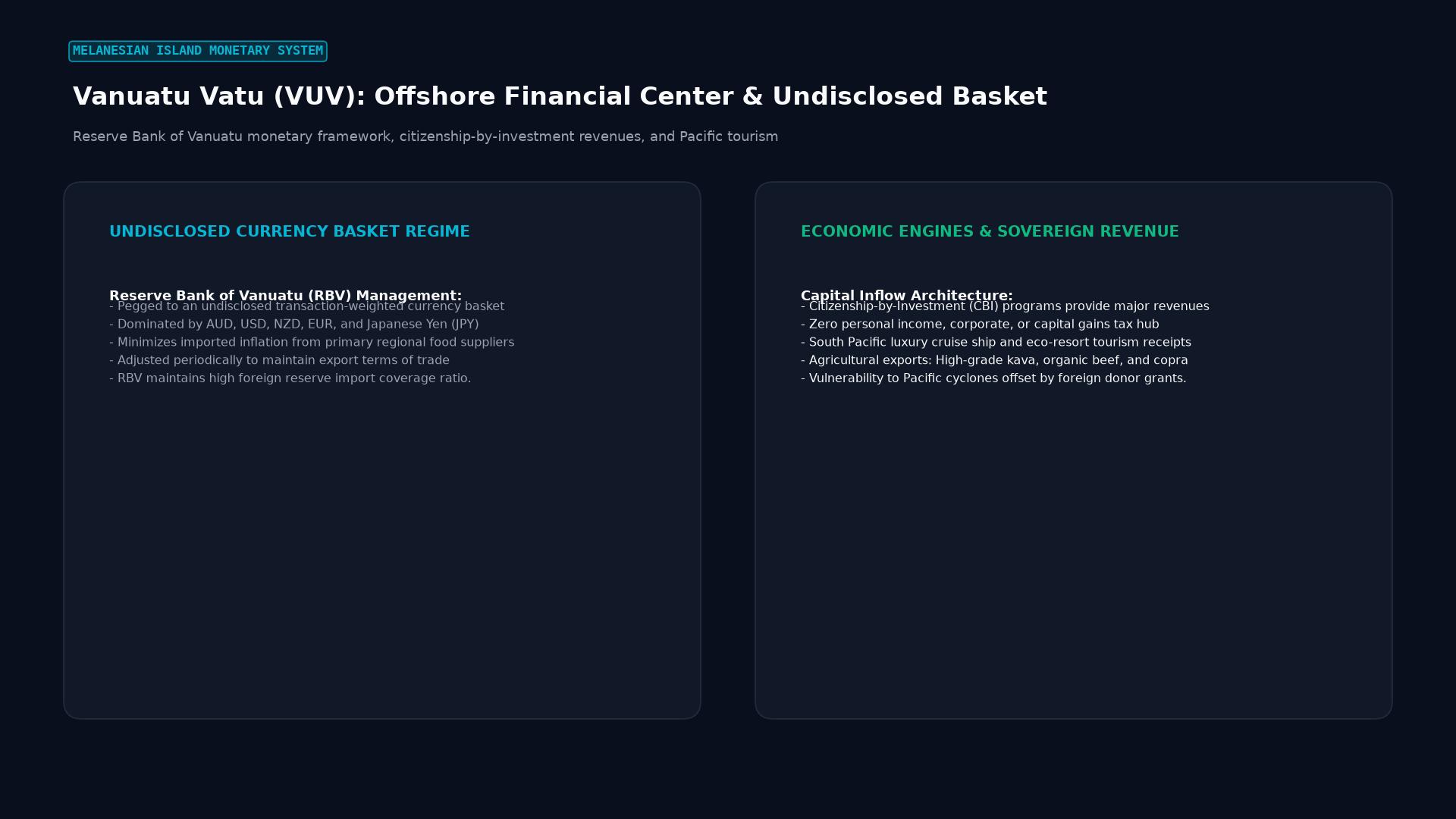 Figure: Reserve Bank of Vanuatu monetary framework, citizenship-by-investment revenues, and Pacific tourism
Historical Context and Currency Genesis
The monetary architecture of Vanuatu reflects its unique colonial history as the Anglo-French Condominium of the New Hebrides:
- The Dual Colonial Currency Era (Pre-1980): Prior to independence, the New Hebrides was jointly administered by the United Kingdom and France. This condominium created parallel monetary circulations: the French-issued New Hebrides franc (FNH) circulated alongside Australian dollars, British pounds, and French francs, creating commercial friction and accounting complexities.
- Independence and Launch of the Vatu (1980–1981): Following the attainment of independence on July 30, 1980, the newly formed sovereign Republic of Vanuatu moved to establish monetary sovereignty. On March 22, 1981, the vatu was introduced at par with the departing New Hebrides franc ($1 \text{ VT} = 1 \text{ FNH}$).
- Phasing Out the Australian Dollar: Concurrently, the legal tender status of the Australian dollar was revoked, establishing the vatu as the exclusive national unit of account.
- Creation of the Reserve Bank of Vanuatu (1989): Initially managed under the Central Bank of Vanuatu established in late 1980, the monetary authority was formally reorganized as the Reserve Bank of Vanuatu under the Reserve Bank of Vanuatu Act of 1989, consolidating prudential oversight and foreign reserve administration.
Monetary Policy Framework of the Reserve Bank of Vanuatu
The Reserve Bank of Vanuatu operates with a primary statutory mandate to promote monetary and financial stability, foster sound economic conditions, and maintain an adequate level of foreign exchange reserves.
The Basket Peg Mechanism
The RBV does not allow the vatu to float freely on global foreign exchange markets. Instead, it determines the daily buying and selling rates of the vatu against major currencies by linking it to a trade-weighted basket:
- Undisclosed Basket Composition: While the exact statistical weights are not publicly disclosed by the RBV to prevent speculative front-running, empirical econometric studies show the basket is heavily weighted toward the Australian Dollar (AUD), reflecting Australia’s status as Vanuatu’s primary source of tourists, commercial imports, and foreign direct investment.
- Other Basket Components: The basket includes the United States Dollar (USD), New Zealand Dollar (NZD), Euro (EUR), and Japanese Yen (JPY).
- Bilateral Exchange Rate Setting: Each business morning, the RBV calculates official mid-rates for the vatu based on the overnight movements of the basket currencies on global markets, quoting official daily rates for commercial banks in Port Vila.
       Theoretical Basket Valuation Equation:

       Index_VUV = w_AUD * (AUD_t / AUD_0) + w_USD * (USD_t / USD_0) + w_NZD * (NZD_t / NZD_0) + ...

       Where:
       w_i = Relative trade, tourism, and remittance weights of trading partner i
       Sum of weights w_i = 1.0
Import Reserve Cover Mandate
Because Vanuatu possesses zero domestic petroleum production and imports the vast majority of its consumer goods, machinery, and medicines, the RBV’s primary operational focus is safeguarding foreign reserve adequacy:
- Statutory Target: The RBV targets maintaining gross official foreign exchange reserves sufficient to cover at least 4.0 months of total merchandise imports.
- During periods of substantial citizenship program receipts and bilateral donor disbursements, reserve cover has frequently exceeded 7 to 10 months of imports, providing an essential buffer against catastrophic natural disasters.
Macroeconomic Drivers and Fiscal Structures
1. Tourism and Regional Integration
Tourism is the commercial engine of Vanuatu’s private sector economy:
- Pre-pandemic and recovery periods saw international leisure arrivals, predominantly from Australia and New Zealand, generating over 30% of total national gross domestic product.
- Cruise ship port calls in Port Vila and Mystery Island provide immediate cash foreign exchange earnings for local transport operators, artisanal craft markets, and hospitality providers.
2. Citizenship by Investment (CBI) Revenues
A unique and significant fiscal driver of Vanuatu’s sovereign balance of payments is its Citizenship by Investment programs (such as the Development Support Program, DSP, and Vanuatu Contribution Program, VCP):
- Foreign investors (primarily from East Asia, the Middle East, and Europe) obtain Vanuatu nationality and biometric passports in exchange for non-refundable hard-currency capital contributions (typically $130,000+).
- In several recent fiscal years, CBI revenues accounted for 30% to 50% of total sovereign government revenues, transforming the national budget into a fiscal surplus and dramatically bolstering the RBV’s foreign exchange reserves.
3. Agricultural Exports: Kava, Beef, and Copra
- Kava (Piper methysticum): Vanuatu is renowned for cultivating high-grade noble kava cultivars. The progressive lifting of international trade restrictions in Europe, Australia, and North America has positioned kava as Vanuatu’s fastest-growing agricultural export.
- Organic Grass-Fed Beef: Exported to regional Pacific markets, Japan, and Australia.
- Copra and Coconut Oil: Processed from coconut plantations across outer provincial islands (Espiritu Santo, Malekula, Pentecost).
4. Climate Vulnerability and Reconstruction Cycles
Vanuatu ranks among the most natural-disaster-prone nations in the world according to the World Risk Index:
- Category 5 tropical cyclones (such as Cyclone Pam in 2015 and twin cyclones Judy and Kevin in 2023) cause damage exceeding 50% to 60% of annual GDP within 24 hours.
- These events destroy agricultural harvests, disable communication infrastructure, and necessitate emergency drawdowns of foreign reserves alongside coordinated financial relief from Australia, New Zealand, the Asian Development Bank, and the World Bank.
+------------------------------------------------------------------------+
|          Comparison of Melanesian and Polynesian Currencies            |
+------------------------------------------------------------------------+
| Currency | Country   | Central Bank             | Exchange Regime      |
| VUV      | Vanuatu   | Reserve Bank of Vanuatu  | Basket peg (AUD dom.)|
| FJD      | Fiji      | Reserve Bank of Fiji     | Basket peg           |
| PGK      | PNG       | Bank of Papua New Guinea | Crawling peg (USD)   |
| SBD      | Solomons  | CB of Solomon Islands    | Basket peg           |
+------------------------------------------------------------------------+
Practical Constraints and Foreign Exchange Operations
For international corporations, investors, and travelers interacting with the vatu:
- Absence of International Derivatives: There are no forward, futures, or options contracts traded on international exchanges for the Vanuatu vatu. Exchange risk must be managed through local commercial bank facilities or hard-currency invoicing.
- No Fractional Subunit: Financial accounting software configuring vatu accounts must set decimal precision to zero ($0$ decimal places), as fractional cents do not exist.
- Exchange Control Framework: While current account transactions (paying for imported goods and services) are generally unencumbered, capital account transfers by residents (such as large overseas capital investments) require prior regulatory vetting from the Reserve Bank of Vanuatu.
- Commercial Banking Landscape: The domestic banking sector is centered in Port Vila and Luganville, featuring regional institutions such as Bank of South Pacific (BSP) Vanuatu, ANZ Bank Vanuatu, and the National Bank of Vanuatu (NBV).
Frequently Asked Questions
Why does the Vanuatu Vatu have no fractional coins (cents)?
When the vatu was introduced in 1981 to replace the New Hebrides franc, the initial exchange value was set at $1 \text{ VT} = 1 \text{ FNH}$. Because the French Pacific franc was already a small-value unit, establishing a fractional subunit like a cent would have produced coins of negligible purchasing power. Consequently, the vatu was established as a non-decimalized, single-tier currency.
How does the Reserve Bank of Vanuatu stabilize the vatu against shocks?
The RBV stabilizes the vatu through its trade-weighted currency basket peg. By referencing a diversified pool of currencies (AUD, USD, NZD, EUR, JPY), sharp fluctuations in any single major currency (such as an abrupt surge or slump in the US dollar) are dampened by offsetting movements in the other basket currencies, stabilizing domestic consumer prices against imported inflation.
Can tourists spend Australian dollars directly in Vanuatu?
While some major resort hotels, duty-free retail shops, and tour operators in Port Vila accept Australian dollars, standard everyday transactions at local produce markets, small retail stores, rural island bungalows, and local transport minibuses require payment in Vanuatu vatu. When Australian dollars are accepted, change is almost universally returned in vatu at a commercial discount.
Ready to trade forex?
Open a free demo account with a regulated broker. Practice with virtual funds before risking real money.